[ISW] 러시아 공세 캠페인 평가, 2025년 9월 22일

“`html

핵심 내용 요약:

  • 블라디미르 푸틴 러시아 대통령은 2026년 2월 만료되는 신전략무기감축협정(New START)을 1년 동안 준수할 것이라고 9월 22일에 발표했으며, 미국에도 같은 조치를 취하도록 위협했습니다.

  • 푸틴 대통령은 러시아-미국 간 군비 협력을 훼손하고 양자 간 군비 협정을 위반한 책임을 서방에 돌렸습니다. 이는 러시아가 과거 수십 년 동안 수많은 다자 및 양자 조약을 위반해온 사실을 무시하는 처사입니다.

  • 푸틴 대통령은 미국-러시아 관계 개선을 촉진하고 우크라이나 전쟁에 대한 양보를 얻어내기 위해 트럼프 행정부에 군비 통제 회담을 하도록 압력을 가하려는 시도를 하고 있습니다. ISW (Institute for the Study of War, 전쟁연구소)는 2025년 8월에 러시아가 이와 같은 시도를 할 것이라고 예측했습니다.

  • 일부 러시아 방산업체들은 경제적 제약으로 인해 생산량과 인력 확충에 어려움을 겪고 있는 것으로 알려졌습니다. 반면 크렘린은 드론 및 미사일 제조업체와 같은 고부가가치 기업에 대한 자금 지원을 우선시하고 있습니다.

  • 유엔(UN)은 2025년 현재까지 러시아의 우크라이나 민간인 대상 드론 공격으로 인한 사상자 수가 2024년에 비해 40% 증가했다고 보고했습니다.

  • 우크라이나군은 9월 21일 밤에서 22일 사이에 점령된 크림반도에 대한 공격을 통해 러시아 고위 관리들을 겨냥했을 가능성이 있습니다.

  • 우크라이나군은 최근 도브로필리아 전술 지역에서 진격했습니다. 러시아군은 최근 리만(Lyman)과 포크롭스크(Pokrovsk) 인근, 그리고 코스티안티니우카-드루시키우카 전술 지역에서 진격했습니다.


관련 최신 자료 및 링크:

다음은 관련 정보를 제공하는 최신 자료 및 링크입니다. (주의: 링크의 내용은 수시로 변경될 수 있으며, 최신 정보를 확인하는 것이 중요합니다.)

  • 신전략무기감축협정 (New START) 관련 정보: 미국 국무부에서 제공하는 New START 관련 자료는 협정의 현황 및 갱신 등에 대한 정보를 제공합니다. 미국 국무부 – New START 협정 (링크 확인 필요)

  • 러시아의 군비 통제 관련 입장: 러시아 외무부의 관련 발표, 성명, 및 보고서를 통해 러시아의 입장을 확인할 수 있습니다. 러시아 외무부 – 안보 및 군비 통제 (영어) (링크 확인 필요)

  • 우크라이나 전쟁 관련 최신 상황: ISW (Institute for the Study of War, 전쟁연구소) 및 기타 국제 뉴스 매체의 최신 보고서를 통해 우크라이나 전황, 러시아의 전략, 민간인 피해 등에 대한 정보를 얻을 수 있습니다. ISW의 분석 자료는 종종 러시아의 행동을 예측하는 데 사용됩니다. Institute for the Study of War (ISW) (링크 확인 필요)

  • 유엔 (UN) 보고서: UN OCHA(인도지원조정실)과 같은 관련 기관의 보고서를 통해 우크라이나 민간인 피해, 인도적 지원 상황 등에 대한 정보를 얻을 수 있습니다. UN OCHA (링크 확인 필요)

  • 러시아 방산업 관련 자료: 국제 뉴스 매체, 연구소, 싱크탱크에서 발표하는 러시아 방산업 관련 기사 및 보고서를 통해 러시아의 군사 생산 현황과 경제 제약에 대한 정보를 확인할 수 있습니다.

참고: 위에 제시된 링크는 정보 제공의 예시이며, 실제 링크 내용은 시간이 지남에 따라 변경될 수 있습니다. 최신 정보를 확인하기 위해 검색 엔진을 사용하여 관련 키워드로 검색하는 것이 좋습니다. 또한, 제공된 정보는 다양한 출처를 통해 교차 검증하는 것이 중요합니다.

“`

[원문]

Russian President Vladimir Putin announced on September 22 that Russia will adhere to the New Strategic Arms Reduction Treaty (New START) for one year following its expiration in February 2026.

September 22, 2025

Information Cutoff: 7:15 pm ET

Christina Harward, Anna Harvey, Justin Young, Jennie Olmsted, Olivia Gibson, Ian Matthews, and George Barros

TOPLINES

Russian President Vladimir Putin announced on September 22 that Russia will adhere to the New Strategic Arms Reduction Treaty (New START) for one year following its expiration in February 2026 and used threats to urge the United States to do the same. Putin claimed that Russia is prepared to continue to adhere to New START’s nuclear arms limitations for one year after it expires on February 5, 2026. New START limits the number of deployed US and Russian strategic nuclear warheads and bombs to 1,550; the number of deployed intercontinental ballistic missiles (ICBMs), submarine-launched ballistic missiles (SLBMs), and heavy bombers for nuclear missions to 700; and the number of deployed and non-deployed ICBM launchers, SLBM launchers, and bombers to 800. New START went into effect in 2011, and Russia suspended its participation in the treaty in February 2023, claiming that the United States was developing new nuclear weapons. Putin claimed that Russia will decide between continuing its “voluntary self-restraint” in February 2027. Putin called on Russian agencies to monitor US adherence to New START until then and threatened that Russia “will respond accordingly.” Putin claimed that completely abandoning New START would be a “mistake” and “short-sighted.” Putin claimed that Russia can respond to any threats “not with words but through military-technical measures.” Putin’s veiled threats are the latest in Russia’s nuclear saber rattling, a tool that the Kremlin often employs as part of its wider reflexive control campaign that aims to push the West to make decisions that benefit Russia.


Putin blamed the West for undermining Russian-US arms cooperation and violating bilateral arms agreements—ignoring how Russia has violated numerous multilateral and bilateral treaties in the past decades. Russia has violated multiple treaties since Putin first became president in 2000. Russia exploited provisions of the Open Skies Treaty (which provided for mutual surveillance flights over member states’ territory) to collect imagery for intelligence purposes and instituted illegal overflight restrictions and airfield designations to legitimize Russia’s occupation of Ukraine and Georgia. Russia suspended its adherence to the Conventional Forces in Europe (CFE) Treaty (which placed limits on the deployment of heavy military equipment in Europe) in 2007 and continues to violate the treaty by stationing troops in Georgia, Moldova, and Ukraine without these states’ consent. Multiple US State Department Compliance Reports published since 2015 have noted how Russia selectively implements provisions of the Organization for Security and Co-operation in Europe’s (OSCE) Vienna Document on the exchange of data about armed forces between OSCE states, including Russia. A 2020 State Department report noted that Russia “no longer feels bound” by the Presidential Nuclear Initiatives that the United States and Russia agreed to in the early 1990s on the non-deployment and elimination of Russia’s arsenal of non-strategic nuclear weapons and that Russia maintained up to 2,000 such weapons in its stockpiles. Russia has repeatedly violated the Chemical Weapons Convention (which prohibits the use of chemical weapons and the development, production, acquisition, and stockpiling of chemical weapons and their precursors) both on the battlefield in Ukraine and with its poisoning of political opponents in Europe; Russia has refused to fully declare its chemical weapons stockpiles and production and development facilities. The State Department noted in response to Russia’s suspension of its participation in New START in 2023 that Russia refused to comply with the treaty’s requirements that the parties exchange data, including ICBM location and status updates and missile launch telemetry data; Russia denied US inspectors’ right to inspect ballistic missile sites in Russia. The United States suspended its participation in the Intermediate-Range Nuclear Forces (INF) Treaty (which banned US and Russian ground-launched nuclear and conventional intermediate- and shorter-range missiles) in February 2019 due to Russian violations with its development, testing, and deployment of intermediate-range 9M729 (SSC-8) missiles. Russia has also used Oreshnik ballistic missiles (which reportedly have a range banned under the INF Treaty) against Ukraine in November 2024 and announced that the missile entered into service in August 2025.

KEY TAKEAWAYS

Russian President Vladimir Putin announced on September 22 that Russia will adhere to the New Strategic Arms Reduction Treaty (New START) for one year following its expiration in February 2026 and used threats to urge the United States to do the same.

Putin blamed the West for undermining Russian-US arms cooperation and violating bilateral arms agreements—ignoring how Russia has violated numerous multilateral and bilateral treaties in the past decades.

Putin is attempting to pressure the Trump administration to engage in arms control talks to facilitate US-Russian rapprochement and extract concessions from the United States about the war in Ukraine, as ISW forecasted Russia would in August 2025.

Some Russian defense industrial enterprises are reportedly struggling to expand their production and workforces due to economic constraints, while the Kremlin is prioritizing funding for high-priority enterprises such as drone and missile manufacturers.

The United Nations (UN) reported that the number of casualties from Russian drone strikes targeting Ukrainian civilians has increased by 40 percent so far in 2025 as compared to 2024.

Ukrainian forces may have targeted high ranking Russian officials in a reported strike against occupied Crimea on the night of September 21 to 22.

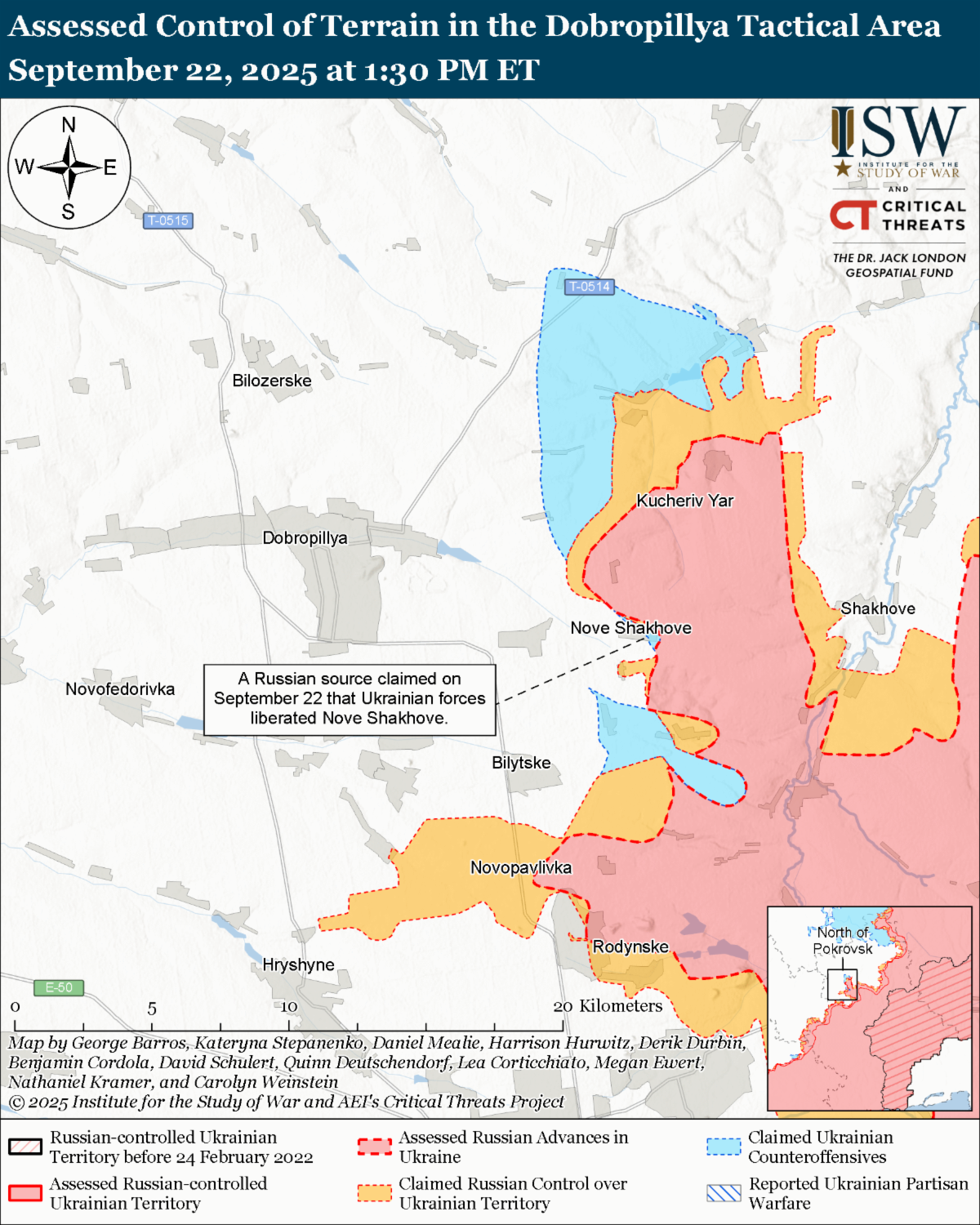
Ukrainian forces recently advanced in the Dobropillya tactical area. Russian forces recently advanced near Lyman and Pokrovsk and in the Kostyantynivka-Druzhkivka tactical area.

NEW EMAIL SUBSCRIPTION OPTIONS

ISW has launched newly customizable email subscription options. Existing subscribers have been auto enrolled in all lists. Click below to learn more about these options and customize your preferences.

ISW is powered by the support of individuals like you.

Help us stay independent and impactful.

Website | Jobs | Internships

Follow ISW on social media:

FacebookXYouTube | InstagramLinkedIn | Threads | Bluesky

© 2025, Institute for the Study of War

Donate online or by sending a check to the Institute for the Study of War at 1400 16th Street NW, Suite #515, Washington, DC 20036. Please consider including the Institute for the Study of War in your estate plans.


ISW is a tax-exempt organization under section 501(c)(3) of the Internal Revenue Code. Donations are tax-deductible to the extent permitted by law.

ISW is a non-partisan, non-profit, public policy research organization. ISW advances an informed understanding of military affairs through reliable research, trusted analysis, and innovative education. We are committed to improving the nation’s ability to execute military operations and respond to emerging threats in order to achieve US strategic objectives.

댓글 달기

이메일 주소는 공개되지 않습니다. 필수 필드는 *로 표시됩니다

위로 스크롤