|
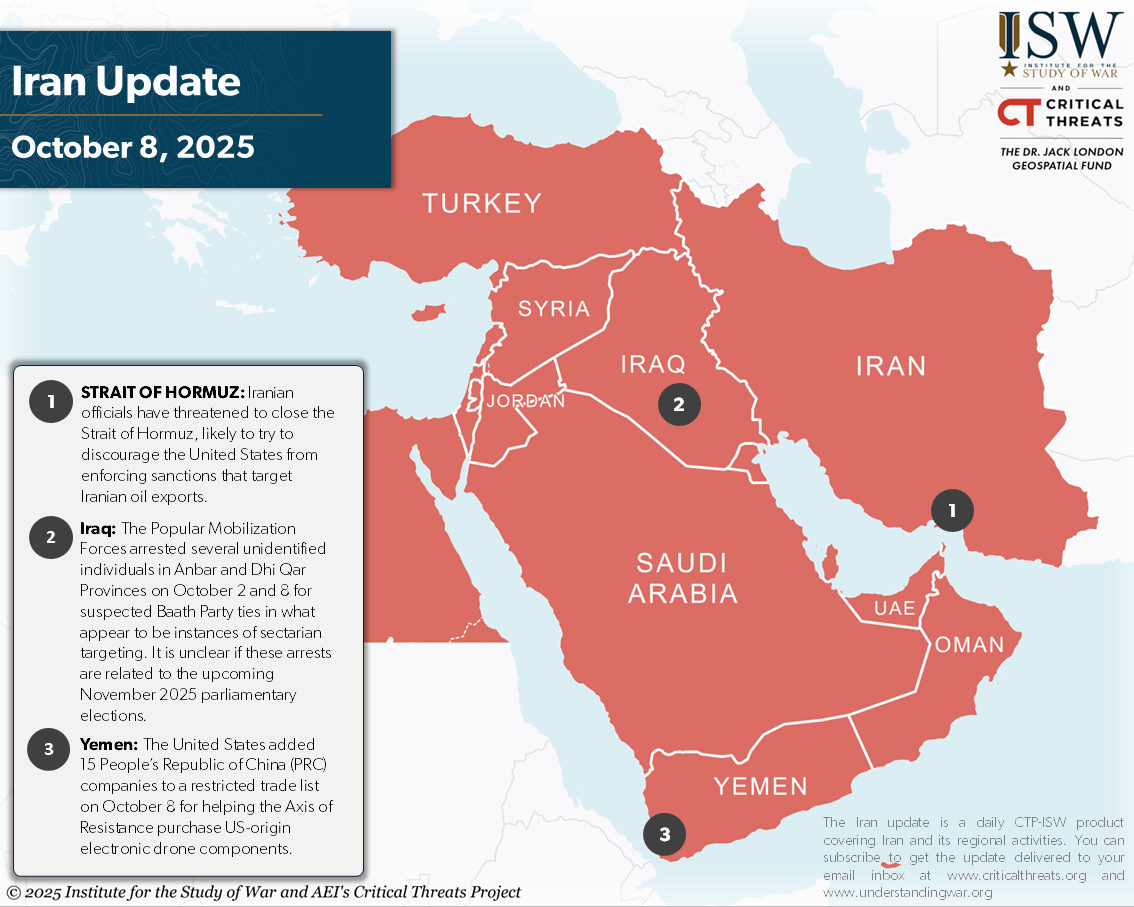
Iranian officials have threatened to close the Strait of Hormuz, likely to try to discourage the United States from enforcing sanctions that target Iranian oil exports. An Iranian parliamentarian warned on October 4 that Iran would close the Strait of Hormuz if the United States or its allies prevent Iranian oil exports. The head of the Iranian Armed Forces Judicial Organization similarly warned on October 5 that Iran would not allow a US presence in the Persian Gulf to threaten Iran’s economic or military security. US President Donald Trump reinstated his maximum pressure campaign against Iran in February 2025 to prevent Iran from obtaining a nuclear weapon and curb its influence abroad. Trump’s maximum pressure campaign seeks to drive Iranian oil exports “to zero.” The United States previously seized Iranian oil tankers and weapons shipments between May 2018 and January 2021 as part of the first Trump administration’s maximum pressure campaign. Reuters reported in March 2025 that the United States was considering a plan for the United States and its allies to halt and inspect Iranian oil tankers at sea. Iran previously attempted to close the strait in 2019 in response to the US maximum pressure campaign by sabotaging Emirati tankers, seizing British ships, and launching cruise missiles at Saudi oil facilities. Iranian officials’ threats to close the Strait of Hormuz come as Iranian military commanders have recently increased inspections of naval units in the Persian Gulf, including naval units deployed at the Nazeat Islands. The Islamic Revolutionary Guards Corps (IRGC) deployed naval mines, ballistic and anti-ship cruise missiles, and fast attack craft to these islands in May 2025. Iranian state-controlled outlet Mehr News detailed Iran’s anti-ship missile capabilities on October 7 and highlighted Iran’s development of new cruise missiles that reportedly have fully automated guidance systems. These capabilities could support a potential Iranian effort to close the Strait of Hormuz.
The Popular Mobilization Forces (PMF) arrested several unidentified individuals in Anbar and Dhi Qar Provinces on October 2 and 8 for suspected Baath Party ties in what appear to be instances of sectarian targeting. The PMF Intelligence and Information Department launched a campaign on October 2 to pursue Baath Party remnants. The PMF is an Iraqi state security service that includes several Iranian-backed Iraqi militias, some of which report to Iran instead of the Iraqi Prime Minister. The 27th PMF Brigade, which the Iranian-backed Badr Organization controls, arrested a man in Karma District, Anbar Province, on October 2 for promoting Baath Party ideology. PMF intelligence units separately arrested several alleged “senior” Baath Party members in Nasiriyah, Dhi Qar Province, on October 8. Prominent Iraqi Shia politicians have commonly conflated Sunnism with membership in the Sunni-dominated Baathist government under Saddam Hussein and have abused de-Baathification measures to target Sunnis.
It is unclear if these arrests are related to the upcoming November 2025 parliamentary elections, but the arrests come as multiple Iranian-backed Iraqi actors have sought to disqualify alleged Baath Party remnants ahead of the elections. CTP-ISW previously assessed that Iraqi Shia politicians are likely attempting to sideline Sunni political opposition ahead of the November 2025 elections by accusing their opponents of having Baathist ties.[18] Iraqi law prohibits Baath Party members from participating in political activities, including competing in elections. Iraqi Shia political parties have weaponized this law and other de-Baathification mechanisms to target Sunnis, particularly Sunni political opposition.
|