|
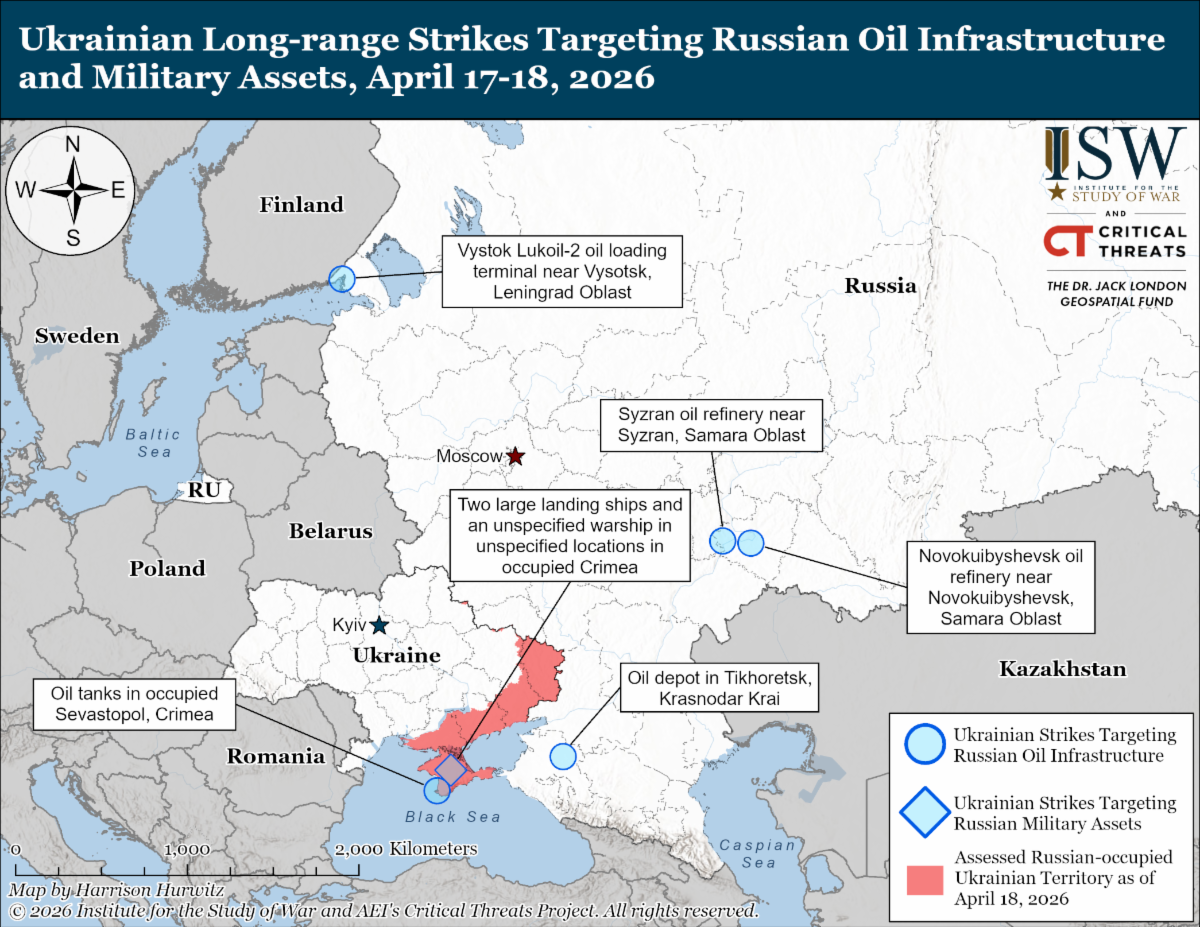
Ukraine’s long-range strike campaign continues to exploit overstretched Russian air defenses to damage oil infrastructure and military assets in Russia and occupied Crimea. The Ukrainian General Staff reported on April 18 that Ukrainian forces struck the Novokuibyshevsk and Syrzan oil refineries in Samara Oblast, an oil terminal at the Vysotsk Lukoil-2 Distribution Transshipment Complex in Leningrad Oblast, and the Tikhoretsk oil pumping station in Krasnodar Krai on the night of April 17 to 18, causing fires at the facilities. Geolocated footage published on April 18 shows fires at the Novokuibyshevsk and Syrzan oil refineries caused fires, and a Ukrainian open-source intelligence (OSINT) source assessed that the strike on Novokuibyshevsk may have damaged up to three tanks. Regional Russian officials acknowledged that Ukrainian drone strikes caused fires at the port in Vysotsk, Leningrad Oblast, and at an oil depot near Tikhoretsk, Krasnodar Krai. Ukraine’s Security Service (SBU) reported on April 18 that Ukrainian forces also struck military and energy targets in occupied Crimea including the Yamal and Azov Ropucha-class project 775 large landing ships (both of the Black Sea Fleet [BSF]), an unidentified third warship, the antenna block of a Delfin communication system, and an MMys-M1 radar station in unspecified areas of occupied Crimea, and fuel tanks at the Yugtorsan oil depot near occupied Sevastopol. The SBU reported that Ukrainian strikes may also have damaged a Russian Grachonok-class project 21980 patrol boat. Geolocated footage published on April 18 shows a fire at the Sevastopol oil depot, and Sevastopol occupation governor Mikhail Razvozhaev acknowledged that the strike caused a fire at a fuel storage tank.
Russian milbloggers criticized Russian air defense failures on the heels of the successful Ukrainian strike campaign against Russian oil and defense industrial infrastructure. A prominent Russian milblogger published a purported note from a Russian air defense servicemember claiming that Ukrainian forces were able to strike the port of Ust-Luga because Russian air defense lacked sufficient surface-to-air missiles (SAMs) to defend against many strike vehicles, leaving Russian air defenses overwhelmed. The note also accused inspectors from the Russian Air Force and Air Defense Forces of caring more about the appearance of the air defense units they inspect than performance. A Kremlin-affiliated Russian milblogger claimed that Leningrad Oblast’s April 17 announcement to begin recruiting reservists for mobile fire groups is belated but smart. The milblogger noted that these groups are becoming increasingly important due to Russia’s SAM shortage and called for these Russian mobile fire groups to intercept as many Ukrainian long-range drones near the frontline as possible. Drozdenko’s reform and the milblogger criticisms indicate that Russian federal subjects are only beginning to respond seriously to Ukrainian long-range strikes and have not yet learned the lessons of previous Russian air defense failures or of Russia’s own strike campaign against Ukrainian infrastructure. It is unclear how successful Russia will be at successfully defending defense industrial and oil infrastructure from Ukrainian strikes, given Russia’s need to cover vast areas and dispersed assets with air defenses, and Russian forces thus far have only taken limited measures to actually mitigate these strikes.
Russia appears to be leveraging Russian SIM cards with international roaming data capability in Ukrainian border areas to support its long-range strike campaign against Ukraine. Ukrainian Ministry of Defense (MoD) advisor on defense technology and drone and electronic warfare (EW) expert Serhiy “Flash” Beskrestnov reported on April 17 that Russian forces equip every Shahed-type long-range drone with SIM cards from Russian telecommunications operator T2, a subsidiary of Russian state telecommunications operator Rostelecom. Establishing connections to cellular data allows Russia to control the drones remotely and lets the drones transmit telemetry data and real-time footage to their operators. Beskrestnov noted that the Russian government special orders these SIM cards from T2 and distributes them to Shahed drone manufacturers. Beskrestnov stated that while Ukraine has blocked T2 SIM cards from roaming in Ukraine, the Russian Shaheds can still fly close to the Belarusian, Polish, and Romanian borders as the Tele2 SIM cards connect to the networks of telecommunication operators in Belarus, Poland, and Romania. Russia has been leveraging Belarusian infrastructure to support its long-range drone strikes against Ukraine and likely intends to leverage unknown loopholes in European telecommunications infrastructure for this same effort.
|