|
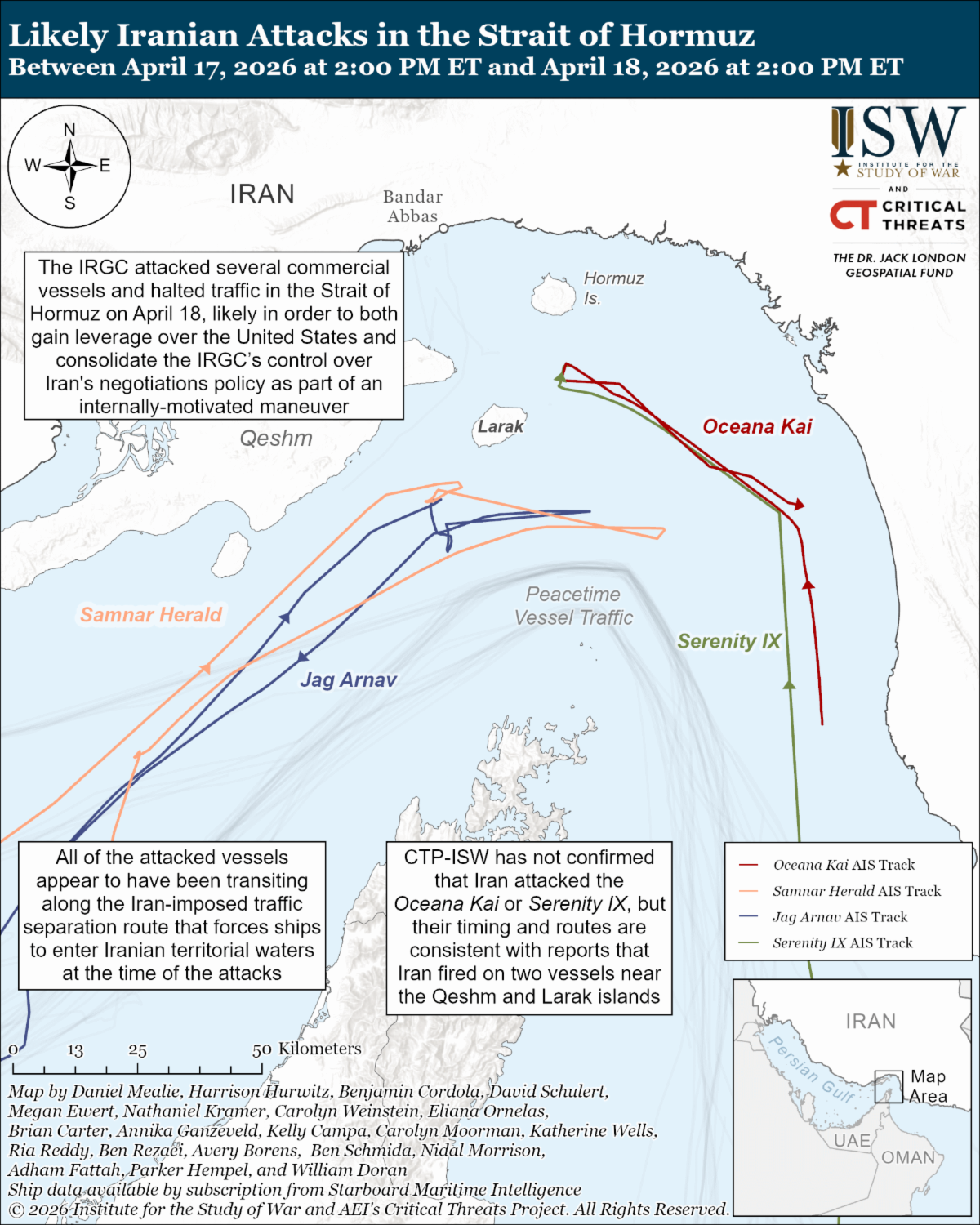
Islamic Revolutionary Guards Corps (IRGC) Commander Major General Ahmad Vahidi and members of his inner circle have likely secured at least temporary control over not only Iran’s military response in this conflict but also Iran’s negotiating position and approach within the past 48 hours. The IRGC Navy attacked several commercial vessels on April 18 and declared that no vessel of “any type or nationality” is permitted passage through the strait, a reversal of Iranian Foreign Affairs Minister Abbas Araghchi’s announcement on April 17 that the strait was “completely open” to commercial traffic. Traffic through the strait has virtually halted as of this writing except for Iranian vessels, according to maritime tracking data. No Iranian vessels have approached the US blockade line, however. IRGC-affiliated media also announced on April 18 that Iran has not agreed to participate in another round of negotiations with the United States due to “excessive” US demands. The IRGC is responsible for coordinating and conducting military actions, but has historically not directly interfered in Iranian diplomacy and negotiations to the extent it currently is.
Regime institutions aligned with Vahidi are presenting a cohesive front against Araghchi and in support of the IRGC’s actions to halt traffic in the strait. The Khatam ol Anbia Central Headquarters, which is functionally controlled by the IRGC, cited the US naval blockade on Iranian ports as the reason for the IRGC’s reimposition of “control” over the strait. Vahidi and Khatam ol Anbia Central Headquarters Commander Ali Abdollahi Aliabadi are reportedly driving the regime’s military decision-making, according to anti-regime media on April 7. A source close to the Supreme National Security Council (SNSC) previously warned IRGC-affiliated Fars News on April 17 that Iran would “close” the strait if the United States continued its blockade. The SNSC released a statement on April 18 that Iran will “exercise supervision and control” over traffic in the strait until the war ends. The SNSC would almost certainly not have released this statement without the approval of SNSC Secretary Mohammad Bagher Zolghadr, which indicates that Zolghadr supports the IRGC’s actions in the strait. Zolghadr, who is a hardline IRGC veteran and long‑time power broker with deep ties to Iran’s security and judicial apparatuses, was appointed to his position during the war after Vahidi reportedly pressured Iranian President Masoud Pezeshkian to appoint him.
Vahidi and individuals close to him may have effectively controlled the negotiations process throughout the war, which is traditionally a role reserved for political leaders. Vahidi likely intended to impose IRGC oversight over the recent US-Iran talks in Islamabad. Vahidi attempted to insert Zolghadr into the Iranian negotiating team in Islamabad despite protests from delegation leaders Parliament Speaker Mohammad Bagher Ghalibaf and Araghchi over Zolghadr’s lack of experience with diplomatic negotiations. Vahidi presumably wanted to send Zolghadr to keep an eye on the negotiations and to inform leaders in Tehran if the negotiating delegation strayed from his or Supreme Leader Mojtaba Khamenei’s directives. Zolghadr sent a complaint to senior IRGC leaders, almost certainly including Vahidi, that Araghchi had surpassed his mandate during the negotiations by expressing flexibility regarding Iran’s support for the Axis of Resistance. Zolghadr’s anger caused senior leaders in Tehran, including former IRGC Intelligence Organization Chief and long-time member of Mojtaba’s inner circle, Hossein Taeb, to call the negotiating delegation back to Tehran.
|