|
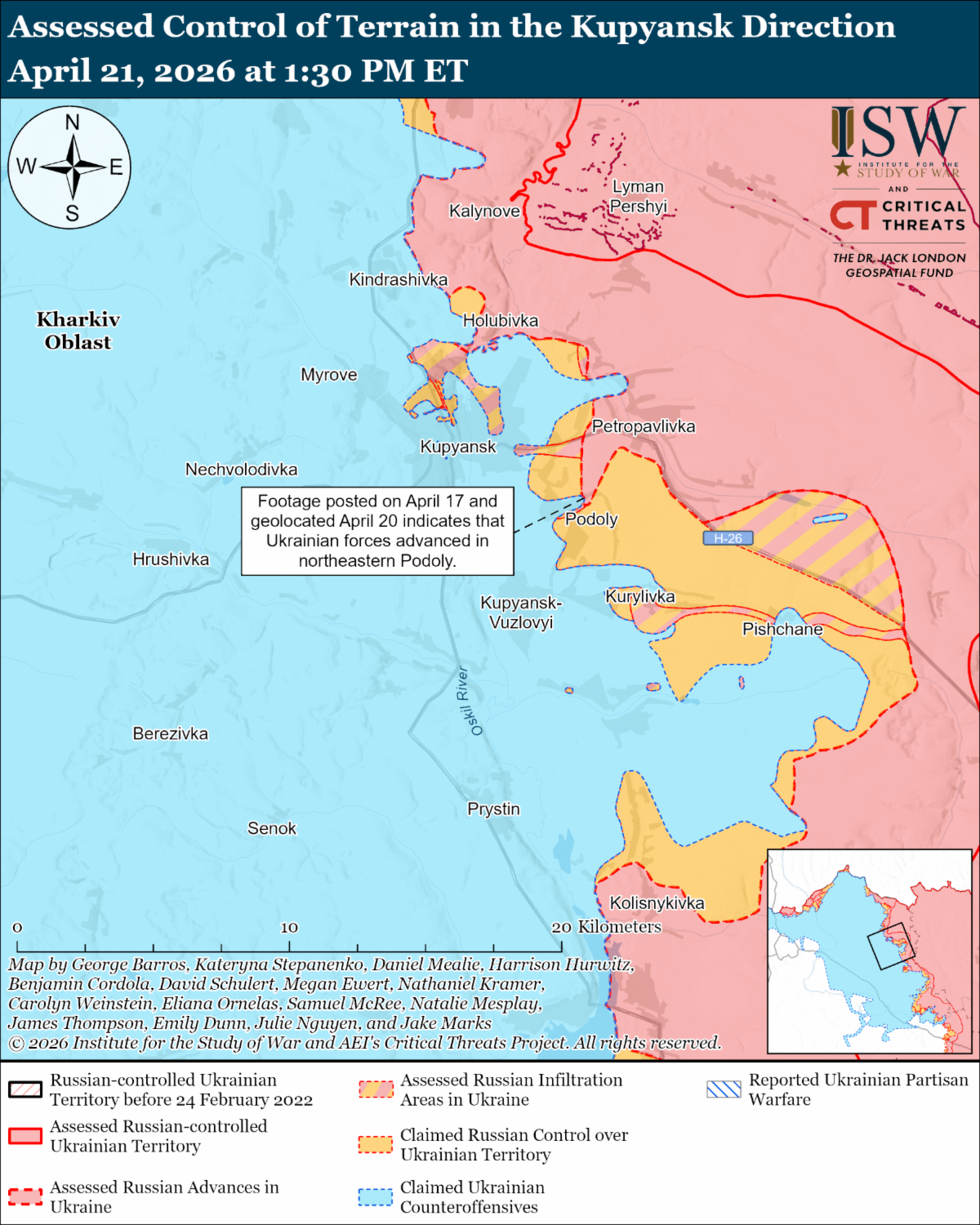
Russian Chief of the General Staff Army General Valery Gerasimov continues to make greatly exaggerated claims of Russian advances amidst Russian forces’ poor performance in their ongoing Spring-Summer 2026 offensive. Gerasimov visited the Russian Southern Grouping of Forces (GoF) command on April 21 and claimed — contrary to available evidence, including pro-Russian war reporting — that Russian forces seized over 1,700 square kilometers and 80 settlements in Ukraine, including the entirety of Luhansk Oblast, since early 2026. Gerasimov claimed that Russian forces seized about 700 square kilometers and 34 settlements in March and April 2026 alone. ISW has only observed evidence to assess that Russian forces advanced 381.5 square kilometers and seized 13 settlements since the start of 2026, and that Russian forces have only seized two settlements and have actually lost 59.79 square kilometers across the theater since March 1. The Russian military command has also previously claimed to have seized Luhansk Oblast three times prior to April 21, two of which were after Ukraine’s Fall 2022 counteroffensive in the area. Gerasimov made several exaggerated claims about Russian operations in specific parts of the frontline, even compared to other Russian sources. Gerasimov claimed that Russian forces advanced to within seven kilometers of Kramatorsk and 12 kilometers of Slovyansk, but even the most expansive previous Russian claims that ISW has observed placed Russian forces at closest roughly 14 kilometers from Kramatorsk and nine kilometers from Slovyansk. Gerasimov claimed that Russian forces seized 70 percent of Lyman, Donetsk Oblast and 75 percent of Novopavlivka, Dnipropetrovsk Oblast, but ISW has not observed evidence to indicate that Russian forces have seized any of Lyman and has only observed evidence to indicate that Russian forces seized 20.51 percent of Novopavlivka. Gerasimov further claimed that Russian forces are fighting in or have seized several small settlements that are several kilometers away from ISW’s current assessed frontline. Gerasimov has been making speeches exaggerating Russian gains roughly once or twice a month for the last several months and has made comparable aggrandized claims on January 15 and 27, February 15, and March 16 so far in 2026.
Even the most generous interpretations of other Russian sources do not support Gerasimov’s claims. The maximalist area of possible Russian gains, which includes areas where ISW has only observed evidence to assess that Russian forces advanced into or infiltrated into combined with unconfirmed areas that Russian sources have claimed as seized, between January 1 and April 21, is 715 square kilometers of Ukrainian territory — only 42 percent of Gerasimov’s claimed Russian gains for this same period. It is notable that no Russian source has provided a map that encompasses a battlefield geometry that includes anything approximating 1,700 square kilometers of Russian gains in 2026. Some of Gerasimov’s claims encompass settlements that are several kilometers from the furthest extent of Russian sources’ claimed Russian advances. Gerasimov claimed that Russian forces entered Borova, roughly 10 kilometers away from the furthest extent of ISW’s assessed Russian advances and roughly four kilometers away from the furthest extent of previous Russian claims. Gerasimov claimed that Russian forces entered Studenok (northwest of Lyman), roughly 12 kilometers away from the furthest extent of ISW’s assessed Russian advances and roughly five kilometers away from the furthest extent of previous Russian claims. Gerasimov claimed that Russian forces entered Zaporozhets (northwest of Orikhiv), roughly 12 kilometers away from the furthest extent of ISW’s assessed Russian advances and roughly three kilometers away from the furthest extent of previous Russian claims. Pro-Russian milblogger Rybar’s most recently published map of the frontline in Zaporizhia Oblast posted on April 20 shows Zaporozhets firmly under Ukrainian control, for example. ISW has not observed any evidence of Russian forces operating in any of these settlements recently, but has observed evidence of Russian forces conducting air and artillery strikes against all of these settlements in the past two months. Russian forces’ usage of these area-of-effect weapons further indicates that Russian forces likely remain a significant distance away from these settlements.
Gerasimov is likely attempting to obscure Russia’s disappointing lack of progress thus far in its Spring-Summer 2026 offensive. Russian forces launched their Spring-Summer 2026 offensive no later than March 17 but have thus far failed to make any tactically significant gains, having lost about 10 square kilometers across the theater since March 17. Russia’s rate of advance has slowed in northeastern, eastern, and southern Ukraine, including in its priority effort against the Fortress Belt in Donetsk Oblast, and Russian forces have had to reduce their tempo of operations in several areas of the frontline due to heavy casualties. Ukrainian defenses and counterattacks are imposing additional costs on Russia’s effort to maintain the facade that Russian forces are constantly advancing across all areas of the frontline simultaneously. Russia’s simultaneously decreasing recruitment rates and increasing casualty rates are threatening the sustainability of the Russian military command’s usual tactics of casualty-heavy, high-intensity waves of assaults and infiltration missions without significant changes to Russia’s force generation system. Gerasimov’s April 21 speech covered Russian operations from the past two to four months, a more expansive time period than the singular months or less that he covered in his January, February, and March 2026 speeches, likely in an attempt to disguise the lack of significant gains by presenting larger claimed gains across a greater timeframe. Despite stretching the timeframe covered in his claims, Gerasimov still could not present frontline claims that even the most expansive claims from Russia’s ultranationalist milblogger community would consider realistic. Russian milbloggers have repeatedly criticized Gerasimov for exaggerating Russian gains near Kupyansk and other parts of the frontline and the practices of seizing settlements “on credit” and sending “beautiful reports,” each alleging unsubstantiated Russian advances to higher-ups from which the military command then makes operational plans and objectives for Russian forces on the ground. Gerasimov also reiterated several previous claims of seizing certain settlements throughout his speech, but presented them as recent claims, attempting to create the false impression that Russian forces are rapidly advancing on the battlefield — contrary to all available evidence.
|