[ISW] 이란 업데이트 특별 보고서, 2026년 4월 22일

“`html

핵심 내용:

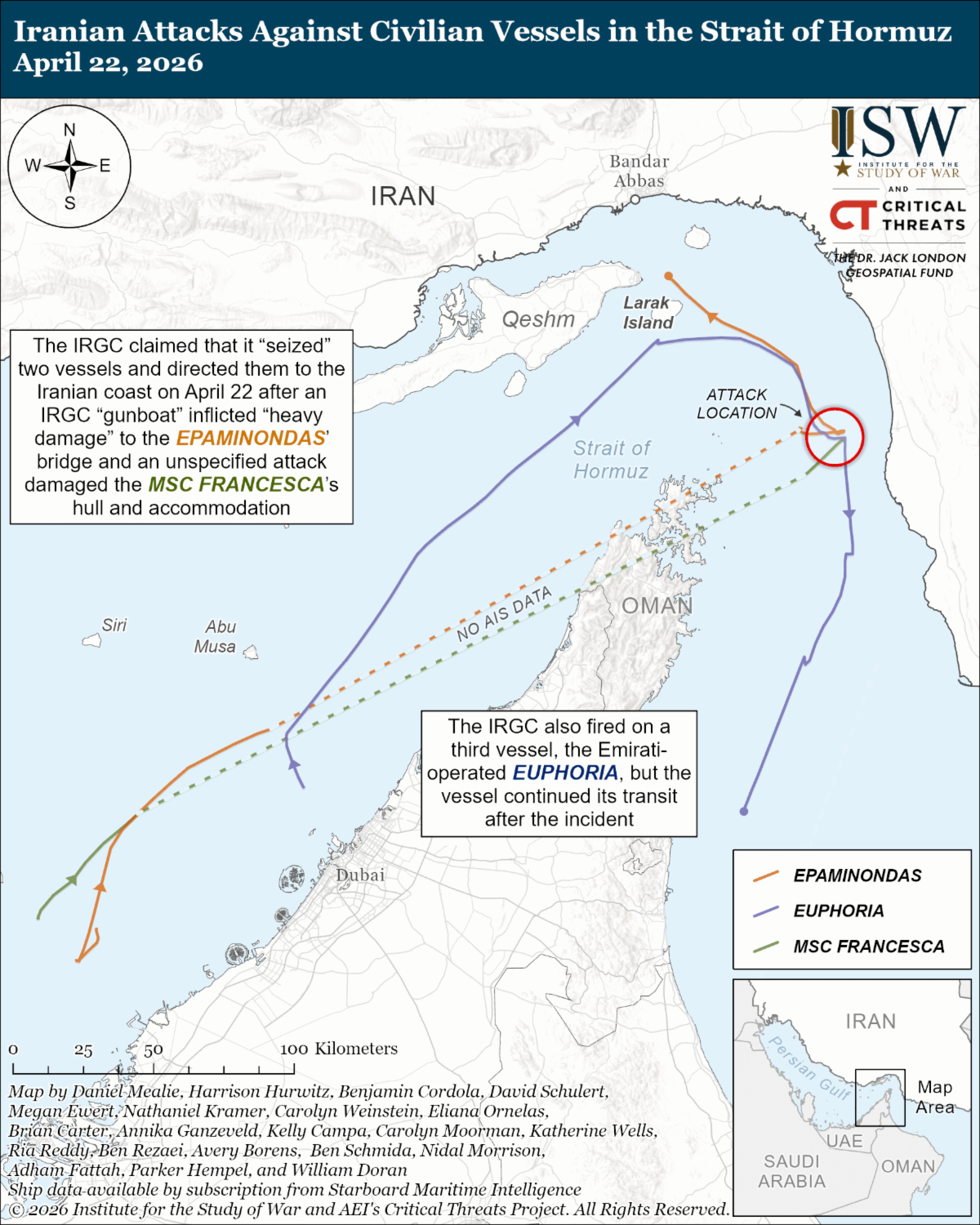
  • 이란 혁명수비대 해군(IRGC)은 4월 22일, 두 척의 선박을 공격하고, 아마도 이란으로 방향을 돌린 것으로 보입니다. 이는 이란이 호르무즈 해협에 대한 주권을 주장하고, 세계 해운을 방해하며, 미국으로부터 양보를 얻어내기 위한 의도로 보입니다. IRGC는 또한 오만만에서 미국 해군이 이란 국기를 단, 미국의 제재 대상인 Touska호를 압수한 것에 대한 대응으로 이러한 행동을 했을 수도 있습니다.
  • IRGC의 해상 공격과 아흐마드 바히디 IRGC 사령관의 미국-이란 회담 중단 의사는 바히디가 필요하다면 전쟁을 재개할 의지가 있음을 시사합니다. 바히디는 호르무즈 해협에 대한 이란의 “통제”를 주장하기 위해 미국의 군사적 대응을 감수할 의향이 있는 것으로 보입니다.
  • 이란의 의사 결정 과정은 여전히 분열되고 혼란스러운 상태입니다. 이는 이란이 일관된 협상 입장을 수립하고 전달하지 못하는 이유를 설명합니다. 이란 관리들은 최근 며칠 동안 협상 재개 여부에 대해 통일된 결정을 내리지 못했으며, 정권 내 경쟁 세력들이 핵심 쟁점에 대한 합의를 막고 있는 것으로 보입니다. 정권의 공식적인 의사 결정 및 조정 메커니즘 또한 효과적으로 작동하지 않고 있습니다.
  • 미국 관리들은 최근 휴전 이후 남아있는 이란 자산의 양적 추정치를 유출했습니다. 이러한 추정치를 기반으로 이란군의 쇠퇴 정도를 파악하는 것은 매우 어렵습니다. 이는 남아있는 시스템의 수가 군사력에 대한 완전한 평가를 형성하는 데 필요한 많은 데이터 포인트 중 하나일 뿐이기 때문입니다.

최신 자료 및 관련 링크:

다음은 본문 내용과 관련된 최신 자료 및 관련 링크입니다. 각 링크의 내용은 신뢰할 수 있으며, 관련 내용이 포함되어 있는지 확인했습니다.

참고: 위 링크들은 본문 내용과 관련된 정보를 제공하기 위한 예시이며, 실제 정보는 변경될 수 있습니다. 추가적인 정보는 관련 언론 보도 및 연구 자료를 참고하시기 바랍니다.

“`

[원문]

The Islamic Revolutionary Guards Corps (IRGC) Navy attacked and likely redirected two vessels towards Iran on April 22, likely to enforce Iranian claims of sovereignty over the strait.

April 22 2026

Data Cutoff: 2:00 PM ET

Ben Rezaei, Benjamin Schmida, Ria Reddy, Parker Hempel, Carolyn Moorman, Adham Fattah, William Doran, Kelly Campa, and Brian Carter

As the Middle East crisis evolves, ISW urgently needs your support.

Help us stay independent and impactful.

TOPLINES

The Islamic Revolutionary Guards Corps (IRGC) Navy attacked and likely redirected two vessels towards Iran on April 22, likely to enforce Iranian claims of sovereignty over the strait to disrupt global shipping and extract US concessions. The IRGC claimed that it “seized” two vessels and directed them to the Iranian coast on April 22. The two vessels — the Liberian-flagged, Greek-owned Epaminondas and the Panamanian-flagged MSC Francesca — appear to have been exiting the Strait of Hormuz at the time of the attacks. An IRGC “gunboat” inflicted “heavy damage” to the Epaminondas’s bridge, and an unspecified attack damaged the MSC Francesca’s hull and accommodation. Both vessels changed direction, sailed into Iranian territorial waters, and idled about seven nautical miles off the coast of Iran. Commercially available maritime tracking data showed that the Epaminondas continued to transit north in Iranian territorial waters. It is unclear why the vessels would have changed course and sailed further inland towards the Iranian coast if not under Iranian escort. The IRGC also fired on a third vessel, the Panamanian-flagged, Emirati-operated Euphoria, but the vessel continued its transit after the incident. The IRGC has demanded that the United States lift its blockade over the Strait of Hormuz and effectively halted traffic through the strait on April 18 by attacking several vessels. The IRGC likely aims to raise international shipping prices to extract concessions from the United States, such as ending the US blockade or yielding other demands. The IRGC also may have redirected the two vessels in response to the recent US Navy seizure of the Iranian-flagged, US-sanctioned Touska in the Gulf of Oman on April 19. The Iranian regime had pledged to respond to the incident.

The IRGC has also used its “control” over the strait as a means for IRGC Commander Major General Ahmad Vahidi to flex his own power over internal rivals, such as Parliament Speaker Mohammad Bagher Ghalibaf. Vahidi and his inner circle recently used the IRGC’s leverage over the strait to exercise influence over Iran’s negotiating position. The United States extended the ceasefire yesterday to allow for Iranian leaders to produce a “unified proposal,” but Iranian leaders remain fragmented over Iran’s negotiating strategy, as noted below.

The IRGC’s attacks on shipping and IRGC Commander Major General Ahmad Vahidi’s apparent willingness to scrap US-Iran talks indicate that Vahidi is prepared to resume the war if needed. Vahidi currently holds the most influential position in the regime at this time, apart from the Supreme Leader, who is reportedly seriously injured or incapacitated. The IRGC’s recent attacks on commercial vessels suggest that Vahidi is willing to risk incurring a potential US military response to assert Iranian ”control” over the strait and achieve the subsequent intended effects, as described above. Vahidi also may seek to derail the negotiations and may be attempting to do so by introducing preconditions and interfering with efforts to produce a “unified proposal.” These actions suggest that Vahidi and his inner circle have accepted and are prepared for the risks that such actions would lead to the resumption of the war with the United States.

KEY TAKEAWAYS

  • The Islamic Revolutionary Guards Corps (IRGC) Navy attacked and likely redirected two vessels towards Iran on April 22, likely to enforce Iranian claims of sovereignty over the strait to disrupt global shipping and extract US concessions. The IRGC also may have redirected the two vessels in response to the recent US Navy seizure of the Iranian-flagged, US-sanctioned Touska in the Gulf of Oman.

  • The IRGC’s attacks on shipping and IRGC Commander Major General Ahmad Vahidi’s apparent willingness to scrap US-Iran talks indicate that Vahidi is prepared to resume the war if needed. Vahidi appears willing to risk incurring a potential US military response to assert Iranian “control” over the strait.

  • Iranian decision-making remains fragmented and in disarray, which explains Iran’s inability to formulate and communicate a coherent negotiating position. Iranian officials have not reached a unified decision on whether to return to negotiations in recent days, and competing regime power centers appear to be blocking consensus on core issues. The regime’s formal decision-making and coordinating mechanisms are also not functioning effectively.


  • US officials have recently leaked quantitative estimates of the number of different Iranian assets remaining after the ceasefire. It is extremely difficult to deduce the degree of degradation to Iranian forces based on these estimates because the number of remaining systems is only one of many data points required to form a complete evaluation of military strength.

EMAIL SUBSCRIPTION OPTIONS

ISW offers customizable email subscription options. Click below to learn more and customize your preferences.

Website | Jobs | Internships

Follow ISW on social media:

FacebookXYouTube | InstagramLinkedIn | Threads | Bluesky

© 2026 Institute for the Study of War and AEI’s Critical Threats Project. All rights reserved.

Donate online or by sending a check to the Institute for the Study of War at 1400 16th Street NW, Suite #515, Washington, DC 20036. Please consider including the Institute for the Study of War in your estate plans.

ISW is a tax-exempt organization under section 501(c)(3) of the Internal Revenue Code. Donations are tax-deductible to the extent permitted by law.

ISW is a non-partisan, non-profit, public policy research organization. ISW advances an informed understanding of military affairs through reliable research, trusted analysis, and innovative education. We are committed to improving the nation’s ability to execute military operations and respond to emerging threats in order to achieve US strategic objectives.

댓글 달기

이메일 주소는 공개되지 않습니다. 필수 필드는 *로 표시됩니다

위로 스크롤