|
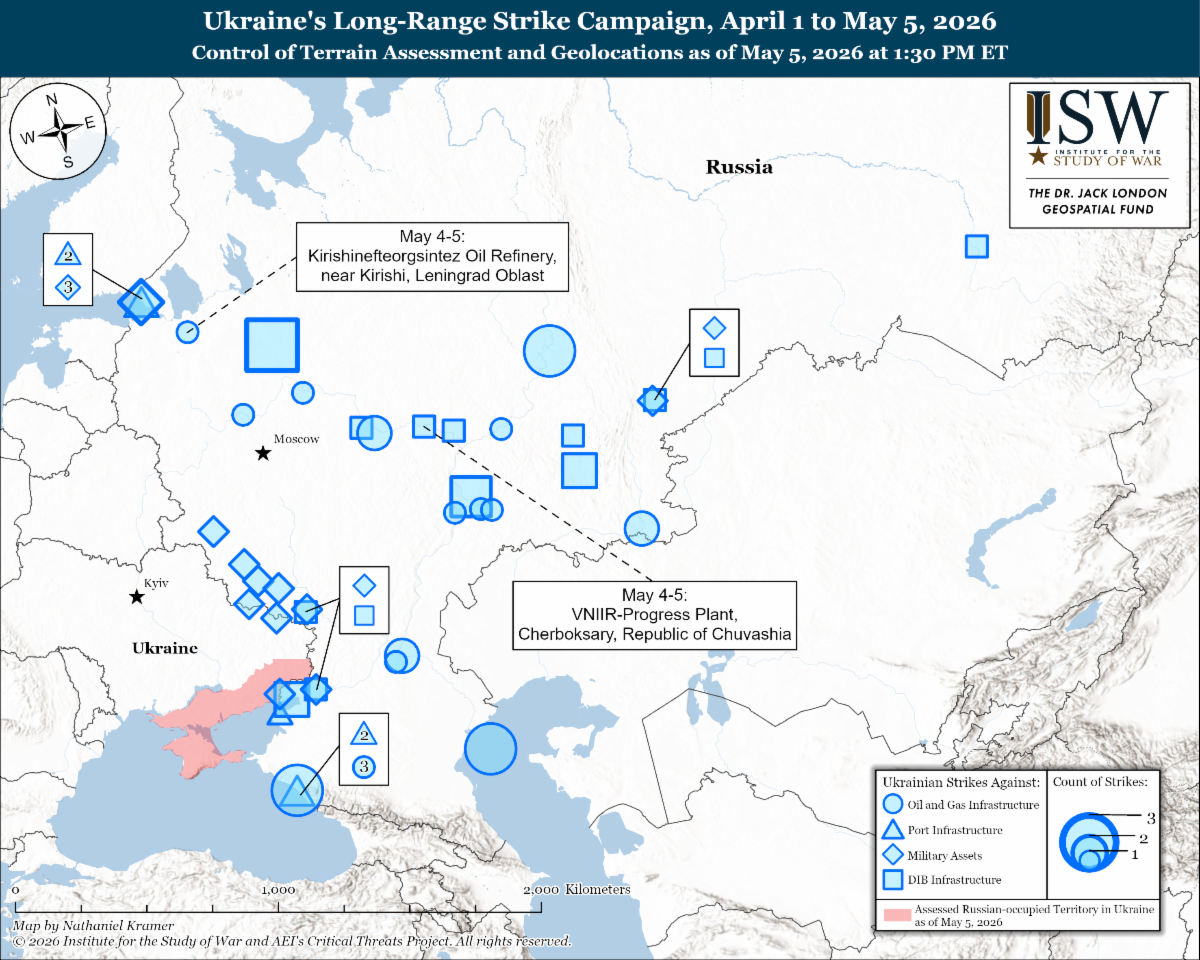
Continued long-range Ukrainian strikes against cities deep in the Russian rear demonstrate Russia’s inability to reliably defend the major cities and infrastructure facilities of European Russia against drone and missile strikes. The Ukrainian General Staff, Main Military Intelligence Directorate (GUR), and Unmanned Systems Forces reported on May 5 that Ukrainian forces struck the Russian Kirishinefteorgsintez Oil Refinery near Kirishi, Leningrad Oblast, and the Russian VNIIR-Progress plant near Cheboksary, Republic of Chuvashia, overnight. The VNIIR-Progress plant produces receivers and antennas for Russia’s Global Navigation Satellite System (GLONASS), Global Positioning System (GPS), and Galileo systems, and Kometa electronic warfare (EW) resistant navigation components, which Russia uses in a variety of long-range drones and missiles. Ukrainian President Volodymyr Zelensky stated that Ukrainian forces used F-5 Flamingo missiles launched at a distance of over 1,500 kilometers to strike the VNIIR-Progress plants. Geolocated footage shows six Ukrainian Flamingo missiles and an An-196 ”Lyutyi” drone striking the plant. Cheboksary is only 300 kilometers from the Alabuga Special Economic Zone (ASEZ), a major Russian industrial and production zone in the Tatarstan Republic, where Russia produces many of the long-range Shahed-type drones it launches at Ukraine. NASA Fire Information for Resource Management System (FIRMS) data for May 5 shows heat anomalies near the Kirishi Oil Refinery. Leningrad Oblast Governor Aleksandr Drozdenko confirmed that a fire broke out in Kirishi. Reuters reported that the Kirishi Oil Refinery halted operations after the Ukrainian drone strike damaged three of the four crude distillation units and several secondary units. The Ukrainian Unmanned Systems Forces (USF) reported that the Kirishinefteorgsintez oil refinery has an annual refining capacity of 20 to 21 million tons of oil per year and is one of the three largest oil refineries in Russia.
Ukrainian strikes are inflicting significant damage across a wide array of Russian cities. The Ukrainian General Staff reported on May 5 that Ukrainian strikes against the Tuapse Oil Refinery in Krasnodar Krai in April 2026 and on May 1 caused over $300 million worth of damage to the refinery and the Tuapse port infrastructure. Satellite imagery published on May 5 shows two damaged workshops at the Sverdlov Plant, a key Russian explosives components manufacturer, in Dzerzhinsk, Nizhny Novgorod Oblast, following a Ukrainian strike on April 30. Ukrainian forces have increased their long-range strike campaign in the past several weeks, targeting several major Russian cities, including Moscow and Chelyabinsk cities; Yekaterinburg, Sverdlovsk Oblast; Primorsk and Ust-Luga, Leningrad Oblast; and Tuapse and Novorossiysk, Krasnodar Krai.
Russia’s threat to retaliate against Ukraine for allegedly planned strikes against Moscow during Victory Day reflects Russian President Vladimir Putin’s recognition that he cannot reliably defend these deep rear areas, including his capital, from Ukrainian strikes. The Russian Ministry of Defense (MoD) declared on May 4 that it will observe a “Victory Day” ceasefire from May 8 to 9 on unilateral instructions from Putin. The MoD published its May 4 statement roughly an hour before Zelensky offered Russia a ceasefire beginning on the night of May 5 to 6, and the Kremlin has not acknowledged Zelensky’s statement. The MoD falsely accused Zelensky of threatening to strike Moscow on May 9 during remarks to the European Political Community summit in Yerevan, Armenia, and the MoD threatened to launch ”a massive retaliatory missile strike on the center of Kyiv." Zelensky stated at the European Political Community summit that “Russia has announced a May 9 parade in Moscow…and they fear drones may pass over Red Square.” Russian and other media sources portrayed Zelensky as saying that Ukraine may strike the May 9 Victory Day parade, but some sources have observed that this is a mischaracterization of his statement. ISW has not observed evidence of Zelensky making another statement at the European Political Community that would align with the MoD’s accusation.
|