|
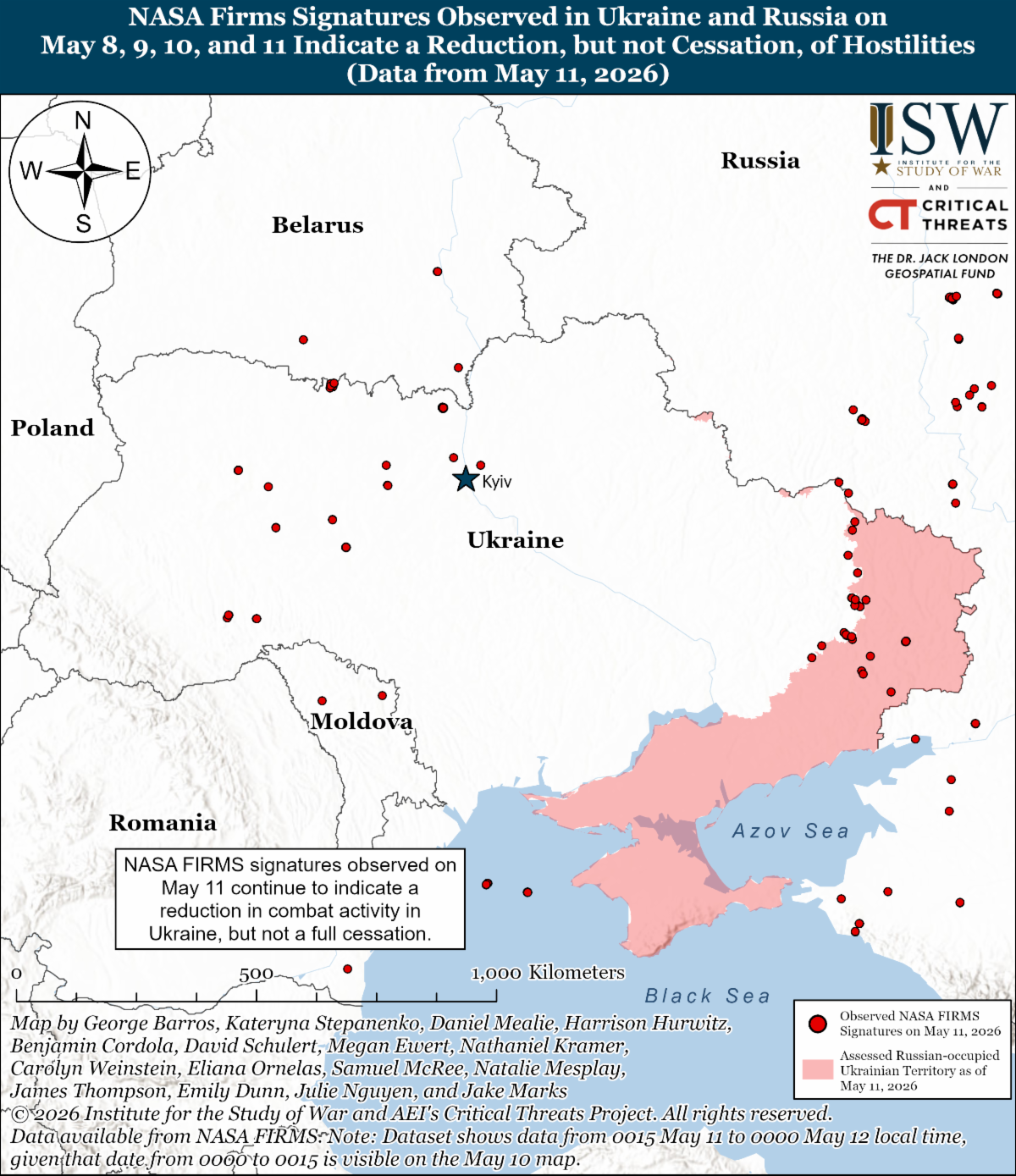
Russian and Ukrainian forces continued limited offensive operations throughout the theater on the final day of the May 9 to 11 ceasefire. Russian and Ukrainian officials accused the other side of violating the ceasefire with artillery, air, and drone strikes and limited ground operations across the theater on May 11. Ukrainian Center for Countering Disinformation Head Lieutenant Andriy Kovalenko reported that Russian forces did not conduct long-range strikes against Ukraine overnight on May 10 to 11. Observed NASA Fire Information for Resources Management System (FIRMS) data signatures from May 11 indicate that hostilities continued to decrease on May 11 but did not cease. The spokesperson of a Ukrainian brigade operating in the Lyman direction reported that Russian forces used the ceasefire to pull forward reserves, accumulate personnel, and continue artillery and first-person view (FPV) strikes. The spokesperson reported that Russian forces increased strikes with Molniya fixed-wing drones during the ceasefire compared to before the ceasefire, and speculated that Russian forces may have stockpiled Molniya drones ahead of the ceasefire for this purpose. The prevalence of mutual accusations and continued localized kinetic combat activity throughout the final day of the ceasefire continues to highlight the fact that ceasefires without explicit enforcement mechanisms, credible monitoring, and defined dispute resolution processes are unlikely to hold.
Recent reports of Ukrainian drones operating near occupied Mariupol as part of battlefield air interdiction (BAI) efforts targeting Russian ground lines of communication (GLOCs) in occupied Donetsk Oblast and Crimea are raising significant concerns among Russian milbloggers. Russian milbloggers expressed concern on May 10 in response to recent Ukrainian footage of Ukrainian Hornet drones freely operating over the T-0509 Mariupol-Donetsk City highway (also called the H-10 highway) near occupied Mariupol, targeting Russian tanker trucks and other military transport vehicles. One of the milbloggers expressed serious concern that the situation along GLOCs near Mariupol is beginning to resemble conditions along the M-30 Horlivka-Panteleymonivka-Yasynuvata-Donetsk City highway, where the milblogger claimed that Ukrainian forces have paralyzed Russian logistics and civilian traffic by using drones. The milblogger claimed that the M-30 highway was safer in 2024 to 2025, despite being closer to the frontline, compared to 2026, when the M-30 at its closest is 35 kilometers from the frontline, due to the increased range of Ukrainian drones. The milblogger claimed that Russian electronic warfare (EW) can only jam Ukrainian Hornet drones if they do not use Starlink or do not have time to auto-lock onto the target. The milblogger expressed concern that Ukrainian forces may be able to fully automate Hornet drones within the next six to 12 months (about December 2026 to March 2027). Another milblogger echoed these concerns, expressing worry that Ukrainian Starlink-enabled drones with a range of up to 200 kilometers are reaching the M-14 Mariupol-Berdyansk-Melitopol-Henichesk highway, a key Russian GLOC along the Sea of Azov coast to occupied Crimea.[8] The Ukrainian 1st Azov National Guard Corps published footage on May 8 of Ukrainian drones reconnoitering and interdicting Russian GLOCs through Mariupol, demonstrating Ukraine’s increased capacity to strike moving targets further into Russia’s operational rear areas as part of an intensifying BAI campaign.[9] Ukraine’s ability to strike moving targets in areas previously considered relatively risk free for Russian forces will likely achieve partial BAI effects and appears to be a point of increasing neuralgia in the Russian ultranationalist information space.
|