|
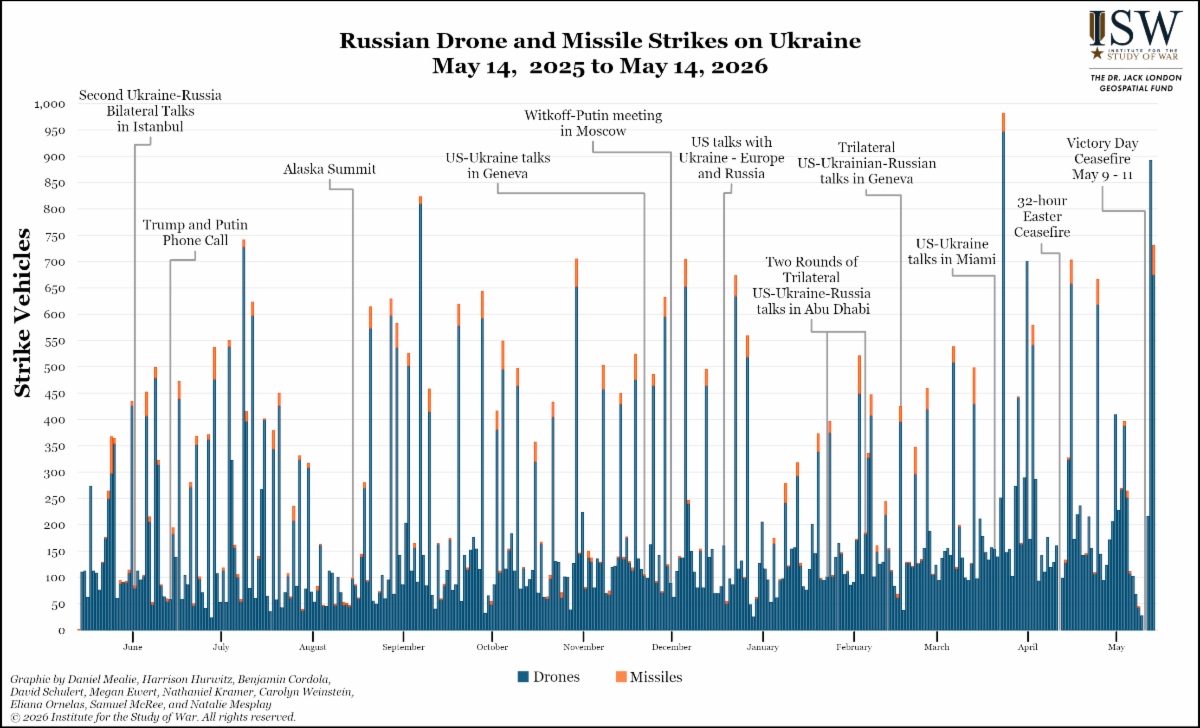
Russian forces have conducted two days of nearly continuous strikes against Ukraine with over 1,600 total long-range drones and missiles that heavily targeted Kyiv City and resulted in high civilian casualties. Russian forces launched a strike package totaling 892 drones and missiles against Ukraine from 1800 on May 12 to 1830 on May 13. The Ukrainian Air Force subsequently reported that Russian forces launched 731 drones and missiles from 1800 local time on May 13 to the morning of May 14. The Ukrainian Air Force reported that Russian forces launched three Kinzhal Kh-47 aeroballistic missiles, 18 Iskander-M/S-400 ballistic missiles, and 35 Kh-101 cruise missiles. The Ukrainian Air Force reported that Russian forces also launched 675 strike drones, decoy drones, and Banderol drone-based cruise missiles. The Ukrainian Air Force reported that Ukrainian forces downed 29 Kh-101s, 12 Iskander-M/S-400s, and 652 drones. Ukrainian Air Forces Spokesperson Colonel Yuriy Ihnat stated that Russian forces largely concentrated the strikes against Kyiv City in an effort to overwhelm Ukraine’s air defenses. Ukrainian officials reported that Russian strikes since the evening of May 13 damaged at least 20 locations in Kyiv City alone, and that a Russian ballistic missile strike collapsed a nine-story residential building in the capital, killing at least 12 people, including a 12-year-old child, and injuring at least 57. Ukrainian officials reported that Russian strikes also damaged port infrastructure in Odesa Oblast, energy infrastructure in Khmelnytskyi and Chernihiv oblasts, and residential areas in Kharkiv City.
The large-scale strike against Kyiv City did not violate the Russian-Ukrainian Victory Day ceasefire but nonetheless demonstrates that Russia is a bad faith negotiator. The Kremlin made multiple threats to launch a concentrated strike at decision-making centers in Kyiv City if Ukrainian forces conducted strikes against Russia’s Victory Day celebrations in Moscow City on May 9. Some Russian officials called for Russia to use ballistic missiles, including the Oreshnik intermediate-range ballistic missile (IRBM), against Kyiv City. Zelensky agreed to a ceasefire between May 9 and 11 and signed a decree on May 8 stipulating that Ukraine would not strike Moscow’s Red Square for the duration of the parade. Ukraine did not strike Moscow during the ceasefire as agreed. Russian forces did not strike the decision-making centers in Kyiv City or use Oreshniks as Kremlin officials had threatened, but Russia’s latest massive strikes against Kyiv City illustrate Russia’s bad-faith understanding of compliance.
The Kremlin continues to replace border oblast governors, likely to scapegoat regional officials for broader border security failures. Russian President Vladimir Putin signed two decrees on May 13 stating that Belgorod Oblast Governor Vyacheslav Gladkov and Bryansk Oblast Governor Alexander Bogomaz both resigned from their posts at their "own requests." Putin appointed Irkutsk Oblast Deputy Governor Major General Alexander Shuvayev as acting Belgorod Oblast governor and former Chelyabinsk Oblast Deputy Governor and occupation Chairperson of the Luhansk People’s Republic (LNR) Government Yegor Kovalchuk as acting Bryansk Oblast governor. ISW first observed reports in early April 2026 that the Kremlin was considering replacing Gladkov with Shuvayev, who is a graduate of the “Time of Heroes” program that seeks to install veterans of the war in Ukraine in various government positions. Russian opposition source Meduza, citing a source close to the Russian Presidential Administration, noted that the Russian political bloc wanted the new Belgorod Oblast governor to have more experience in civilian administration, but ultimately settled on Shuvayev.
|