[ISW] 이란 업데이트 특별 보고서, 2026년 5월 18일

“`html

핵심 내용 요약:

  • 이란의 최신 역제안, 미국의 요구사항 충족 불확실: 5월 18일 Axios에 따르면, 이란의 역제안은 “우라늄 농축 중단 또는 고농축 우라늄(HEU) 비축분 인도”에 대한 약속을 포함하지 않는 것으로 보입니다. 미국의 요구사항은 이란이 HEU를 미국에 인도해야 한다는 것입니다.
  • 트럼프, 이란 공격 계획 취소: 도널드 트럼프 전 미국 대통령은 5월 18일 Truth Social을 통해 5월 19일에 예정되었던 이란에 대한 미군 공격을 취소했다고 발표했습니다. 카타르, 아랍에미리트, 사우디 지도자들이 협상 진행 및 이란의 보복 우려로 인해 공격 중단을 요청한 데 따른 것입니다. 그러나 트럼프는 협상이 실패할 경우, “전면적인 대규모 공격”을 즉시 시작할 준비를 미군에 지시했다고 언급했습니다.
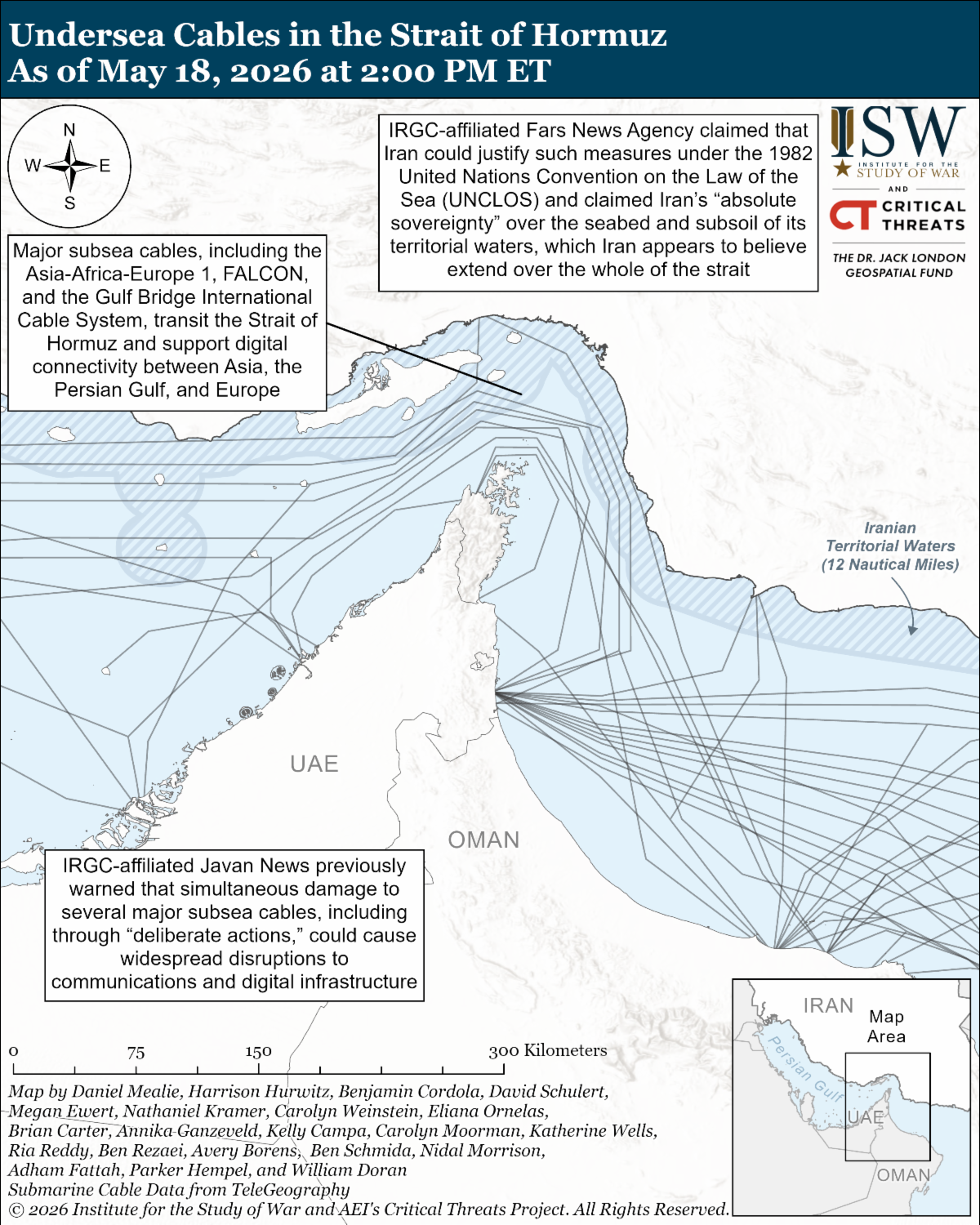
  • 호르무즈 해협 통제 시도: 이란은 유엔 해양법 협약(UNCLOS) 위반에도 불구하고 호르무즈 해협 통제에 대한 주장을 공식화하고 제도화하는 작업을 계속하고 있습니다. 이란은 호르무즈 해협이 자국 영해에 속하기 때문에 이러한 행동이 UNCLOS에 따라 “합법적”이라고 잘못 주장하고 있습니다.
  • IRGC 관련 매체의 위협: IRGC(이란 혁명 수비대) 관련 매체들은 호르무즈 해협과 관련된 상업 및 디지털 활동을 지속적으로 위협하고 있으며, 이는 이란 정부의 해협 통제 제도화 노력의 일환입니다.

최신 관련 자료 및 링크:

주의사항: 링크된 자료들은 상황 변화에 따라 내용이 변경될 수 있습니다. 최신 정보를 얻기 위해 여러 자료를 참고하고, 정보를 비판적으로 검토하는 것이 중요합니다.

“`

[원문]

Iran’s latest counterproposal does not appear to meet US demands.

May 18, 2026

Data Cutoff: 2:00 PM ET

Ben Rezaei, Adham Fattah, Nidal Morrison, Will Doran, Avery Borens, and Brian Carter

As the Middle East crisis evolves, ISW urgently needs your support.

Help us stay independent and impactful.

TOPLINES

Iran’s latest counterproposal does not appear to meet US demands. Reuters reported on May 18 that Iran sent a new proposal with similar terms to proposals previously rejected by the United States. A senior US official and source briefed on the matter told Axios on May 18 that Iran’s counterproposal does not contain a commitment “about suspending uranium enrichment or handing over its existing stockpile of highly enriched uranium (HEU).” The US official added that the Trump Administration believes Iran’s proposal is ”insufficient.” Islamic Revolutionary Guards Corps (IRGC)-affiliated media reported on May 18 that ”major disagreements” remain between the United States and Iran and stated that Iran would never agree to ”an end to the war in return for nuclear commitments.” US demands have been and continue to be that Iran must give its HEU to the United States, dismantle its nuclear facilities, and pause uranium enrichment for at least 20 years.

US President Donald Trump announced on Truth Social on May 18 that he canceled a scheduled US military strike against Iran that was planned for May 19. Trump stated that Qatari Emir Sheikh Tamim bin Hamad al Thani, Saudi Crown Prince Mohammed bin Salman, and Emirati President Mohamed bin Zayed asked him to suspend the strike “for two or three days” due to ongoing negotiations. A US official and an unspecified source told Axios that the three Gulf leaders warned that they would ”pay the price“ if the United States conducted new strikes on Iran and expressed concerns that Iran would retaliate by targeting their energy and oil infrastructure. Trump noted that the Gulf leaders believe that the United States and Iran can reach a deal that is “very acceptable to the United States” and that would prevent Iran from obtaining nuclear weapons. Trump added that he instructed US Defense Secretary Pete Hegseth, US Chairman of the Joint Chiefs of Staff General Dan Caine, and the US military to remain prepared to launch a “full, large-scale assault” against Iran on short notice if negotiations fail.

Iran continues to formalize and institutionalize its claimed control over transit through the Strait of Hormuz in contravention of the UN Charter on the Law of the Sea (UNCLOS). The newly established Persian Gulf Strait Authority (PGSA) stated on X on May 18 that it serves as the “legal institution and representative authority” of the Iranian regime for managing transit through the strait. Iran has incorrectly asserted that this is ”legal” under the UNCLOS because the Strait of Hormuz is within Iran’s territorial waters. Article 37 of the UNCLOS states that straits ”used for international navigation between one part of the high seas or an exclusive economic zone and another part of the high seas or an exclusive economic zone” are international straits. Article 38 guarantees that ”all ships and aircraft enjoy the right of transit passage” through such straits, and Article 44 prohibits bordering states–like Iran–from ”hampering” or suspending passage.

KEY TAKEAWAYS

  • Iran’s latest counterproposal does not appear to meet US demands. A senior US official and source briefed on the matter told Axios on May 18 that Iran’s counterproposal does not contain a commitment “about suspending uranium enrichment or handing over its existing stockpile of highly enriched uranium (HEU).” US demands have been and continue to be that Iran must give its HEU to the United States.

  • US President Donald Trump announced on Truth Social on May 18 that he canceled a scheduled US military strike against Iran that was planned for May 19. Trump’s announcement comes after Qatari, Emirati, and Saudi leaders asked Trump to suspend the strike “for two or three days” due to ongoing negotiations and concerns over Iranian retaliation. Trump, however, noted that he instructed the US military to remain prepared to launch a “full, large-scale assault” against Iran on short notice if negotiations fail.

  • Iran continues to formalize and institutionalize its claimed control over transit through the Strait of Hormuz in contravention of the UN Charter on the Law of the Sea (UNCLOS). Iran has incorrectly asserted that this is ”legal” under the UNCLOS because the Strait of Hormuz is within Iran’s territorial waters.

  • IRGC-affiliated outlets continue to threaten commercial and digital activity linked to the Strait of Hormuz as part of broader regime efforts to institutionalize Iranian authority over the waterway.

EMAIL SUBSCRIPTION OPTIONS

ISW offers customizable email subscription options. Click below to learn more and customize your preferences.

Website | Jobs | Internships

Follow ISW on social media:

FacebookXYouTube | InstagramLinkedIn | Threads | Bluesky

© 2026 Institute for the Study of War and AEI’s Critical Threats Project. All rights reserved.

Donate online or by sending a check to the Institute for the Study of War at 1400 16th Street NW, Suite #515, Washington, DC 20036. Please consider including the Institute for the Study of War in your estate plans.

ISW is a tax-exempt organization under section 501(c)(3) of the Internal Revenue Code. Donations are tax-deductible to the extent permitted by law.

ISW is a non-partisan, non-profit, public policy research organization. ISW advances an informed understanding of military affairs through reliable research, trusted analysis, and innovative education. We are committed to improving the nation’s ability to execute military operations and respond to emerging threats in order to achieve US strategic objectives.

댓글 달기

이메일 주소는 공개되지 않습니다. 필수 필드는 *로 표시됩니다

위로 스크롤