[ISW] 러시아 공세 작전 평가, 2026년 5월 25일

“`html

핵심 요약:

  • 러시아는 전승절 휴전 정신을 위반하며 키이우 시에 대한 조직적인 공격을 위협했습니다. 이는 휴전 자체의 굴욕 이후 힘을 과시하려는 의도로 보입니다.
  • 크렘린은 자국의 공격이 민간인을 대상으로 한 우크라이나의 공격에 대한 보복이라고 주장하며, 서방 국가들이 러시아의 키이우에 대한 집중적인 공격에 대응하는 것을 늦추려 하고 있습니다. 그러나 이러한 주장은 크렘린의 과거 행적과 일치하지 않습니다.
  • 러시아 정부가 우크라이나군이 국제법을 위반했다고 비난하는 것은 러시아군의 조직적인 국제법 위반에서 주의를 돌리려는 시도입니다.
  • 러시아군은 두 번째 오레시니크 중거리 탄도 미사일(IRBM)을 발사했을 수 있으며, 이는 고장으로 인해 이미 대규모였던 5월 23~24일 공격에서 점령된 도네츠크주에 떨어졌습니다.
  • 블라디미르 푸틴 러시아 대통령은 5월 25일, 국제 또는 외국 법원에서 기소된 “러시아 시민”을 방어하기 위해 해외에서 러시아군 사용을 승인할 수 있는 법을 제정했습니다.
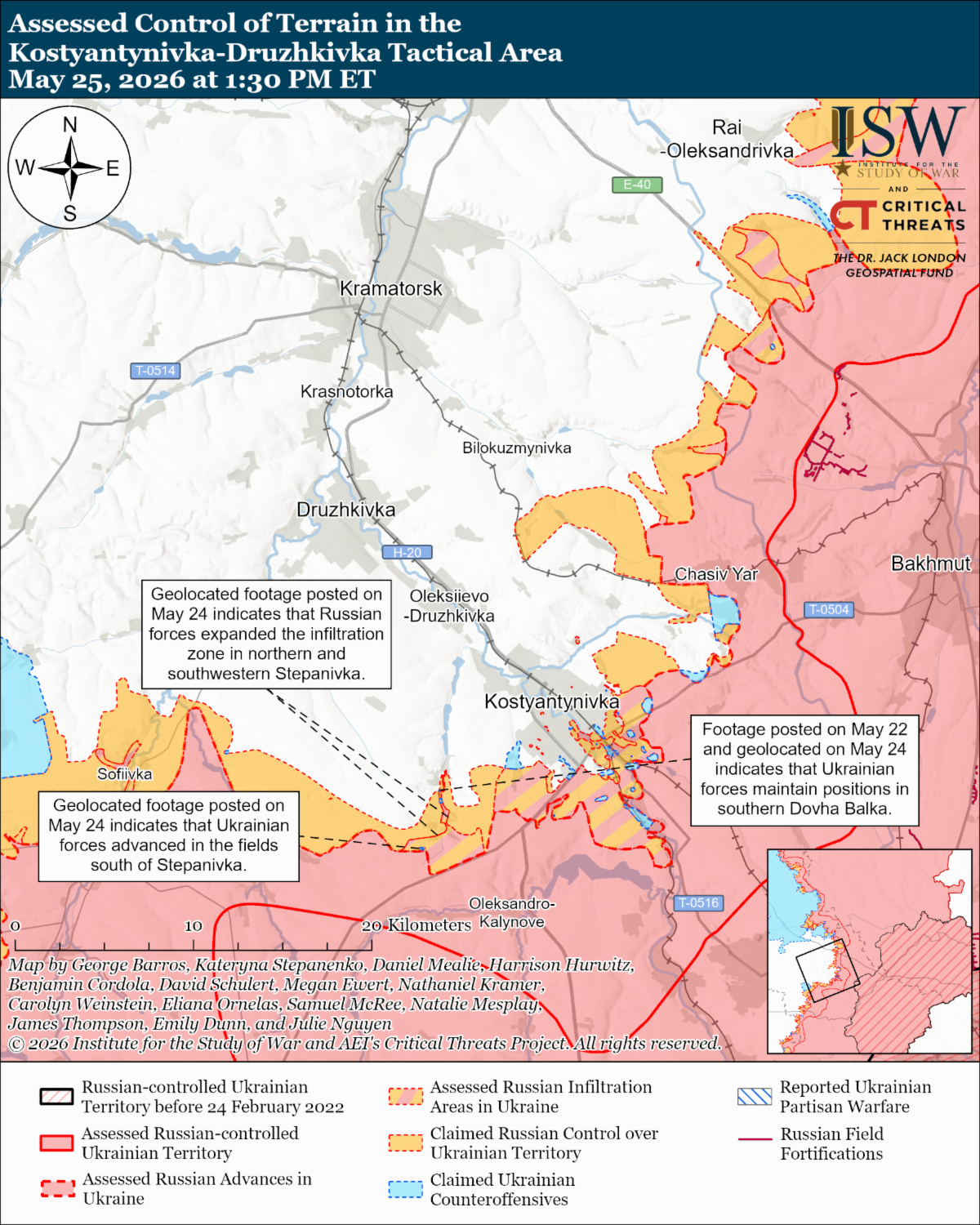
  • 우크라이나군은 코스티안티니우카-드루지키우카 전술 지역과 자포리자주 서부에서 진격했습니다. 러시아군은 코스티안티니우카-드루지키우카 및 도브로필리아 전술 지역에서 진격했습니다.
  • 러시아군은 하룻밤 사이에 262대의 드론을 우크라이나 방향으로 발사했습니다.

최신 관련 자료 및 링크:

다음은 관련 정보를 제공하는 최신 자료 및 링크입니다. 링크의 내용이 제대로 있는지 확인했습니다.

주의: 전쟁 상황은 유동적이므로, 위에 제시된 정보는 현재 시점을 기준으로 합니다. 최신 정보는 링크된 자료들을 참고하시기 바랍니다.

“`

[원문]

Russia threatened systematic strikes on Kyiv City in violation of the spirit of the Victory Day ceasefire, likely to posture strength after the humiliation of the ceasefire itself.

May 25, 2026

Data Cutoff: 12:15 PM ET

Samuel Shafiro, Grace Mappes, Christina Harward, Jennie Olmsted, Anjou Kang-Stryker, and George Barros 

TOPLINES

Russia threatened systematic strikes on Kyiv City in violation of the spirit of the Victory Day ceasefire, likely to posture strength after the humiliation of the ceasefire itself. The Russian Ministry of Foreign Affairs (MFA) warned on May 25 that Russia will launch a “systematic” strike series against Ukrainian defense industrial facilities, including drone design and production sites, decision-making centers, and headquarters in Kyiv City. The Russian MFA called for foreign citizens, diplomats, and international organizations to evacuate Kyiv City and warned Kyiv residents to avoid military and government infrastructure in the city. Russian forces have targeted civilian, government, defense industrial, and military objects in Kyiv City throughout the war, most recently in a May 23 to 24 strike that damaged government buildings and cultural sites. Russia’s warning and continued strikes are an attempt to obfuscate Russia’s weakness, particularly following its May 9 Victory Day parade. Russian President Vladimir Putin is attempting to recover from his humiliation from having to ask Ukraine for permission to hold the Victory Day parade and to distract from Russia’s inability to protect its capital and other deep-rear cities from Ukraine’s intensifying long-range drone strikes. Putin is also struggling to shield the Russian population from the strain on the Russian economy as a result of his war, and Russian economic and societal issues are generating domestic discontent with Putin and his government. Russian forces are also failing to make operationally significant advances in their ongoing Spring-Summer 2026 offensive, as Ukrainian counterattacks, overall drone dominance, and mid–range strike campaign are inhibiting Russian advances and increasing the material and personnel cost of its offensive operations.

The Kremlin is claiming that its strikes are retaliatory in response to an alleged Ukrainian strike against civilians to temper any Western urgency to respond to Russia’s intensified strikes on Kyiv, but this claimed justification does not align with the Kremlin’s historical pattern of behavior. The Russian MFA framed its May 25 threat against Kyiv City as a retaliation for Ukraine’s May 21 to 22 strikes against a college in occupied Starobilsk, Luhansk Oblast, which Russia also used as justification for its May 23 to 24 strike series against Kyiv City. Russian Foreign Minister Sergey Lavrov called US Secretary of State Marco Rubio on May 25 to inform him about the Russian threat against Kyiv City and spread the Kremlin’s ongoing information operation falsely portraying Ukraine and its European partners as undermining peace efforts. These justifications are thin, however. Russia has historically launched its largest strike packages immediately before and after prominent bilateral or trilateral peace negotiations, likely to disrupt and prolong the peace process. Russia has not produced dispositive evidence that Ukraine’s May 21 to 22 strike against Starobilsk was against an exclusively civilian object, following Ukrainian claims that Russian forces established a military quarter on the grounds of the struck college. Russia has established legitimate military targets in civilian buildings before, likely in an effort to use civilians and civilian infrastructure as human shields. Russia is exploiting the ambiguous situation to allege that Ukraine committed a war crime when there is no clear evidence that it was necessarily so.

KEY TAKEAWAYS

  • Russia threatened systematic strikes on Kyiv City in violation of the spirit of the Victory Day ceasefire, likely to posture strength after the humiliation of the ceasefire itself.  

  • The Kremlin is claiming that its strikes are retaliatory in response to an alleged Ukrainian strike against civilians to temper any Western urgency to respond to Russia’s intensified strikes on Kyiv, but this claimed justification does not align with the Kremlin’s historical pattern of behavior.  

  • The Russian government’s accusations that Ukrainian forces violated international law are an attempt to distract from Russian forces’ systematic violations of international law.

  • Russian forces may have launched a second Oreshnik intermediate-range ballistic missile (IRBM), which reportedly malfunctioned and struck occupied Donetsk Oblast during the already large and costly May 23 to 24 strike package.

  • Russian President Vladimir Putin enacted a law on May 25 allowing him to authorize the use of the Russian Armed Forces overseas to defend “Russian citizens” being prosecuted in international or foreign national courts.

  • Ukrainian forces advanced in the Kostyantynivka-Druzhkivka tactical area and in western Zaporizhia Oblast. Russian forces advanced in the Kostyantynivka-Druzhkivka and Dobropillya tactical areas.


  • Russian forces launched 262 drones toward Ukraine overnight.

ISW is powered by the support of individuals like you.

Help us stay independent and impactful.

Website | Jobs | Internships

Follow ISW on social media:

FacebookXYouTube | InstagramLinkedIn | Threads | Bluesky

© 2026 Institute for the Study of War and AEI’s Critical Threats Project. All rights reserved.

Donate online or by sending a check to the Institute for the Study of War at 1400 16th Street NW, Suite #515, Washington, DC 20036. Please consider including the Institute for the Study of War in your estate plans.


ISW is a tax-exempt organization under section 501(c)(3) of the Internal Revenue Code. Donations are tax-deductible to the extent permitted by law.

ISW is a non-partisan, non-profit, public policy research organization. ISW advances an informed understanding of military affairs through reliable research, trusted analysis, and innovative education. We are committed to improving the nation’s ability to execute military operations and respond to emerging threats in order to achieve US strategic objectives.

댓글 달기

이메일 주소는 공개되지 않습니다. 필수 필드는 *로 표시됩니다

위로 스크롤