[ISW] 러시아 공세 캠페인 평가, 2025년 9월 24일

“`html

핵심 내용 요약:

  • 크렘린은 우크라이나에서의 평화를 확보하려는 도널드 트럼프 미국 대통령의 노력을 막기 위해 핵 위협을 사용하고 있습니다.
  • 러시아는 도널드 트럼프 미국 대통령이 최근 정확하게 지적한 러시아의 경제적 약점을 은폐하기 위한 다각적인 정보 캠페인을 시작했습니다.
  • 볼로디미르 젤렌스키 우크라이나 대통령은 평화 협상에 참여하고 우크라이나 헌법 및 우크라이나 법률에 따라 선거를 실시하겠다는 의지를 재확인했습니다.
  • 9월 24일, 우크라이나 전 최고 사령관이자 현재 영국 주재 우크라이나 대사인 발레리 잘루즈니 장군은 러시아군이 기동력을 되찾기 위해 기술 혁신과 지상 전술을 적용하고 있다고 평가했습니다.
  • 9월 24일, 칼리닌그라드에서 발원한 러시아 전파 방해가 리투아니아로 향하던 마가리타 로블레스 스페인 국방부 장관의 항공기 GPS를 교란했을 가능성이 있습니다.
  • 우크라이나군은 최근 러시아와 점령된 크림 반도를 상대로 일련의 공중 및 해상 드론 공격을 감행했으며, 여기에는 러시아 석유 인프라 및 드론 생산 시설도 포함되었습니다.
  • 우크라이나군은 최근 리만(Lyman)과 포크로프스크(Pokrovsk) 인근, 그리고 도브로필랴(Dobropillya) 전술 지역에서 진격을 시도했습니다. 러시아군은 최근 시베르스크(Siversk) 인근, 포크로프스크(Pokrovsk) 인근, 코스티안티니우카-드루지키우카(Kostyantynivka-Druzhkivka) 전술 지역, 그리고 서부 자포리자(Zaporizhia) 지역에서 진격을 시도했습니다.

최신 자료 및 관련 링크:

“`

**주의 사항:**

* **링크 검토:** 위에 제시된 링크들은 현재 시점에서 유효하고, 관련 내용을 포함하고 있는지 확인했습니다. 그러나, 링크는 시간이 지남에 따라 변경될 수 있으므로, 필요에 따라 다시 확인하시기 바랍니다.
* **정보 출처:** 제시된 링크들은 신뢰할 수 있는 정보 출처 (예: ISW, NYT, BBC, CFR, IMF)를 기반으로 합니다.
* **언어:** 모든 영어 단어는 한국어로 번역했습니다.
* **업데이트:** 전쟁 상황은 매우 유동적이므로, 위의 정보는 특정 시점의 상황을 반영합니다. 최신 정보를 얻으려면 지속적으로 뉴스 및 분석 자료를 확인하는 것이 중요합니다.

[원문]

The Kremlin is using nuclear threats to influence US President Donald Trump to stop his efforts to secure peace in Ukraine.

September 24, 2025

Information Cutoff: 9 pm ET

Jennie Olmsted, Jessica Sobieski, Christina Harward, Justin Young, Grace Mappes, Daria Novikov, Ian Matthews, and Kateryna Stepanenko

TOPLINES

The Kremlin is using nuclear threats to influence US President Donald Trump to stop his efforts to secure peace in Ukraine. Russian Security Council Deputy Chairperson Dmitry Medvedev used his English-language X (formerly Twitter) account on September 23 to reiterate Russian President Vladimir Putin’s recent announcement that Russia is prepared to continue to adhere to the nuclear arms limitations in the New Strategic Arms Reduction Treaty (New START) for one year after it expires on February 5, 2026. Medvedev stated that the Trump administration must now decide whether it will follow suit. Medvedev claimed that US adherence to the letter of the treaty “is not enough,” however, and that the United States “must give up on weakening Russia with sanctions and tariffs” or else “the risk of direct conflict remains high.” Medvedev’s veiled nuclear threats directly tie US agreement to stop all its economic measures targeting Russia—the main tool that the Trump administration is using to try to bring Putin to the negotiating table to end the war in Ukraine—to Russia’s continued adherence to New START or readiness to agree to any future arms control treaties. Medvedev’s threats are part of wider Kremlin efforts to delay peace negotiations, use threats to secure Russia’s desired demands in Ukraine, secure concessions that benefit Russia, and deter the United States from supporting Ukraine.

Russia launched a multipronged informational campaign intended to mask Russia’s economic weakness that US President Donald Trump recently correctly identified. Kremlin officials responded on September 24 directly and indirectly to Trump’s September 23 statement outlining Russia’s military shortcomings and economic turmoil. Kremlin Spokesperson Dmitry Peskov responded to Trump’s statement about how Russia’s poor economic situation makes Russia look like a “paper tiger,” claiming that Russia is “more closely associated with a bear” and that “there are no paper bears.” Peskov also explicitly rejected Trump’s assertion that Ukraine could retake territory with assistance from the North Atlantic Treaty Organization (NATO) and the European Union (EU). Peskov claimed that Ukraine’s military position is significantly worse than in Spring 2022 and that US efforts to “encourage” Ukraine to continue military operations are “misguided." The Kremlin aims to convince Trump and the West that continuing to support Ukraine and oppose Russia is not viable and that the United States should instead allow Russia to continue its war unimpeded.


The Kremlin launched three distinct narratives in response to Trump’s September 23 statement: statements about the Kremlin’s continued commitment to its original war aims; claims that a Russian victory in Ukraine is inevitable; and claims that the United States should focus on bilateral US-Russian economic relations. Peskov claimed that Russian President Vladimir Putin is open to the settlement process to end the war in Ukraine and that Trump “cannot help but see Putin’s openness to this process.” Peskov claimed that the “war is not aimless” but is meant to ensure Russia’s security and Russian interests and to eliminate the war’s “root causes.” The Kremlin has repeatedly defined the alleged root causes as NATO’s eastward expansion and Ukraine’s alleged discrimination against Russian speakers. The Kremlin often uses claims about the root causes to call for Ukraine and the West to give in to Russia’s original war aims. Peskov also provided excuses for Putin’s disinterest in participating in a bilateral meeting with Ukrainian President Volodymyr Zelensky, claiming that a meeting without significant preparation would be a “public relations stunt doomed to fail.” Putin remains uninterested in good faith negotiations that require compromises and is instead making the same demands of Ukraine and the West as he did in late 2021 and February 2022.

KEY TAKEAWAYS

  • The Kremlin is using nuclear threats to influence US President Donald Trump to stop his efforts to secure peace in Ukraine.

  • Russia launched a multipronged informational campaign intended to mask Russia’s economic weakness that US President Donald Trump recently correctly identified.

  • Ukrainian President Volodymyr Zelensky reiterated his commitment to engaging in peace negotiations and holding elections in accordance with the Ukrainian Constitution and Ukrainian law.

  • Former Ukrainian Command-in-Chief and current Ukrainian Ambassador to the United Kingdom General Valerii Zaluzhnyi assessed on September 24 that Russian forces are adapting technological innovations and ground tactics in an attempt to restore maneuver to the battlefield.

  • Russian jamming originating from Kaliningrad Oblast likely disrupted the GPS on Spanish Defense Minister Margarita Robles’ plane flying to Lithuania on September 24.

  • Ukrainian forces recently conducted a series of aerial and naval drone strikes against Russia and occupied Crimea, including against Russian oil infrastructure and drone production facilities.

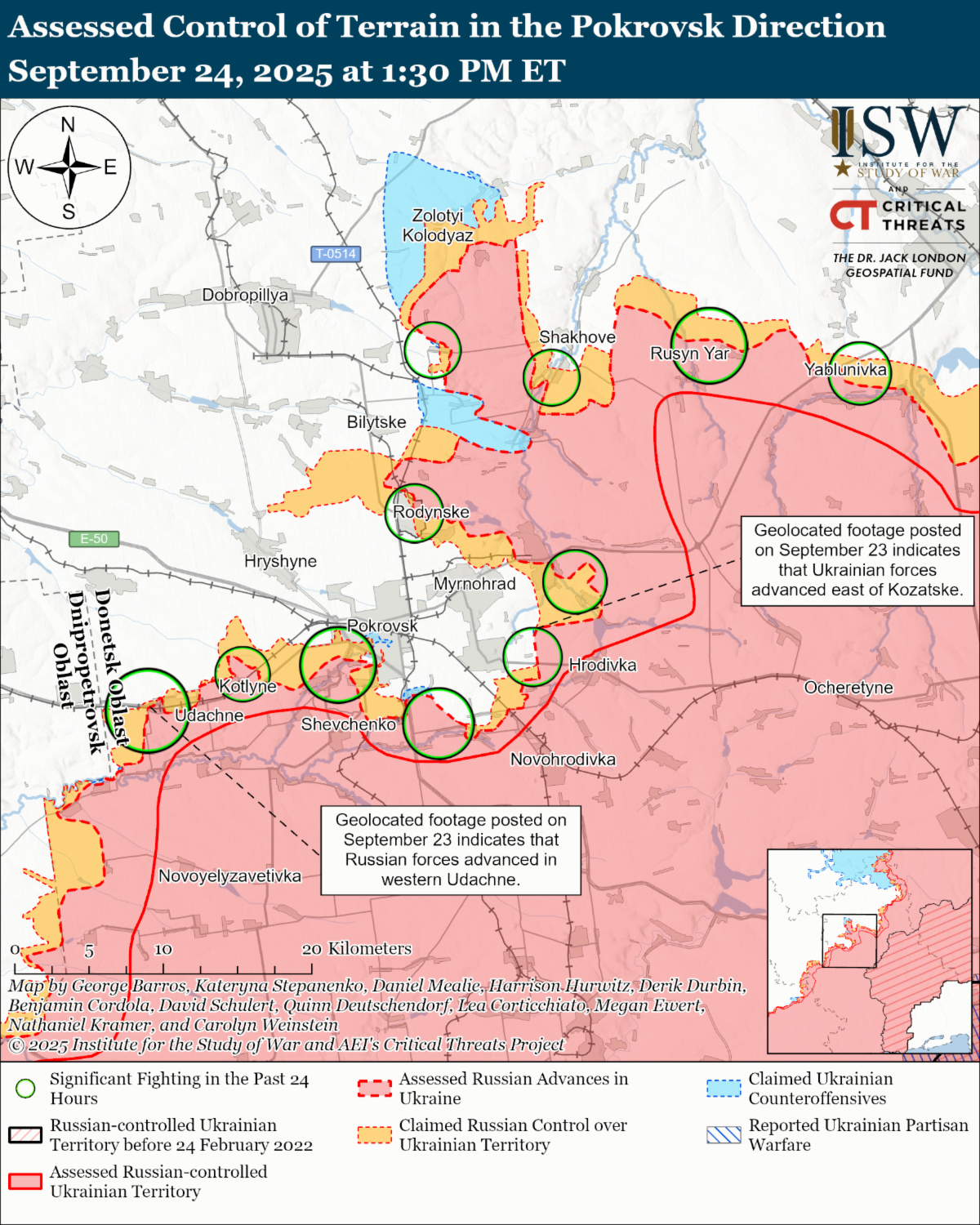
  • Ukrainian forces recently advanced near Lyman and Pokrovsk and in the Dobropillya tactical area. Russian forces recently advanced near Siversk and Pokrovsk, in the Kostyantynivka-Druzhkivka tactical area, and in western Zaporizhia Oblast.

NEW EMAIL SUBSCRIPTION OPTIONS

ISW has launched newly customizable email subscription options. Existing subscribers have been auto enrolled in all lists. Click below to learn more about these options and customize your preferences.

ISW is powered by the support of individuals like you.

Help us stay independent and impactful.

Website | Jobs | Internships

Follow ISW on social media:

FacebookXYouTube | InstagramLinkedIn | Threads | Bluesky

© 2025, Institute for the Study of War

Donate online or by sending a check to the Institute for the Study of War at 1400 16th Street NW, Suite #515, Washington, DC 20036. Please consider including the Institute for the Study of War in your estate plans.


ISW is a tax-exempt organization under section 501(c)(3) of the Internal Revenue Code. Donations are tax-deductible to the extent permitted by law.

ISW is a non-partisan, non-profit, public policy research organization. ISW advances an informed understanding of military affairs through reliable research, trusted analysis, and innovative education. We are committed to improving the nation’s ability to execute military operations and respond to emerging threats in order to achieve US strategic objectives.

댓글 달기

이메일 주소는 공개되지 않습니다. 필수 필드는 *로 표시됩니다

위로 스크롤