[ISW] 이란 업데이트, 2025년 10월 2일

“`html

핵심 내용 요약:

  • 이란의 전략적 재고: (Iranian Strategic Re-Think)

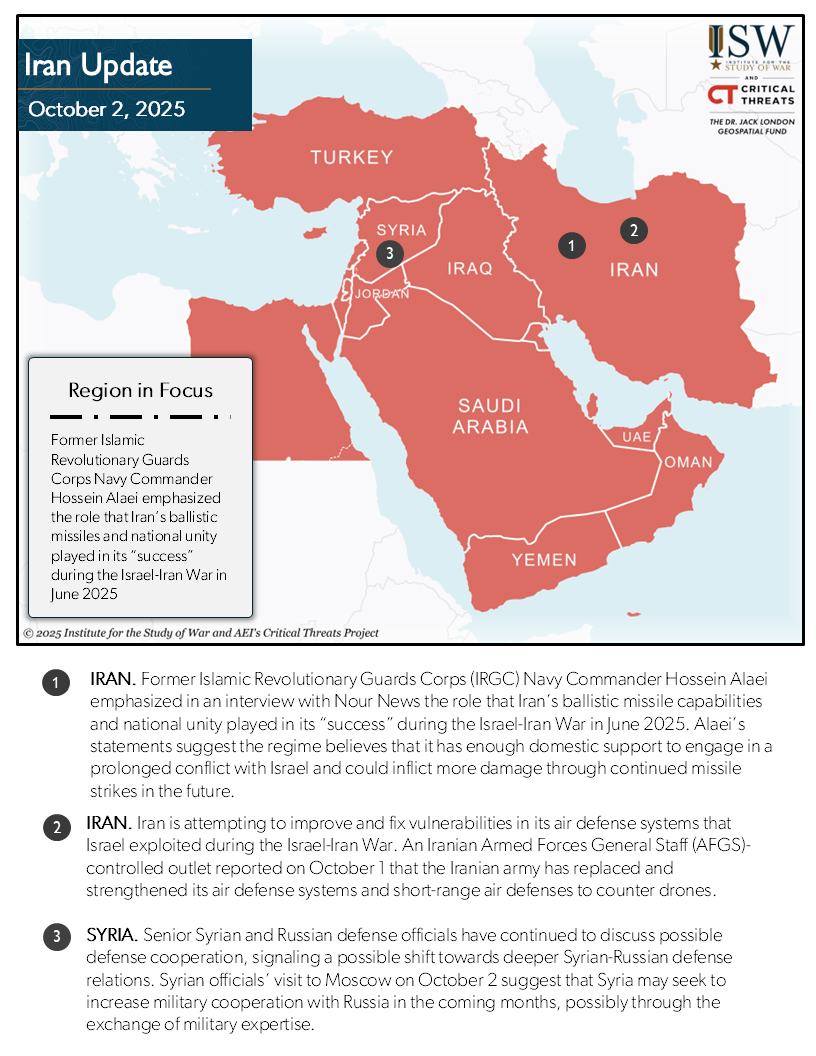
    전 이란 혁명수비대 해군 사령관 호세인 알라에이는 Nour News와의 인터뷰에서 이란의 탄도 미사일 능력과 국가 통합이 2025년 6월 이스라엘-이란 전쟁에서 이란의 “성공”에 기여했다고 강조했습니다. 알라에이의 발언은 이란 정권이 이스라엘과의 장기적인 분쟁을 수행할 만큼 충분한 국내 지지를 받고 있으며, 향후 지속적인 미사일 공격을 통해 더 큰 피해를 입힐 수 있다고 믿고 있음을 시사합니다.

  • 이란 방공: (Iranian Air Defense)

    이란은 이스라엘-이란 전쟁에서 이스라엘이 악용한 자국 방공 시스템의 취약점을 개선하고 해결하려 노력하고 있습니다. 이란군 참모본부(AFGS)가 통제하는 언론은 10월 1일 이란군이 드론에 대응하기 위해 방공 시스템과 단거리 방공망을 교체하고 강화했다고 보도했습니다.

  • 시리아-러시아 방위 협력: (Syrian-Russian Defense Cooperation)

    시리아와 러시아의 고위 국방 관계자들이 지속적으로 가능한 방위 협력에 대해 논의하며, 시리아-러시아 간 더 깊은 방위 관계를 향한 전환 가능성을 시사하고 있습니다. 10월 2일 시리아 관리들의 모스크바 방문은 시리아가 향후 몇 달 안에 군사 전문 지식 교환 등을 통해 러시아와의 군사 협력을 강화하려 할 수 있음을 시사합니다.

관련 최신 자료 및 링크:

  • 미국 외교협회 (CFR) – 이란 관련 페이지 (영어):

    이란과 관련된 최신 분석, 뉴스, 보고서를 제공합니다. 여기에서 이란의 전략, 군사력, 지역 내 활동에 대한 정보를 얻을 수 있습니다.

    (확인 결과: 해당 페이지는 이란과 관련된 다양한 자료들을 제공하며, 위에서 언급된 내용과 관련된 정보도 포함하고 있을 수 있습니다.)

  • 알자지라 – 이란 관련 페이지 (영어):

    이란에 대한 최신 뉴스 및 분석을 제공합니다. 이란의 정치, 경제, 군사, 외교 정책 등을 다룹니다.

    (확인 결과: 해당 페이지는 이란 관련 최신 뉴스 및 분석을 제공하며, 위에 언급된 내용과 관련된 정보도 포함하고 있을 수 있습니다.)

  • 로이터 – 이란 관련 페이지 (영어):

    이란에 대한 최신 뉴스 및 분석을 제공합니다. 이란의 정치, 경제, 군사, 외교 정책 등을 다룹니다.

    (확인 결과: 해당 페이지는 이란 관련 최신 뉴스 및 분석을 제공하며, 위에 언급된 내용과 관련된 정보도 포함하고 있을 수 있습니다.)

  • 미국 국무부 – 이란 관련 페이지 (영어):

    미국 국무부의 이란 관련 정책, 성명, 보고서 등을 제공합니다. 이란에 대한 미국의 입장을 파악하는 데 도움이 됩니다.

    (확인 결과: 해당 페이지는 이란에 대한 미국의 정책 및 입장을 보여주는 공식 자료들을 제공합니다. 위의 내용과 직접적인 연관성은 낮지만, 이란 관련 전반적인 맥락을 이해하는 데 도움이 될 수 있습니다.)

  • 디펜스 뉴스 – 이란 관련 페이지 (영어):

    이란의 군사력, 국방, 안보 관련 최신 뉴스 및 분석을 제공합니다. 이란의 미사일 개발, 방공 능력 등을 다룹니다.

    (확인 결과: 해당 페이지는 이란의 군사력, 국방 관련 뉴스 및 분석을 제공하며, 특히 이란의 군사적 능력과 관련된 최신 정보를 얻을 수 있습니다.)

“`

[원문]

Former Islamic Revolutionary Guards Corps (IRGC) Navy Commander Hossein Alaei emphasized the role that Iran’s ballistic missile capabilities and national unity played…

October 2, 2025

Information Cutoff: 2:00 pm ET

Ben Rezai, Adham Fattah, Kelly Campa, Zahra Wakilzada, Avery Borens, and Brian Carter

TOPLINES

Former Islamic Revolutionary Guards Corps (IRGC) Navy Commander Hossein Alaei emphasized the role that Iran’s ballistic missile capabilities and national unity played in its “success” during the Israel-Iran War in June 2025. Alaei claimed that Iran demonstrated the strength of its ballistic missiles and national unity during the war in an interview with Nour News on October 1. Alaei claimed that Iran‘s demonstration of these strengths caused the United States and Israel to call for a ceasefire. Alaei also claimed that Iranian missiles became more precise throughout the war and that no segment of the Iranian population chose to side with Israel in support of internal division. Alaei’s reflections almost certainly reflect only some segments of the regime’s national security community, and CTP-ISW cannot determine whether Alaei’s statements are reflective of a broader trend in Iranian strategic thought or if it is isolated to only a small number of thinkers.

Alaei’s statements regarding Iran‘s ballistic missiles and national unity suggest that some elements of the regime’s national security community believe that the regime has enough domestic support to engage in a prolonged conflict with Israel and could inflict more damage through continued missile strikes. These reflections indicate that some Iranian officials believe that at least some elements of its previous efforts to deter and defend against Israeli strikes could be successful in the future, presumably with some modifications. Israel accomplished its campaign objectives—the degradation of Iran’s nuclear and ballistic missile programs—in the Israel-Iran War, but it needed to end the war rapidly and at a moment of its own choosing. Israel forced Iran to rapidly end the war by creating the perception of a credible existential threat to the Iranian regime. Israel struck Iranian institutions and other assets used by the Iranian regime to ensure regime stability. A series of strikes against these institutions and assets that the Israelis design to demonstrate a credible threat to the regime’s stability could be expanded or contracted depending on how the regime responds and Israel’s desire for a ceasefire. Israel calculated that the Iranian regime’s overwhelming interest in ensuring regime survival would compel it to agree to a ceasefire. Alaei appears to be implying that the war illustrated that, in the future, Iranian missiles could be more successful if Israeli interceptor stockpiles are depleted. Alaei also suggests that national unity would have sustained a longer war, but it is unclear if expanded Israeli strikes would change Iranian calculations about regime stability.

Alaei’s assumptions that the ballistic missile attack campaign and national unity were part of Iran’s “success” seem to disregard the reality that Israeli operations did not intend to collapse the regime or even seriously threaten it. Israel only aimed to demonstrate its military capability to destroy Iran’s ability to control its population. Israel retains that capability, and as noted above, could decide to expand or contract its military campaign against regime targets and threaten regime stability as it deems necessary to accomplish its objectives.

KEY TAKEAWAYS

  • Iranian Strategic Re-Think: Former Islamic Revolutionary Guards Corps (IRGC) Navy Commander Hossein Alaei emphasized in an interview with Nour News the role that Iran’s ballistic missile capabilities and national unity played in its “success” during the Israel-Iran War in June 2025. Alaei’s statements suggest the regime believes that it has enough domestic support to engage in a prolonged conflict with Israel and could inflict more damage through continued missile strikes in the future.

  • Iranian Air Defense: Iran is attempting to improve and fix vulnerabilities in its air defense systems that Israel exploited during the Israel-Iran War. An Iranian Armed Forces General Staff (AFGS)-controlled outlet reported on October 1 that the Iranian army has replaced and strengthened its air defense systems and short-range air defenses to counter drones.

  • Syrian-Russian Defense Cooperation: Senior Syrian and Russian defense officials have continued to discuss possible defense cooperation, signaling a possible shift towards deeper Syrian-Russian defense relations. Syrian officials’ visit to Moscow on October 2 suggests that Syria may seek to increase military cooperation with Russia in the coming months, possibly through the exchange of military expertise.

NEW EMAIL SUBSCRIPTION OPTIONS

ISW has launched newly customizable email subscription options. Existing subscribers have been auto enrolled in all lists. Click below to learn more about these options and customize your preferences.

ISW is powered by the support of individuals like you.

Help us stay independent and impactful.

Website | Jobs | Internships

Follow ISW on social media:

FacebookXYouTube | InstagramLinkedIn | Threads | Bluesky

Donate online or by sending a check to the Institute for the Study of War at 1400 16th Street NW, Suite #515, Washington, DC 20036. Please consider including the Institute for the Study of War in your estate plans.

ISW is a tax-exempt organization under section 501(c)(3) of the Internal Revenue Code. Donations are tax-deductible to the extent permitted by law.

ISW is a non-partisan, non-profit, public policy research organization. ISW advances an informed understanding of military affairs through reliable research, trusted analysis, and innovative education. We are committed to improving the nation’s ability to execute military operations and respond to emerging threats in order to achieve US strategic objectives.

댓글 달기

이메일 주소는 공개되지 않습니다. 필수 필드는 *로 표시됩니다

위로 스크롤