|
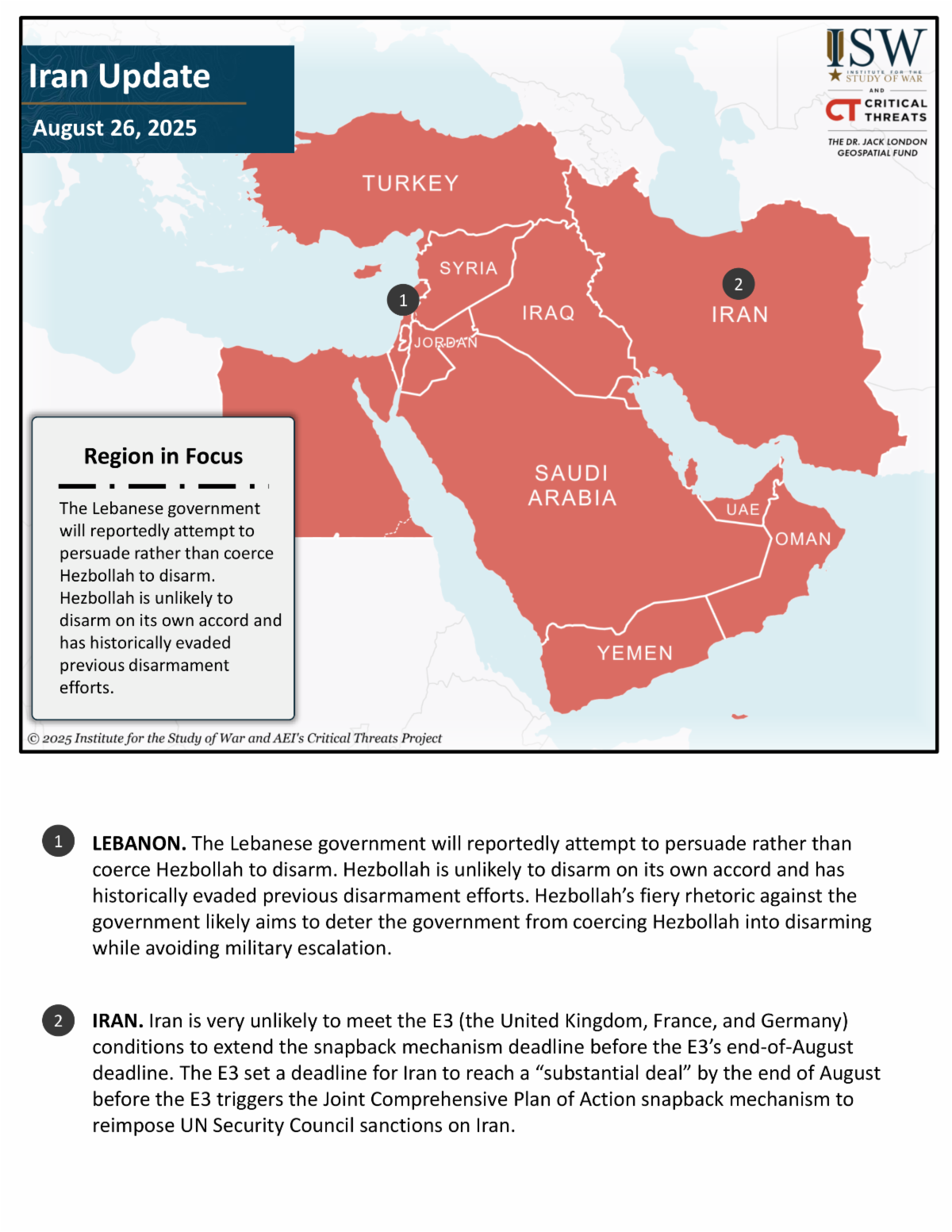
The Lebanese government will reportedly attempt to persuade rather than coerce Hezbollah to disarm. Hezbollah is unlikely to disarm on its own accord and has historically evaded previous disarmament efforts. US Special Envoy Thomas Barrack said that the Lebanese government will focus on persuasion to encourage Hezbollah disarmament after his meeting with Lebanese President Joseph Aoun on August 26. Barrack announced that Lebanon will present a plan on August 31 that aims to encourage Hezbollah to surrender its weapons to the Lebanese Armed Forces (LAF). Hezbollah’s threats to encourage violence if efforts to disarm it persist suggest that the group is attempting to test the government’s willingness to disarm it. A plan based on persuasion is therefore unlikely to disarm Hezbollah successfully, because the group will face few negative consequences if it declines to disarm. Barrack is attempting to build an ”economic zone” in southern Lebanon to court Hezbollah’s supporters, which is an incentive for the rank-and-file of Hezbollah fighters, but would probably not court ideologically motivated Hezbollah fighters and leadership. Hezbollah has used financial incentives, including jobs, salaries, pensions, and benefits, to retain its support base among Lebanese Shia civilians and to recruit young fighters.
Hezbollah’s fiery rhetoric against the government likely aims to deter the government from coercing Hezbollah into disarming while avoiding military escalation. Hezbollah has previously launched mass protests in response to much less significant Lebanese government efforts to counter the group. Hezbollah and its ally, the Amal Movement, incited a protest in Beirut in October 2021 in response to the Lebanese government’s investigation into the potential role of Hezbollah officials in the Beirut port explosion. This investigation was much less significant to Hezbollah’s long-term survival than government efforts in 2025 to disarm Hezbollah, which are supported by the prime minister. The 2021 protests rapidly descended into sectarian clashes between pro-Hezbollah protestors and anti-Hezbollah Lebanese Forces members, which killed at least six individuals. Hezbollah has largely refrained from officially inciting protests in response to the Lebanese government’s recent decision to disarm the group, however. Hezbollah and the Amal Movement only called on supporters to protest once on August 25, but later postponed the protests to allow for dialogue. Hezbollah’s dialogue suggests that the group fears escalation because its weaker position and the inherent unpredictability of protests or military escalation could rapidly spiral out of Hezbollah’s control.
Iran is very unlikely to meet the E3 (the United Kingdom, France, and Germany) conditions to extend the snapback mechanism deadline before the E3’s end-of-August deadline. The E3 set a deadline for Iran to reach a “substantial deal” by the end of August before the E3 triggers the Joint Comprehensive Plan of Action (JCPOA) snapback mechanism to re-impose UN Security Council sanctions on Iran. The snapback mechanism is set to expire on October 18, marking the end of the ten-year period outlined in UN Security Council Resolution 2231, but the E3 would need to initiate the snapback process at the end of August in order to meet the October 18 deadline. An Iranian delegation led by Deputy Foreign Affairs Minister for Political Affairs Majid Takht Ravanchi and Deputy Foreign Affairs Minister for Legal and International Affairs Kazem Gharibabadi met with E3 officials in Geneva, Switzerland, on August 26 to discuss potential snapback sanctions and a snapback mechanism deadline extension. An unspecified source told an Axios reporter on August 26 that the Iranians “have [not] put tangible, detailed deliverables on the table.” Another source added that Iran offered “very little to work with” to secure an extension. The E3 previously proposed on July 25 to extend the snapback mechanism’s deadline in exchange for full cooperation with the International Atomic Energy Agency (IAEA), a resumption of nuclear talks with the United States, and accounting for its 60 percent enriched uranium stockpile. Iran has repeatedly rejected this proposal. Iran has reiterated its right to enrich uranium domestically, continued to deny the IAEA access to Iranian nuclear facilities struck in the 12-day Israel-Iran War, and set maximalist preconditions for resuming nuclear talks with the United States.
|