“`html
핵심 내용 요약:
- 호르무즈 해협 통제권 관련: 이란이 호르무즈 해협을 통제하도록 허용하는 미국의 합의나 해결은 미국의 심각한 패배를 의미하며, 세계 무역에 치명적인 영향을 미칠 수 있는 선례를 남길 것입니다. 이는 해협이 중요한 에너지 수송의 요충지이기 때문입니다. 이란의 통행 규제 능력을 미국이 인정하는 것은 호르무즈 해협의 항행 자유 원칙을 훼손하고, 이란이 자국의 요구사항 준수를 조건으로 해협 접근을 제한하여 테헤란이 세계 경제와 미국 및 동맹국에 지속적인 압력을 가할 수 있게 할 것입니다.
- 보호세 갈취 시도: 이란은 호르무즈 해협에 대한 통제권을 강화하기 위해 수수료를 지불하고 이슬람 혁명 수비대(IRGC)의 프로토콜을 준수하는 선박에 우선 통행을 허용하는 방식으로 보호세를 갈취하려 시도하고 있습니다. 또한 이란은 이란과 관련 없는 선박의 해협 통과를 계속 막고 있습니다.
- 미국의 조치: 전쟁 중 미국군은 처음으로 이란 국적 컨테이너선을 나포했습니다. 상업적으로 이용 가능한 해운 데이터에 따르면, 미국 해군은 4월 19일 이란 또는 이란 관련 선박 최소 3척이 이란 항구로 방향을 바꾸도록 강요했습니다.
- 협상 가능성: 미국 부통령 JD Vance, 중동 특사 Steve Witkoff, Jared Kushner가 4월 21일 파키스탄 이슬라마바드에서 이란과의 협상에 참여할 예정입니다. 그러나 4월 19일 오후 6시(동부 표준시) 기준으로 ISW-CTP는 이란 측에서 협상 참여를 확인하는 내용을 관찰하지 못했습니다.
- 미사일 및 드론 위협 평가: 미국-이스라엘 연합군이 이란의 탄도 미사일 및 드론 프로그램에 가한 피해에 대한 불완전한 보고로 인해 이란의 미사일과 드론이 여전히 제기하는 위협에 대한 정량적 평가를 내리기 어렵습니다.
- 분쟁 재개 가능성: 이란이 지원하는 이라크 민병대 카타입 헤즈볼라가 4월 18일에 발표한 성명은 IRGC 쿠드스군 사령관 에스마일 가아니 준장이 4월 18일 바그다드에서 이라크 민병대 지도자들과의 회담에서 미국 및 이스라엘과의 분쟁 재개를 위한 준비를 논의했음을 시사합니다. 가아니는 분쟁 재개 시 이라크 민병대와 다른 저항 축 그룹 간의 미국, 이스라엘, 걸프 국가에 대한 협력을 강화하는 방안을 구체적으로 논의했을 수 있습니다.
최신 자료 및 관련 링크:
- 이란의 호르무즈 해협 통제 시도 및 그 영향
- 자료: (링크 없음 – 해당 내용을 다루는 최신 뉴스 기사나 분석 보고서를 검색하여 링크를 추가해야 합니다.) 호르무즈 해협의 전략적 중요성, 이란의 통제 시도, 국제 유가 및 무역에 미치는 영향 등을 다루는 기사나 보고서가 있는지 확인하고 링크를 추가합니다.
- 참고: 이 부분은 현재 제공된 정보만으로는 링크를 제공할 수 없습니다. 관련 내용을 다루는 최신 뉴스 기사나 보고서를 직접 찾아 링크를 추가해야 합니다.
- 미국의 대응 및 외교적 노력
- 자료: (링크 없음 – 해당 내용을 다루는 최신 뉴스 기사나 분석 보고서를 검색하여 링크를 추가해야 합니다.) 미국 정부의 대이란 정책, 협상 가능성, 관련 외교적 움직임 등을 다루는 기사나 보고서를 찾습니다.
- 참고: 이 부분은 현재 제공된 정보만으로는 링크를 제공할 수 없습니다. 관련 내용을 다루는 최신 뉴스 기사나 보고서를 직접 찾아 링크를 추가해야 합니다.
- 이란의 군사적 움직임 및 동향
- 자료: (링크 없음 – 해당 내용을 다루는 최신 뉴스 기사나 분석 보고서를 검색하여 링크를 추가해야 합니다.) 이란의 군사적 활동, IRGC의 역할, 주변국과의 관계 등을 다루는 기사나 보고서를 찾습니다.
- 참고: 이 부분은 현재 제공된 정보만으로는 링크를 제공할 수 없습니다. 관련 내용을 다루는 최신 뉴스 기사나 보고서를 직접 찾아 링크를 추가해야 합니다.
- 미사일 및 드론 위협 평가 관련
- 자료: (링크 없음 – 해당 내용을 다루는 최신 뉴스 기사나 분석 보고서를 검색하여 링크를 추가해야 합니다.) 이란의 미사일 및 드론 기술, 위협 평가, 관련 정보 부족 문제 등을 다루는 기사나 보고서를 찾습니다.
- 참고: 이 부분은 현재 제공된 정보만으로는 링크를 제공할 수 없습니다. 관련 내용을 다루는 최신 뉴스 기사나 보고서를 직접 찾아 링크를 추가해야 합니다.
주의: 위에 제시된 링크는 예시이며, 실제 관련 자료를 검색하여 최신 정보를 담고 있는 링크로 대체해야 합니다. 또한, 링크의 내용이 정확하고 신뢰할 수 있는지 반드시 확인해야 합니다.
“`
**설명:**
1. **한국어 번역:** “Key Takeaways”를 한국어로 번역하여 핵심 내용 요약을 제공합니다.
2. **워드프레스 HTML 형식:** 결과를 워드프레스에서 쉽게 사용할 수 있도록 HTML 형식으로 구성합니다.
3. **최신 자료 및 링크:** 관련 내용을 다루는 최신 뉴스 기사, 분석 보고서 등의 링크를 제시합니다. (하지만, 제공된 정보만으로는 링크를 찾을 수 없어, 직접 검색하여 링크를 추가해야 함을 명시합니다.)
4. **내용 확인:** 링크의 내용이 정확한지 확인하는 것이 중요함을 강조합니다.
5. **영어 번역:** 본문의 영어 단어(예: US, IRGC 등)를 한글로 번역합니다.
6. **참고:** 링크를 찾기 위한 지침을 제공하고, 현재 정보로는 링크를 제공할 수 없음을 명확히 합니다. 사용자가 직접 관련 자료를 검색하여 링크를 추가하도록 안내합니다.
7. **구조:** 내용의 명확성을 위해 핵심 내용, 관련 자료, 그리고 주의사항을 구분하여 제시합니다.
**추가적인 개선 사항 (링크 추가를 제외하고):**
* 각 항목의 제목을 좀 더 구체적으로 만들 수 있습니다. 예를 들어, “호르무즈 해협 통제권 관련”을 “이란의 호르무즈 해협 통제 시도와 국제 무역에 미치는 영향”과 같이 구체화할 수 있습니다.
* 자료 검색 및 링크 추가 시, 신뢰할 수 있는 언론사, 연구기관, 정부 기관 등의 자료를 활용하는 것이 좋습니다.
* 만약 링크를 추가할 수 있다면, 각 링크에 대한 간단한 설명을 덧붙여 어떤 내용이 담겨 있는지 독자들이 쉽게 알 수 있도록 하는 것이 좋습니다.
* 가능하다면, 분석적인 내용을 좀 더 추가하여 독자들이 문제의 심각성을 더 잘 이해할 수 있도록 돕습니다. 예를 들어, 이란이 호르무즈 해협을 통제할 경우 발생할 수 있는 구체적인 경제적, 안보적 위협을 상세히 설명할 수 있습니다.
[원문]

|
April 19, 2026
Data Cutoff: 2:00 ET
|
|
|
Benjamin Schimda, Avery Borens, Adham Fattah, Nidal Morrison, Carolyn Moorman, and Annika Ganzeveld
|
|
|
As the Middle East crisis evolves, ISW urgently needs your support.
Help us stay independent and impactful.
|
|
|
Any US settlement or resolution of the conflict that enables Iran to control traffic through the Strait of Hormuz would represent a major US defeat and set a precedent with critical implications for global trade, given the strait’s role as a critical energy chokepoint. Iran has repeatedly claimed sovereignty over the Strait of Hormuz, but Iran has no legal claim to the strait, which international law defines as an international waterway. Iran has repeatedly attempted to regulate traffic through the strait by directing vessels through Iranian territorial waters, extracting fees, and attacking and threatening maritime traffic. Recent Iranian proposals to the United States have also implicitly demanded that the United States and international community recognize Iran’s “control” over the strait. Iran has offered to “let” vessels transit the strait in these proposals, but Iran’s “letting” traffic through the strait implies that Iran can “let” traffic through an international waterway. These proposals are consistent with persistent Iranian messaging throughout the war that Iran seeks to impose a new status quo for transit through the strait. Any US acceptance of Iran’s ability to regulate transit would undermine the principle of freedom of navigation through the Strait of Hormuz and enable Iran to condition access to the strait on compliance with its demands, thereby enabling Tehran to exert persistent pressure on the global economy and the United States and its allies.
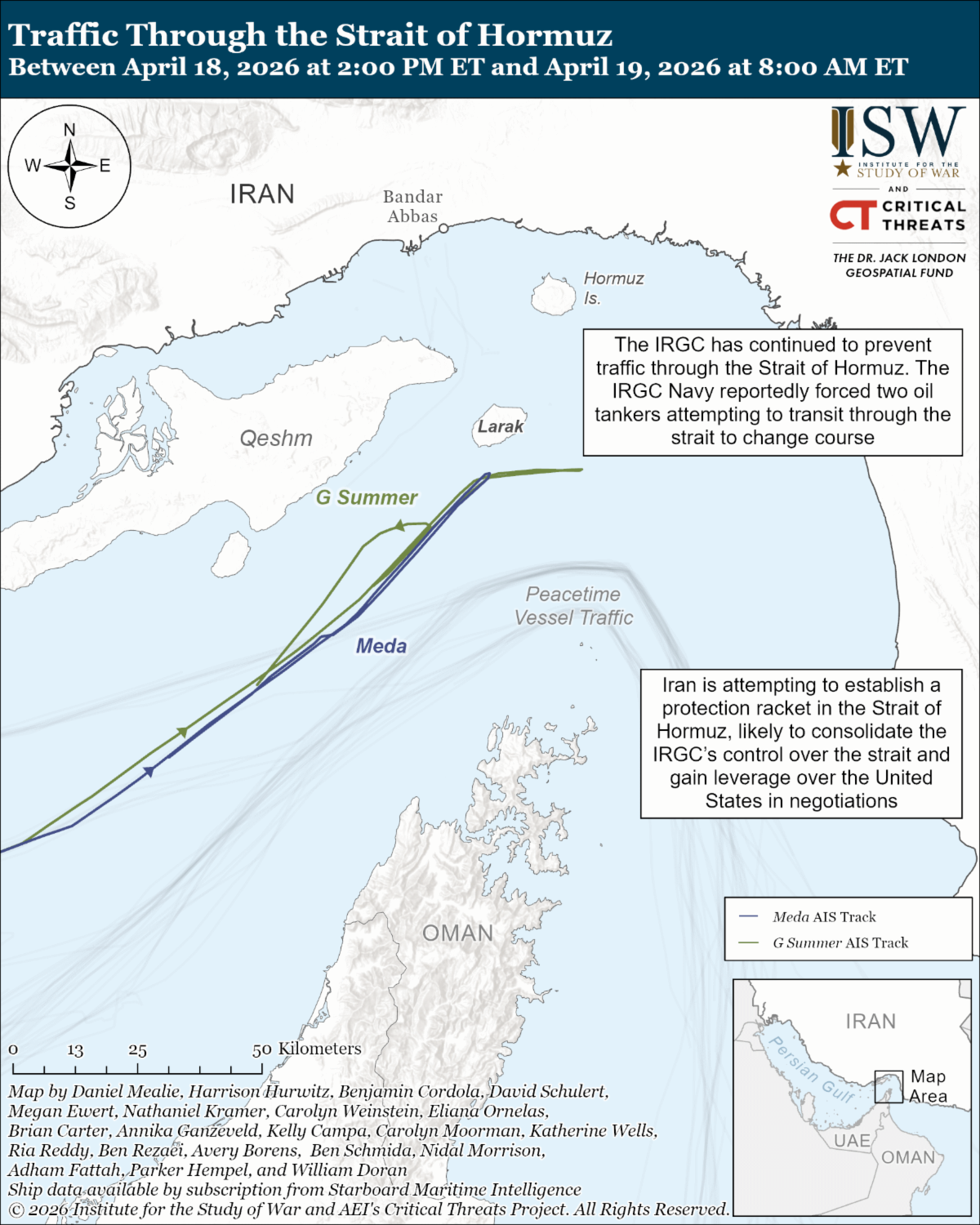
Iran is attempting to establish a protection racket in the Strait of Hormuz by granting priority transit to vessels that pay fees and comply with Islamic Revolutionary Guards Corps (IRGC) protocols as part of its effort to try to consolidate control over the strait. A senior Iranian official told CNN on April 18 that vessels that pay “security fees” and comply with the IRGC’s protocols will receive priority transit through the Strait of Hormuz, while those that refuse to pay will face delayed passage. Iran has reportedly charged vessels around $2 million USD to transit the strait.Extracting fees from commercial vessels enables Iran to earn income amid the United States’ efforts to impose economic pressure on Iran through its blockade of Iranian ports.
The IRGC has also continued to prevent non-Iranian-linked vessels from transiting the strait. Bloomberg reported on April 18 that at least five liquefied natural gas (LNG) tankers reversed course after Iran warned the vessels’ captains that it had closed the Strait of Hormuz. No LNG tankers have exited the Strait of Hormuz since the war began in February. Iranian media separately reported on April 19 that the IRGC forced the Botswana-flagged Meda and the Angola-flagged G Summer to change course after the vessels attempted to cross the Strait of Hormuz. Commercially available shipping data indicates that the G Summer later transited the Strait of Hormuz via the Iranian-approved route on April 19.
|
|
- Any US settlement or resolution of the conflict that enables Iran to control traffic through the Strait of Hormuz would represent a major US defeat and set a precedent with critical implications for global trade, given the strait’s role as a critical energy chokepoint. Any US acceptance of Iran’s ability to regulate transit would undermine the principle of freedom of navigation through the Strait of Hormuz and enable Iran to condition access to the strait on compliance with its demands, thereby enabling Tehran to exert persistent pressure on the global economy and the United States and its allies.
- Iran is attempting to establish a protection racket in the Strait of Hormuz by granting priority transit to vessels that pay fees and comply with Islamic Revolutionary Guards Corps (IRGC) protocols as part of its effort to try to consolidate control over the strait. Iran has also continued to prevent non-Iranian-linked vessels from transiting the strait.
- US forces seized an Iranian-flagged container ship for the first time during the war. Commercially available shipping data indicates that the US Navy also forced at least three Iranian or Iranian-linked ships to change course toward Iranian ports on April 19.
- US Vice President JD Vance, US Special Envoy to the Middle East Steve Witkoff, and Jared Kushner are expected to travel to Islamabad, Pakistan, to engage in negotiations with Iran on April 21. ISW-CTP has not observed any Iranian sources confirming Iran’s participation in the negotiations as of 6:00 PM ET on April 19, however.
- Incomplete reporting about the damage that the US-Israeli combined force inflicted on Iran’s ballistic missile and drone programs precludes the development of a quantitative assessment about the threat that Iranian missiles and drones still pose.
- A statement released by Iranian-backed Iraqi militia Kataib Hezbollah on April 18 appears to confirm that IRGC Quds Force Commander Brigadier General Esmail Ghaani discussed preparations for renewed conflict with the United States and Israel during his meetings with Iraqi militia leaders in Baghdad on April 18. Ghaani may have specifically discussed enhancing coordination between Iraqi militias and other Axis of Resistance groups against the United States, Israel, and the Gulf states in the event of renewed conflict.
|
|
EMAIL SUBSCRIPTION OPTIONS
|
|
|
ISW offers customizable email subscription options. Click below to learn more and customize your preferences.
|
|
|
© 2026 Institute for the Study of War and AEI’s Critical Threats Project. All rights reserved.
Donate online or by sending a check to the Institute for the Study of War at 1400 16th Street NW, Suite #515, Washington, DC 20036. Please consider including the Institute for the Study of War in your estate plans.
ISW is a tax-exempt organization under section 501(c)(3) of the Internal Revenue Code. Donations are tax-deductible to the extent permitted by law.
ISW is a non-partisan, non-profit, public policy research organization. ISW advances an informed understanding of military affairs through reliable research, trusted analysis, and innovative education. We are committed to improving the nation’s ability to execute military operations and respond to emerging threats in order to achieve US strategic objectives.
|
|
|
|
|