[ISW] 이란 업데이트 특별 보고서, 2026년 4월 20일

“`html

핵심 내용 요약

  • 이란 국회의장 모하마드 바게르 갈리바프가 미국과의 협상에 반대하는 이슬람 혁명 수비대(IRGC) 사령관인 아흐마드 바히디 소장 및 다른 고위 정부 관리들과 심각한 내부 논쟁을 벌이는 것으로 보입니다.
  • 현재 바히디가 갈리바프보다 우위를 점하고 있는 것으로 보입니다. 이스라엘 언론 보도에 따르면, 바히디는 최고 지도자 모즈타바 하메네이에게 직접 접근할 수 있는 유일한 이란 관리이며, 주요 결정을 다른 정부 관계자들에게 전달하는 역할을 하고 있습니다.
  • 미국과 이란 대표단은 며칠 안에 파키스탄 이슬라마바드에서 두 번째 회담을 가질 예정입니다. 그러나 미국의 요구와 이란의 요구는 대체로 변함없는 것으로 보입니다.
  • 미 해군은 이란 항구에 대한 봉쇄를 지속적으로 시행하여 봉쇄 시작 이후 27척의 선박이 항로를 변경하도록 지시했습니다. 미군은 해군 봉쇄를 위반하려던 이란 관련 선박 2척을 돌려보낸 것으로 보입니다.
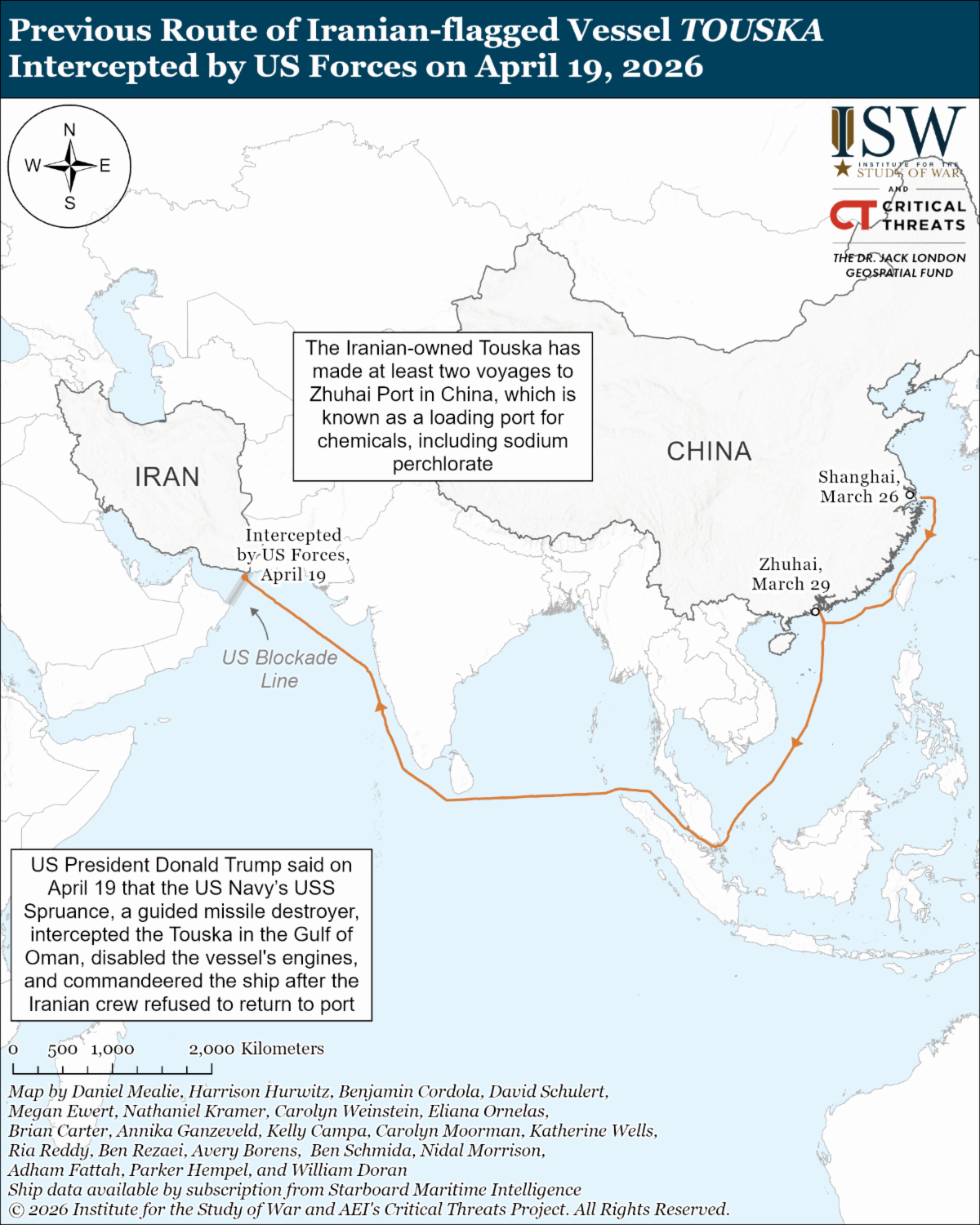
  • 카탐 올 안비아 중앙 본부는 4월 19일 미 해군이 이란 국기 게양 선박인 미국 제재 대상인 투스카를 나포한 것이 미-이란 휴전을 위반했다고 주장했습니다. 익명의 보안 소식통은 로이터 통신에 투스카가 중국에서 이란으로 이중 용도 품목을 운송했을 가능성이 높다고 밝혔습니다.
  • 이란 의회는 호르무즈 해협을 통과하는 이스라엘 관련 선박을 금지하고, “적대 국가” 선박이 해협을 통과하려면 이란 최고 국가 안보 위원회의 승인을 받도록 요구하며, 이란에 “피해를 입힌” 국가가 이란에 배상할 때까지 해협 통과를 금지하는 법안을 마련하여 호르무즈 해협에 대한 이란의 “통제”를 공식화하려고 시도하고 있습니다.

최신 자료 및 관련 링크

아래 링크들은 위에 언급된 내용과 관련된 최신 정보들을 제공합니다. 링크 내용을 확인하여 최신 동향을 파악하십시오.

“`

[원문]

US and Iranian delegations will reportedly meet in Islamabad, Pakistan, for a second round of talks in the coming days.

April 20, 2026

Data Cutoff: 2:00 PM ET

Ben Schmida, Avery Borens, Nidal Morrison, Adham Fattah, Ria Reddy, Katherine Wells, and Annika Ganzeveld

As the Middle East crisis evolves, ISW urgently needs your support.

Help us stay independent and impactful.

TOPLINES

Iranian Parliament Speaker Mohammad Bagher Ghalibaf appears to be engaged in a serious intra-regime debate with Islamic Revolutionary Guards Corps (IRGC) Commander Major General Ahmad Vahidi and other senior regime officials opposed to negotiations with the United States. Ghalibaf publicly defended negotiations on Iranian state television on April 18, arguing that diplomacy with the United States, alongside military power, is necessary to secure Iran’s objectives. Ghalibaf also reportedly criticized hardline officials, including Supreme National Security Council (SNSC) member Saeed Jalili and hardline parliamentarian Amirhossein Sabeti, for their opposition to negotiations during a meeting with advisers, but his criticisms were likely implicitly directed at Vahidi. US officials separately told Axios on April 20 that the US negotiating delegation thought it was “negotiating with the right people“ in Islamabad on April 11 and 12 but that the IRGC effectively told the Iranian negotiating delegation upon their return to Tehran that they ”don’t speak for” the IRGC. Senior regime officials, including former IRGC Intelligence Organization Chief Hossein Taeb, reportedly called the Iranian negotiating delegation back to Tehran after it surpassed its mandate. A second US official told Axios that “we aren’t sure who’s in charge and neither do they.” This report is consistent with CTP-ISW‘s assessment that there is a division between Vahidi and his inner circle and members of Iran‘s negotiating team over Iran’s negotiations policy. This report is also consistent with ISW-CTP’s assessment that Iranian Supreme Leader Mojtaba Khamenei has not played the role of cohering and arbitrating between various factions as his father used to do, which has likely exacerbated intra-regime fighting.

Vahidi appears to have the upper hand over Ghalibaf at the moment. Vahidi is reportedly the only Iranian official with direct access to Supreme Leader Mojtaba Khamenei and is serving as a conduit for relaying key decisions to other regime officials, according to Israeli media on April 19. Israeli media also reported on April 19 that Iranian officials‘ inability to contact Mojtaba is a significant obstacle to continued US-Iran negotiations. Ghalibaf’s push for diplomacy and apparent effort to reach a deal may also be a bid to protect his domestic position and maintain credibility. Ghalibaf reportedly fears that both his and Araghchi’s positions are at risk if the IRGC consolidates control. Ghalibaf’s removal as the parliament speaker would represent a major defeat for Ghalibaf and his domestic positions and signify a victory for Vahidi. These reports are consistent with ISW-CTP’s ongoing assessment that Vahidi and members of his inner circle have likely consolidated control over not only Iran’s military response in the conflict but also Iran’s negotiations policy.

US and Iranian delegations will reportedly meet in Islamabad, Pakistan, for a second round of talks in the coming days. Two US officials speaking to the New York Times on April 20 stated that US Vice President JD Vance will travel to Pakistan on April 21. Two Iranian officials told the New York Times that Iranian Parliament Speaker Mohammad Bagher Ghalibaf, who led the Iranian delegation in the first round of talks, would attend the upcoming talks if Vance attended. US and Iranian demands appear to have largely stayed the same. US officials speaking to the Wall Street Journal stated that the US delegation is pushing for the immediate reopening of the Strait of Hormuz, a pause in Iranian uranium enrichment for at least 20 years, and the removal of Iran’s highly enriched uranium (HEU) stockpile from Iran. The Wall Street Journal reported that Iran’s demands are Iranian ”control” over the strait, the lifting of sanctions on Iran, and a shorter pause in uranium enrichment. US President Donal

KEY TAKEAWAYS

  • Iranian Parliament Speaker Mohammad Bagher Ghalibaf appears to be engaged in a serious intra-regime debate with Islamic Revolutionary Guards Corps (IRGC) Commander Major General Ahmad Vahidi and other senior regime officials opposed to negotiations with the United States.

  • Vahidi appears to have the upper hand over Ghalibaf at the moment. Vahidi is reportedly the only Iranian official with direct access to Supreme Leader Mojtaba Khamenei and is serving as a conduit for relaying key decisions to other regime officials, according to Israeli media on April 19.

  • US and Iranian delegations will reportedly meet in Islamabad, Pakistan, for a second round of talks in the coming days. US and Iranian demands appear to have largely stayed the same, however.

  • The US Navy continued to enforce its blockade of Iranian ports, directing 27 vessels to change course since the start of the blockade. US forces likely forced two Iranian-linked vessels attempting to violate the Navy’s blockade to turn around.

  • The Khatam ol Anbia Central Headquarters claimed that the April 19 seizure of the Iranian-flagged, US-sanctioned Touska by the US Navy violated the US-Iran ceasefire. Unspecified security sources told Reuters that the Touska was likely transporting dual-use items from China to Iran.

  • The Iranian Parliament is attempting to formalize Iranian “control” over the Strait of Hormuz by drafting a bill that would ban Israeli-linked vessels from transiting the Strait of Hormuz, require vessels from “hostile countries” to obtain approval from Iran’s Supreme National Security Council to transit the strait, and bar states that “caused damage” to Iran from transiting the strait until they paid reparations to Iran.

EMAIL SUBSCRIPTION OPTIONS

ISW offers customizable email subscription options. Click below to learn more and customize your preferences.

Website | Jobs | Internships

Follow ISW on social media:

FacebookXYouTube | InstagramLinkedIn | Threads | Bluesky

© 2026 Institute for the Study of War and AEI’s Critical Threats Project. All rights reserved.

Donate online or by sending a check to the Institute for the Study of War at 1400 16th Street NW, Suite #515, Washington, DC 20036. Please consider including the Institute for the Study of War in your estate plans.

ISW is a tax-exempt organization under section 501(c)(3) of the Internal Revenue Code. Donations are tax-deductible to the extent permitted by law.

ISW is a non-partisan, non-profit, public policy research organization. ISW advances an informed understanding of military affairs through reliable research, trusted analysis, and innovative education. We are committed to improving the nation’s ability to execute military operations and respond to emerging threats in order to achieve US strategic objectives.

댓글 달기

이메일 주소는 공개되지 않습니다. 필수 필드는 *로 표시됩니다

위로 스크롤