|
US Forces Korea (USFK) may become central to US efforts to mobilize allied defense industrial bases (DIB) for US operational efficiency in the Indo-Pacific. The USFK proposed a plan that would clarify South Korea’s operational role in a potential Taiwan contingency. USFK Commander Xavier Brunson proposed establishing South Korea as a Regional Sustainment Hub (RSH) on April 22. The concept builds on the US Department of Defense’s 2024 “Regional Sustainment Framework,” which aims to reduce time and cost by conducting maintenance, repair, and overhaul (MRO) in allied countries rather than returning assets to the United States. South Korea already conducts maintenance of certain US aircraft. Establishing South Korea as an RSH would expand current maintenance efforts to include warships, missile systems, and drones. The US’s ability to conduct MRO in South Korea’s forward-deployed hubs may improve the response capabilities and logistical efficiency of US forces during a Taiwan contingency. The US’s 2026 National Defense Strategy (NDS) proposed enabling US allies to take primary responsibility for their own defense while prioritizing deterrence against the People’s Republic of China (PRC) in the Indo-Pacific. US Under Secretary of Defense for Policy Elbridge Colby previously stated the need to reorient the USFK to better address broader regional threats, including the PRC. The South Korean Lee Jae Myung administration proposed transferring wartime operational control (OPCON) from the United States to South Korea, increasing South Korea’s defense budget to 3.5 percent of GDP, and developing an indigenous nuclear-powered attack submarine (SSN) to showcase its commitments to its defense following the NDS’s release.
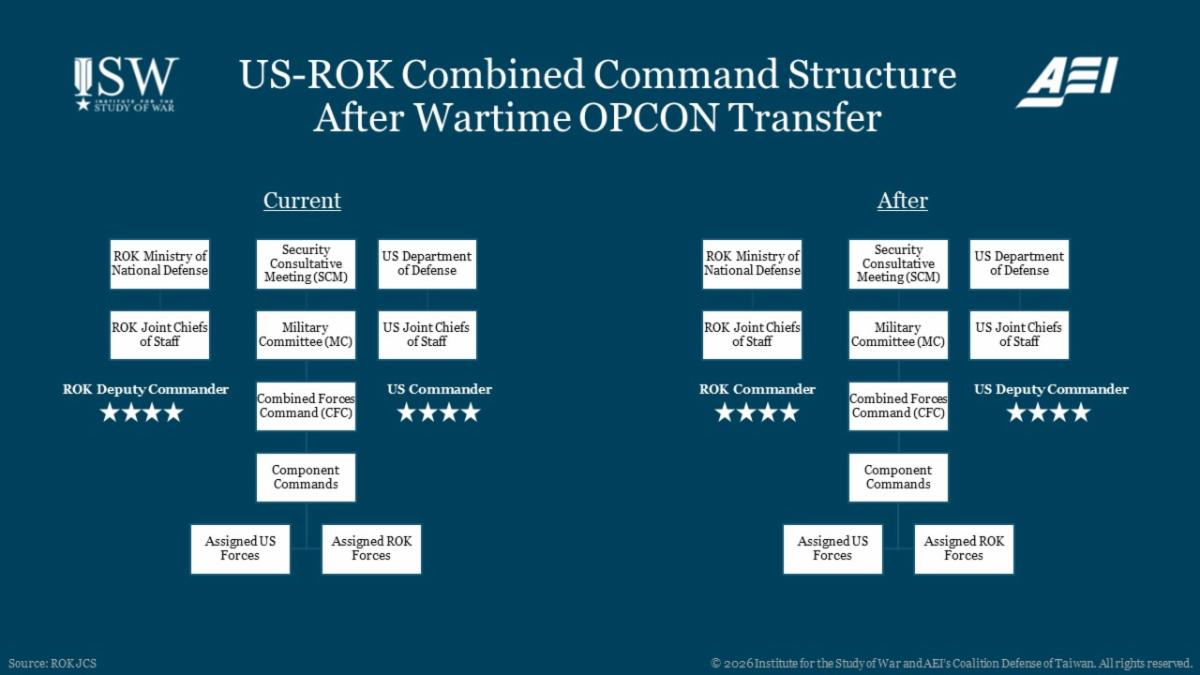
The Lee administration’s response to the NDS may suggest a willingness for South Korea to assume a broader role in deterring the PRC, aligned with US alliance expectations in the Indo-Pacific. A completed OPCON transfer would position South Korea to lead combined defense operations on the Korean Peninsula. Lee has argued that South Korea’s diesel-electric submarine fleet lacks the endurance to track North Korean and PRC submarines, suggesting that South Korea would use SSNs to counter PRC submarine activities. The establishment of South Korea as an RSH would likely require the Lee administration to adopt a more assertive stance regarding South Korea’s operational role in a potential Taiwan contingency. South Korea has maintained strategic ambiguity regarding cross-Strait issues, likely due to the PRC’s significance to South Korea’s economy. The PRC imposed economic pressure on South Korea following South Korea’s 2017 deployment of the United States-provided Terminal High Altitude Area Defense (THAAD) system. The PRC may again use economic pressure to deter South Korea from cooperating with the US plan.
The United States and South Korea appear aligned on accelerating the transfer of wartime OPCON from the United States to South Korea by 2029. USFK Commander General Xavier Brunson stated on April 22 that USFK submitted a roadmap to the Pentagon detailing the requirements South Korea must meet to transfer wartime OPCON by the second quarter of the 2029 fiscal year. Brunson said the OPCON timeline is in a “good position,” given South Korea’s continued investments in defense, while also acknowledging the need for South Korea to invest more in its defense industry to accelerate the acquisition of systems needed for the OPCON transfer. South Korea’s Ministry of National Defense (MND) said the defense ministers of South Korea and the United States would finalize the transfer timeline at the annual Security Consultative Meeting (SCM) in October 2026, before submitting the plan to the presidents of both countries. The Lee Jae Myung administration proposed completing the OPCON transition by 2030, and US President Donald Trump agreed to support the transition in a joint fact sheet published on November 14.
|