[ISW] 이란 업데이트 특별 보고서, 2026년 5월 7일

“`html

주요 내용 요약:

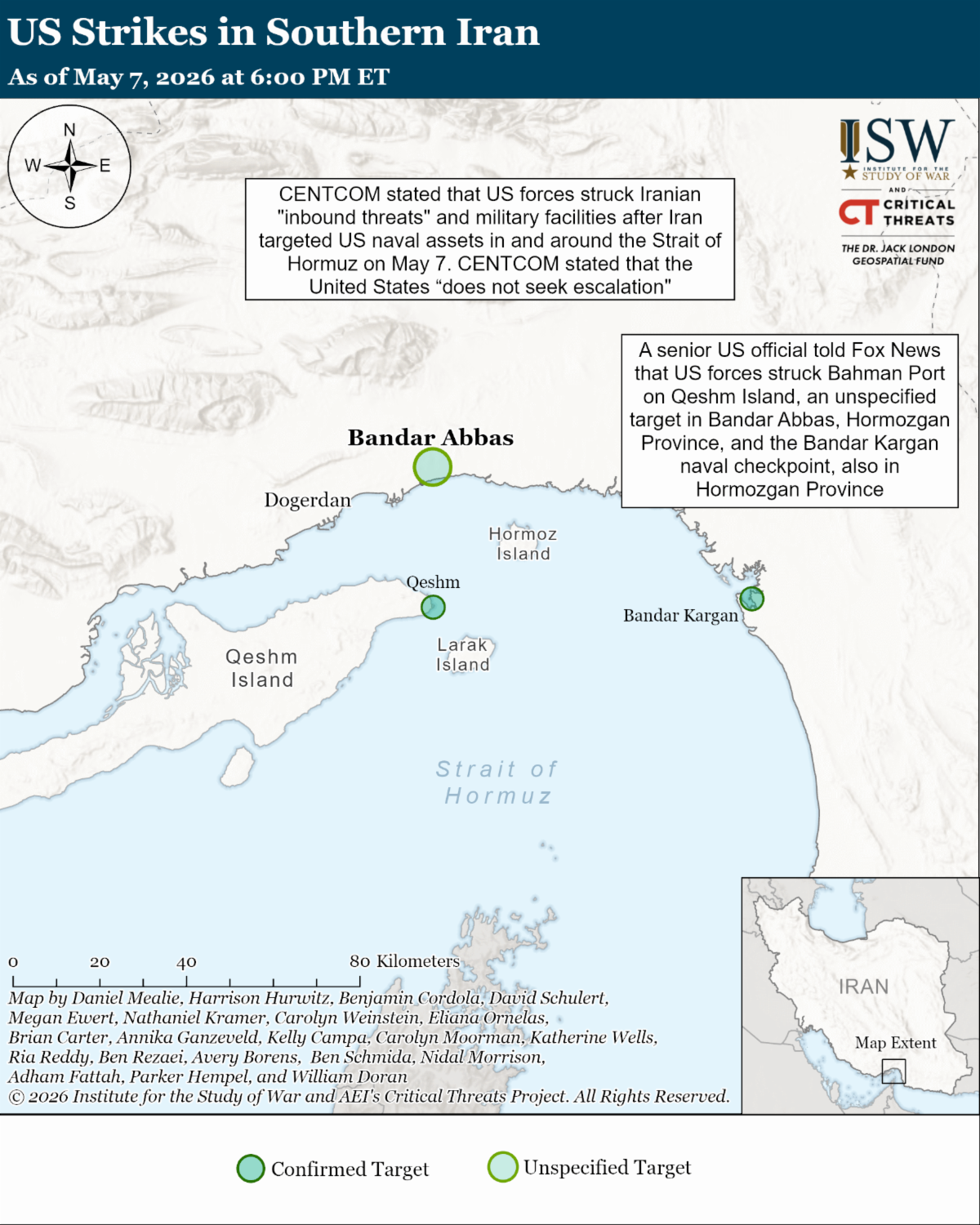
  • 5월 7일, 미국 중부 사령부 (CENTCOM)는 미국 해군 자산을 공격한 이란에 대응하여, 미국군은 “침입하는 위협을 제거”하고 호르무즈 해협 주변에서 미국 군대에 대한 공격의 책임을 지는 이란 군사 시설을 타격했다고 발표했습니다. CENTCOM은 미국이 “확전을 추구하지 않는다”고 밝혔습니다.
  • 미국과 이란은 핵심 현안, 특히 이란의 핵 프로그램 및 호르무즈 해협에 대한 이란의 주권 행사 노력과 관련하여 여전히 의견 차이를 보이고 있습니다. 이란의 고농축 우라늄 (HEU) 비축량과 농축 활동은 합의의 주요 장애물 중 일부입니다.
  • 이란은 미국의 이익에 매우 해로운 방식으로 지역 및 글로벌 해상 규범을 근본적으로 재편하는 방식으로 호르무즈 해협에 대한 주권을 공식적으로 인정받으려고 시도하고 있습니다.
  • 이란 정권 언론은 이란 최고 지도자 모즈타바 하메네이와 대통령 마수드 페제시키안의 회담을 강조하여 정권 내 분열에 대한 보도 속에서 단결을 과시하려 했습니다. 페제시키안은 모즈타바에게 IRGC (이란 혁명수비대)의 UAE 공격을 중단하고 재발을 막아달라고 요청하기 위해 긴급 회동을 요청한 것으로 알려졌습니다. 이란 언론과 모즈타바의 사무실이 모즈타바와 페제시키안이 무엇을 논의했는지에 대한 세부 사항을 제공하지 않았다는 사실은 페제시키안이 모즈타바에게 정권의 현재 정책을 변경하도록 설득하지 못했음을 시사합니다.

관련 최신 자료 및 링크:

주의: 링크의 내용은 상황에 따라 변경될 수 있으므로, 최신 정보를 확인하시기 바랍니다. 위의 링크들은 현재 시점에서 내용을 제대로 포함하고 있는 것으로 확인되었습니다.

“`

[원문]

CENTCOM announced on May 7 that US forces “eliminated inbound threats” and struck Iranian military facilities

May 7, 2026

Data Cutoff: 6:00 PM ET

Ben Rezaei, Adham Fattah, Parker Hempel, Will Doran, Ben Schmida, Katherine Wells, Avery Borens, Ria Reddy and Annika Ganzeveld

As the Middle East crisis evolves, ISW urgently needs your support.

Help us stay independent and impactful.

TOPLINES

US Central Command (CENTCOM) announced on May 7 that US forces “eliminated inbound threats” and struck Iranian military facilities responsible for attacks on US forces after Iran targeted US naval assets in and around the Strait of Hormuz. CENTCOM stated that the United States “does not seek escalation.” CENTCOM reported that Iranian forces launched multiple missiles, drones, and fast attack craft at US naval assets, including the USS Truxtun, USS Rafael Peralta, and USS Mason, while the vessels were transiting the strait. CENTCOM confirmed that the munitions did not hit any US assets. US forces subsequently struck Iranian military targets responsible for the attacks, including missile and drone launch sites, command-and-control centers, and intelligence, surveillance, and reconnaissance sites. A senior US official told Fox News that US forces struck Bahman Port on Qeshm Island, an unspecified target in Bandar Abbas, Hormozgan Province, and the Bandar Kargan naval checkpoint, also in Hormozgan Province. The official added that the strikes do not indicate a resumption of the war.

Iranian media claimed that Iran fired missiles at US warships south of Chabahar Port after US forces targeted two Iranian vessels near Jask, Hormozgan Province, and Fujairah Port in the United Arab Emirates (UAE). Khatam ol Anbia Central Headquarters Spokesperson Ebrahim Zolfaghari warned Emirati civilians to “stay away from oil and military centers” following the attacks. The recent strikes follow a series of Iranian attacks against the UAE on May 4 and 5, including a strike on the Fujairah Petroleum Industrial Zone, a key port that the UAE uses to bypass the strait. ISW-CTP will continue to monitor this situation and provide further analysis in its May 8 morning thread on X.

The United States and Iran remain divided over key issues, particularly issues related to Iran’s nuclear program and Iranian efforts to assert sovereignty over the Strait of Hormuz. The Wall Street Journal, citing senior US officials, reported on May 6 that the US Government has seven main demands. These demands include the dismantlement of Fordow, the Esfahan Nuclear Technology Center, and Natanz, a ban on underground nuclear activities, on-demand inspections, a 20-year moratorium on enrichment, an Iranian commitment not to seek a nuclear weapon, the removal of all enriched nuclear material from Iran, and the reopening of the Strait of Hormuz. Iranian officials continue to reject many of these demands, however. Parliamentary National Security and Foreign Policy Commission Vice Chairman Behnam Saeedi stated on May 7 that Iran’s red lines include enrichment, the Strait of Hormuz, complete sanctions relief, and the release of frozen Iranian assets. Saeedi added that negotiations will fail if the United States does not accept Iran’s “right” to enrichment. Unspecified individuals familiar with the matter told the Wall Street Journal on May 6 that key issues, including the length of any enrichment moratorium, the possible removal of Iran’s HEU from Iran, and Iran’s assertion of sovereignty over the Strait of Hormuz, “remain unresolved and are expected to complicate any talks.”

KEY TAKEAWAYS

  • US Central Command (CENTCOM) announced on May 7 that US forces “eliminated inbound threats” and struck Iranian military facilities responsible for attacks on US forces after Iran targeted US naval assets in and around the Strait of Hormuz. CENTCOM stated that the United States “does not seek escalation.”

  • The United States and Iran remain divided over key issues, particularly issues related to Iran’s nuclear program and Iranian efforts to assert sovereignty over the Strait of Hormuz. Iran’s highly enriched uranium (HEU) stockpile and enrichment activities are some of the main obstacles to a deal.

  • Iran is increasingly attempting to formalize recognition of its sovereignty over the Strait of Hormuz in a way that would fundamentally remake regional and global maritime norms in a manner extremely detrimental to US interests.

  • Iranian regime media highlighted a meeting between Iranian Supreme Leader Mojtaba Khamenei and President Masoud Pezeshkian, likely to display unity amid reports of divisions within the regime. Pezeshkian reportedly sought an emergency meeting with Mojtaba to ask him to stop the IRGC’s attacks on the UAE and to prevent their reoccurrence. The fact that Iranian media and Mojtaba’s office have not provided details about what Mojtaba and Pezeshkian discussed suggests that Pezeshkian did not convince Mojtaba to alter the regime’s current policies.

EMAIL SUBSCRIPTION OPTIONS

ISW offers customizable email subscription options. Click below to learn more and customize your preferences.

Website | Jobs | Internships

Follow ISW on social media:

FacebookXYouTube | InstagramLinkedIn | Threads | Bluesky

© 2026 Institute for the Study of War and AEI’s Critical Threats Project. All rights reserved.

Donate online or by sending a check to the Institute for the Study of War at 1400 16th Street NW, Suite #515, Washington, DC 20036. Please consider including the Institute for the Study of War in your estate plans.

ISW is a tax-exempt organization under section 501(c)(3) of the Internal Revenue Code. Donations are tax-deductible to the extent permitted by law.

ISW is a non-partisan, non-profit, public policy research organization. ISW advances an informed understanding of military affairs through reliable research, trusted analysis, and innovative education. We are committed to improving the nation’s ability to execute military operations and respond to emerging threats in order to achieve US strategic objectives.

댓글 달기

이메일 주소는 공개되지 않습니다. 필수 필드는 *로 표시됩니다

위로 스크롤