[ISW] 러시아 공세 작전 평가, 2026년 5월 9일

“`html

핵심 내용 요약:

  • 러시아와 우크라이나 군대는 5월 9일에서 11일 휴전 기간 동안 제한적인 공세 작전을 지속했습니다.
  • 러시아군은 휴전 기간을 활용하여 전역에서 병력 교대, 증원, 재배치 및 물류 지원을 수행했으며, 이는 곧 있을 공세 작전을 지원하기 위한 것으로 보입니다.
  • 러시아와 우크라이나는 5월 9일 현재, 합의된 포로 교환(각 1,000명)을 아직 실시하지 않았습니다.
  • 우크라이나의 전장 성공은 러시아군이 전역에서 상당한 진전을 이루는 것을 막았으며, 블라디미르 푸틴 러시아 대통령에게 승전 기념일에 축하할 만한 상당한 작전적 성공을 빼앗았습니다.
  • 러시아의 우크라이나 전쟁은 푸틴으로 하여금 수도를 포함한 후방 깊숙한 지역을 우크라이나 드론으로부터 확실하게 방어할 수 없게 되면서, 이전 해보다 훨씬 작은 규모로 승전 기념일 열병식을 개최하도록 강요했습니다.
  • 푸틴은 우크라이나의 공격 위협에도 불구하고 승전 기념일 열병식을 강행하는 것으로 보아, 현재 전장의 현실을 받아들이기를 거부하고 있습니다.
  • 푸틴은 승전 기념일을 통해 우크라이나 전쟁을 현 세대 러시아인에게 제2차 세계 대전에서 소련의 역할과 동등한 것으로 자리매김했습니다.
  • 러시아군은 계속해서 증가하는 사상자 수를 겪고 있습니다.
  • 우크라이나군은 최근 하르키우주 북부와 보로바 방향에서 진격했습니다.

최신 정보 및 관련 자료:

다음은 본 요약과 관련된 최신 정보와 자료를 제공하는 링크입니다. (링크는 자료의 최신성을 보장하지 않으며, 각 링크의 내용을 직접 확인하시기 바랍니다.)

  • ISW (Institute for the Study of War) 보고서: 본 요약은 ISW의 분석을 기반으로 작성되었을 가능성이 높습니다. ISW 웹사이트에서 우크라이나 전쟁 관련 최신 보고서를 찾아보세요. (https://www.understandingwar.org/)
  • 뉴스 기사: 로이터, AP 통신, BBC, CNN 등 주요 외신에서 우크라이나 전쟁 관련 최신 뉴스 기사를 검색해 보세요. 특히 5월 9일 전후의 전황과 관련하여 관련 기사를 찾아볼 수 있습니다.
  • 우크라이나 국방부 공식 발표: 우크라이나 국방부의 공식 발표를 통해 최신 전황 정보를 확인할 수 있습니다. (https://www.mil.gov.ua/en/) (영문)
  • 러시아 국방부 공식 발표: 러시아 국방부의 공식 발표를 통해 러시아 측의 입장을 확인할 수 있습니다. (러시아어)

주의사항: 전쟁 상황은 유동적이므로, 위에 제시된 정보는 현재 상황과 다를 수 있습니다. 제공된 링크의 내용을 직접 확인하고, 다양한 출처를 통해 정보를 얻어 객관적인 시각을 유지하는 것이 중요합니다.

“`

[원문]

Russian and Ukrainian forces continued limited offensive operations across the theater throughout the first day of the May 9 – 11 ceasefire.

May 9, 2026

Data Cutoff: 8:45 PM ET

Jennie Olmsted, Jakub Kostka, Justin Young, Anna Thacker, and George Barros

TOPLINES

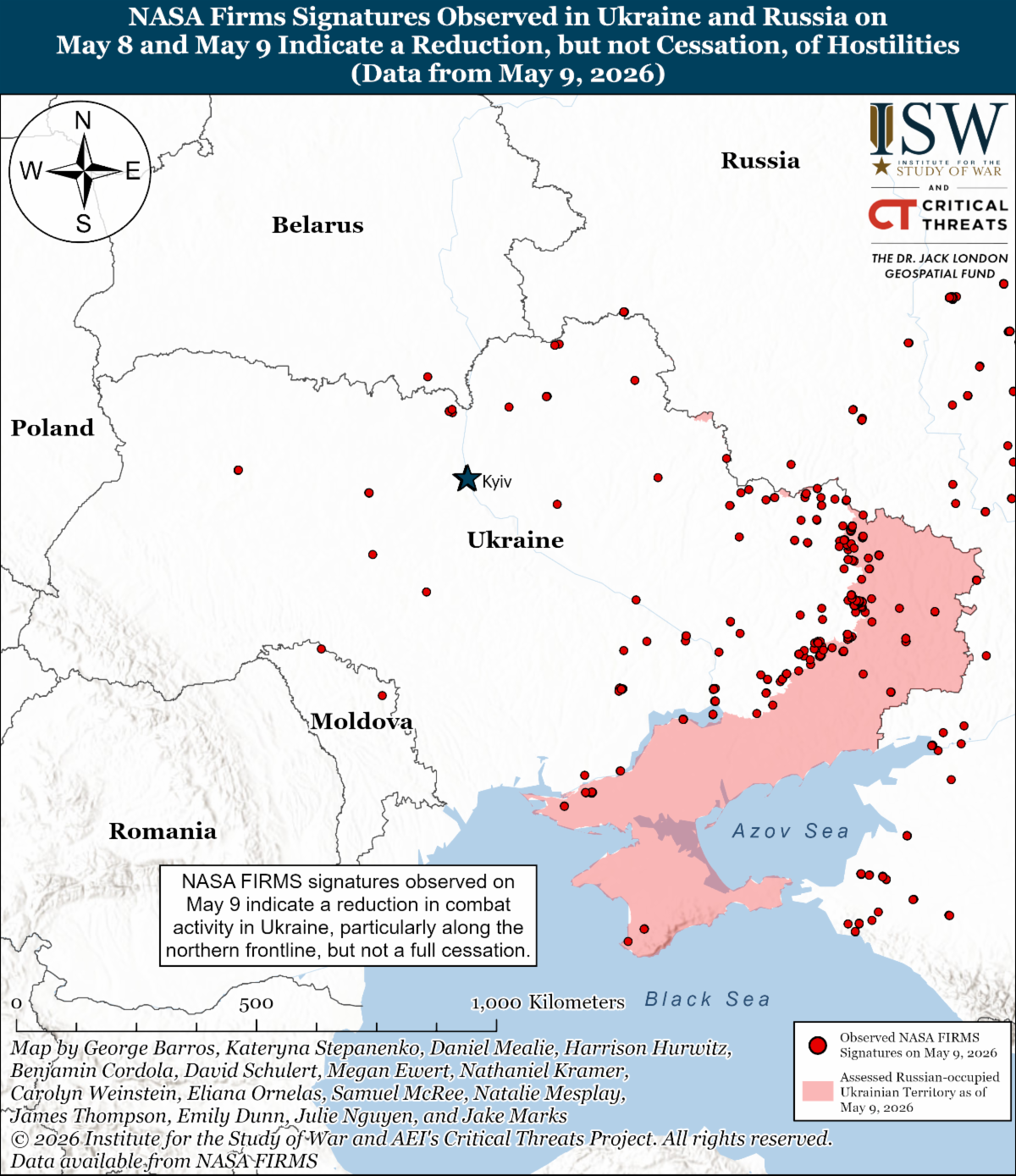
Russian and Ukrainian forces continued limited offensive operations across the theater throughout the first day of the May 9 – 11 ceasefire. Both Ukrainian and Russian officials issued competing accusations that the other side violated the ceasefire on May 9. The Ukrainian General Staff reported on May 9 that there were 51 combat engagements after the ceasefire went into effect. Ukrainian officials reported that Russian drones struck residential infrastructure in Kharkiv and Kherson oblasts during the day on May 9. The Russian Ministry of Defense (MoD) accused Ukraine of violating the ceasefire 8,970 times, including launching 12 ground attacks, 1,173 artillery, MLRS, and mortar strikes, and 7,151 drone strikes. The Ukrainian Air Force reported on May 9 that Russian forces launched one Iskander-M missile and 43 Shahed, Gerbera, Italmas, and Parodyia drones against Ukraine after 1800 on May 8, but it is unclear whether these strikes took place before or after the ceasefire went into effect at midnight on May 9. Observed National Aeronautics and Space Administration Fire Information for Resource Management System (NASA FIRMS) signatures from May 8 and 9 and Ukrainian and Russian reporting indicate that there was a reduction in hostilities across the theater, particularly in northern Ukraine, but not a cessation of hostilities. Russian and Ukrainian sources reported that the overall operational tempo across certain areas of the frontline decreased despite persistent tactical combat missions that violated the ceasefire.

Russian forces used the ceasefire to conduct rotations, reinforcements, redeployments, and logistics throughout the theater, likely to support imminent future offensive operations. Ukrainian military sources reported on May 9 that Russian forces used the ceasefire for regrouping, rotations, logistics, and position fortification in the Kupyansk, Lyman, and Slovyansk directions and in northern Kharkiv Oblast. The Ukrainian 7th Rapid Reaction Corps of the Air Assault Forces reported on May 9 that Ukrainian forces observed redeployed elements of the 90th Tank Division (41st Combined Arms Army [CAA], Central Military District [CMD]) operating in the Pokrovsk direction. ISW first observed reports on May 4 that the 90th Tank Division had redeployed from the Oleksandrivka and Novopavlivka directions, and the reduction of tempo on May 9 may have supported the division’s redeployment. The 7th Corps noted that the Russian military command has recently begun establishing command posts in Myrnohrad (east of Pokrovsk) to support Russian attacks toward Rodynske (north of Myrnohrad). A source reporting on the Russian Western Grouping of Forces claimed on May 9 that the ceasefire is allowing Russian forces to advance and consolidate positions northwest of Lyman in areas where Ukrainian drone activity has previously prevented Russian forces from fortifying these positions. Russian forces have repeatedly used ceasefires to regroup, conduct rotations, and improve logistics along the frontline. Russian forces will likely continue to take advantage of any reduction in operational tempo on May 10 and 11 to further regroup and reinforce positions as to resume reinvigorated offensive operations once the ceasefire period ends.

KEY TAKEAWAYS

  • Russian and Ukrainian forces continued limited offensive operations across the theater throughout the first day of the May 9 – 11 ceasefire.

  • Russian forces used the ceasefire to conduct rotations, reinforcements, redeployments, and logistics throughout the theater, likely to support imminent future offensive operations.

  • Russia and Ukraine have not yet conducted the reportedly agreed to prisoner-of-war (POW) swap of 1,000 prisoners each as of May 9.

  • Ukrainian defense successes on the battlefield have prevented Russian forces from making significant advances across the theater, depriving Russian President Vladimir Putin of any significant operational successes to celebrate on Victory Day.

  • Russia’s war in Ukraine forced Putin to hold his Victory Day parade on a much smaller scale than in previous years, as Putin cannot reliably defend deep rear areas, including the capital, from Ukrainian drones.

  • Putin’s insistence on holding the Victory Day parade despite the threat of Ukrainian strikes reflects Putin’s refusal to accept the realities of the current battlespace.

  • Putin used Victory Day to position the war in Ukraine as this generation of Russians’ equivalent to the Soviet Union’s role in World War II.

  • Russian forces continue to suffer increasing casualty rates.


  • Ukrainian forces recently advanced in northern Kharkiv Oblast and in the Borova direction.

EMAIL SUBSCRIPTION OPTIONS

ISW offers customizable email subscription options. Click below to learn more and customize your preferences.

ISW is powered by the support of individuals like you.

Help us stay independent and impactful.

Website | Jobs | Internships

Follow ISW on social media:

FacebookXYouTube | InstagramLinkedIn | Threads | Bluesky

© 2026 Institute for the Study of War and AEI’s Critical Threats Project. All rights reserved.

Donate online or by sending a check to the Institute for the Study of War at 1400 16th Street NW, Suite #515, Washington, DC 20036. Please consider including the Institute for the Study of War in your estate plans.


ISW is a tax-exempt organization under section 501(c)(3) of the Internal Revenue Code. Donations are tax-deductible to the extent permitted by law.

ISW is a non-partisan, non-profit, public policy research organization. ISW advances an informed understanding of military affairs through reliable research, trusted analysis, and innovative education. We are committed to improving the nation’s ability to execute military operations and respond to emerging threats in order to achieve US strategic objectives.

댓글 달기

이메일 주소는 공개되지 않습니다. 필수 필드는 *로 표시됩니다

위로 스크롤