|
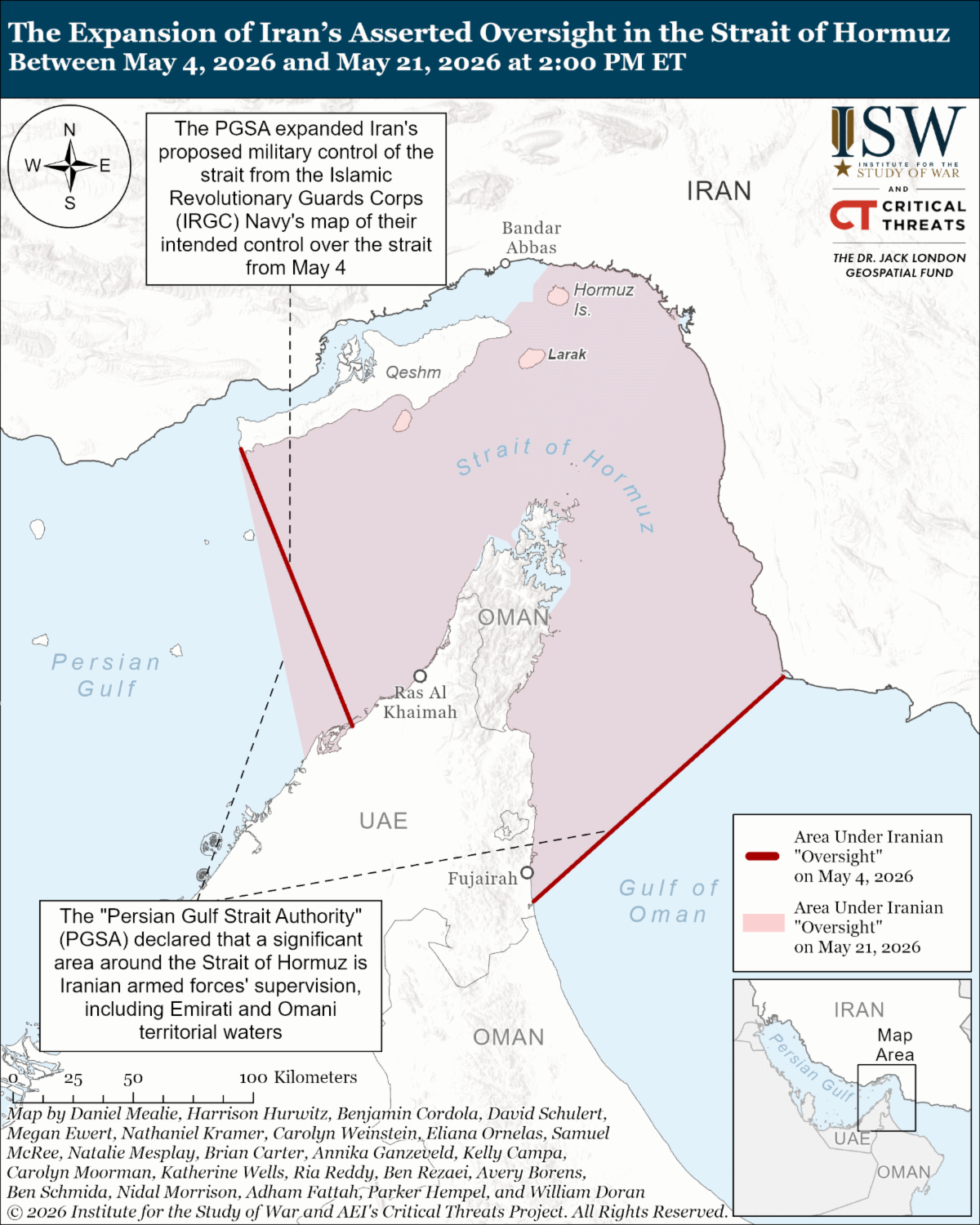
Iran has not submitted a response to the latest US proposal as multiple mediators continue efforts to narrow gaps between the United States and Iran. Both US and Iranian officials said on May 21 that nuclear weapons and the Strait of Hormuz remain the two “sticking points” on negotiations. Axios reported on May 20 that Pakistan and Qatar drafted a revised memo to bridge US-Iran gaps, while other mediators, including Saudi Arabia, Turkey, and Egypt, have supported the effort. Iranian media reported on May 21 that Iran is still reviewing the proposal and has not yet responded. Iranian media added that Iran is discussing the Iranian text’s overarching framework, some details, and confidence-building measures as guarantees. It stated that the text has narrowed some gaps “to some extent,” but that further progress depends on whether the United States moves away from military threats.
Iranian officials appear divided over potential nuclear concessions, especially whether Iran should send its highly enriched uranium (HEU) stockpile abroad. Two unspecified senior Iranian sources told Reuters on May 21 that Iranian Supreme Leader Mojtaba Khamenei issued a directive that Iran’s HEU should remain inside Iran. The sources added that top Iranian officials believe that sending the HEU stockpile abroad would leave Iran more vulnerable to future US and Israeli attacks. An unspecified US official and another unspecified senior Iranian official denied the existence of a directive from Mojtaba on May 21, however. The senior Iranian official confirmed that Iran’s consistent position is to down-blend the stockpile inside Iran, however. Iranian Foreign Affairs Ministry Spokesperson Esmail Baghaei stated on May 21 that the negotiations focus on ending the war on all fronts, including in Lebanon, “at this stage,” and that media claims about nuclear issues, including enriched materials or enrichment, “are merely media speculation and lack credibility.”
The reporting does not clarify the seniority of the Iranian leakers or clarify their motives, but the leaks about the alleged directive from Mojtaba and subsequent denials suggest disagreement within the Iranian regime over nuclear concessions. Top US officials, including Vice President JD Vance and Secretary of State Marco Rubio, have highlighted the “fractures” in the regime in recent days and have noted that these fractures are causing challenges as negotiations continue. ISW-CTP continues to assess that Islamic Revolutionary Guards Corps (IRGC) Commander Major General Ahmad Vahidi plays a dominant role in policy formation. Vahidi and those around him reportedly previously opposed discussions over the nuclear issue, while the Iranian negotiating team led by Mohammad Bagher Ghalibaf and Iranian Foreign Affairs Minister Abbas Araghchi discussed the nuclear issue during the first round of US-Iran talks in Islamabad. The Associated Press also noted that Ghalibaf and Araghchi faced “criticism” for showing too much willingness to make concessions in Islamabad. Ghalibaf and Araghchi reportedly discussed the nuclear issue “contrary to instructions from Tehran.” Such instructions, ISW-CTP noted at the time, could have only come from Vahidi or the supreme leader. The leaks and denials about Mojtaba’s directive on May 21 are emblematic of this debate, which has been playing out since April.
|