|
Iran and the United States have not bridged key differences on all the major demands in the US-Iran talks. Iranian officials said that they are unwilling to discuss their nuclear program on May 25, and Iranian regime media on May 25 insisted that the United States observe Iran’s right to enrich uranium on Iranian territory. Mediators and US officials added that the United States will not provide economic relief to Iran without serious commitments from Iran on its nuclear program. This represents a major impasse in talks because Iran refuses to discuss its nuclear program without economic relief. US President Donald Trump stated on Truth Social on May 26 that Iran’s highly enriched uranium (HEU) must be “immediately turned over” to the United States or else destroyed where it is within Iran or at another “acceptable location” with verification. The two sides remain far apart on the Strait of Hormuz, as well, which is discussed in greater detail below.
Granting Iran economic relief by unfreezing funds or removing sanctions would likely decrease Iranian military reconstitution timelines. Iran reportedly demanded that the US immediately release the first half of frozen Iranian assets upon signing the agreement and the second half of the assets within 60 days, according to Islamic Revolutionary Guards Corps (IRGC) media on May 26. The exact amount of these assets is unclear. The Iranian Foreign Affairs Ministry spokesperson explicitly said that Iran would use its unfrozen assets to reconstitute and improve the ballistic missile and drone programs. Iranian officials have also called for the United States to lift the US Navy blockade and sanctions on oil as part of the deal for at least 30 to 60 days. Detailed reconstitution timelines do not exist in the open-source, and intelligence leaks about these timelines are impossible to judge on their own merits due to the lack of context provided in leaks. ISW-CTP has previously assessed that Iran would likely need a longer period of time to reconstitute its missile program than it did after the June 2025 strikes because the combined force struck many more production targets than Israel did in June 2025. This relative assessment — as well as any more detailed assessment — relies on various assumptions about the amount of funds Iran can put towards reconstitution and rebuilding of its military forces, among other factors. Unfreezing funds or dropping sanctions gives Iran relatively more funds to put towards reconstitution.
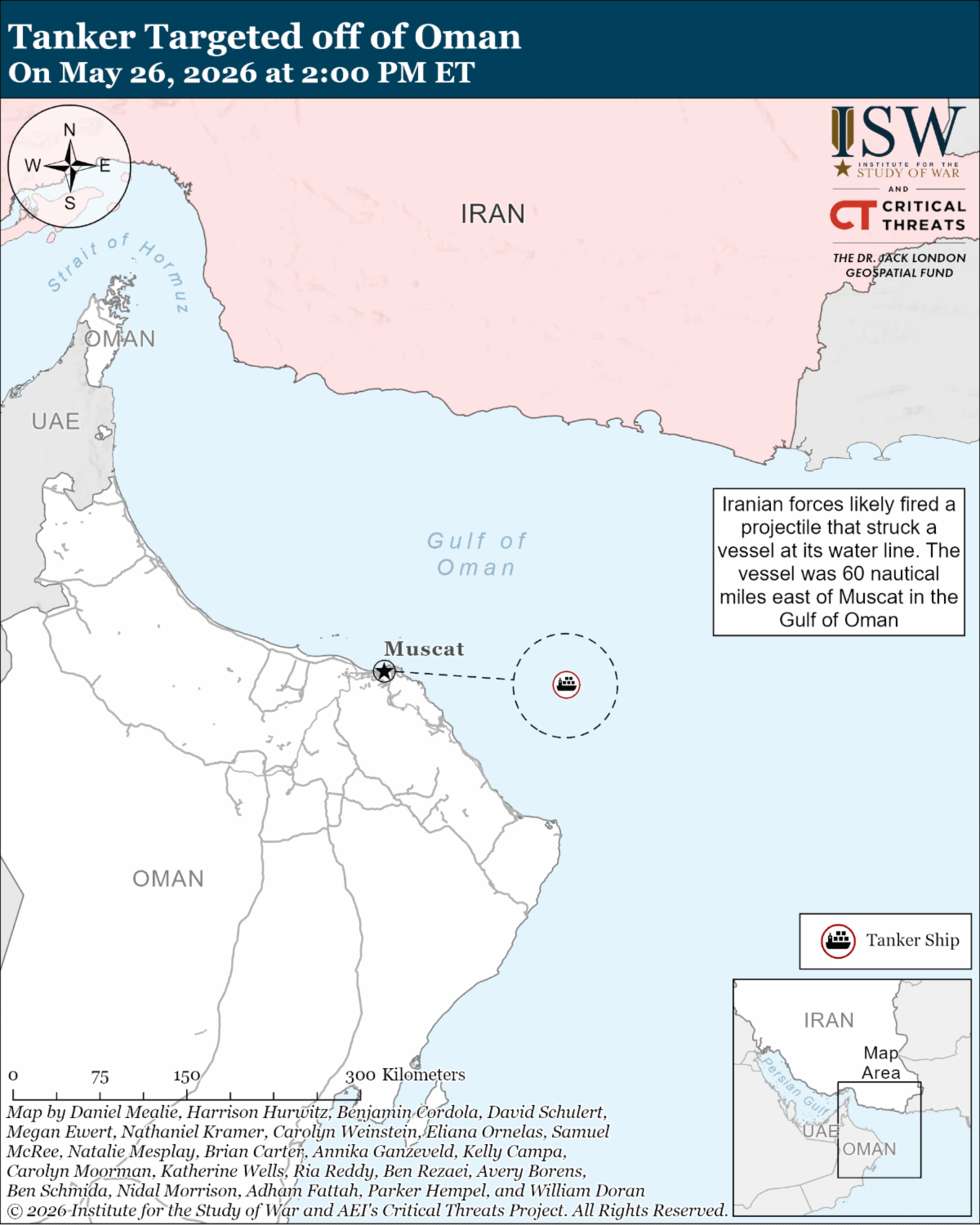
Iran is also refusing to reopen the Strait of Hormuz and using force to ensure the recognized traffic separation scheme remains closed. Iranian officials continue to state Iran will only re-open the strait to civilian ships under “Iranian arrangements,” and Supreme Leader Mojtaba Khamenei’s guidance to the Iranian government on May 25 said Iran must leverage the strait for economic gain. This position directly contradicts the US position on freedom of navigation, because freedom of navigation through an international waterway has no ”arrangements” imposed by another state. Iran has forced vessels to proceed through the strait using its territorial waters and an illegitimate (but unmined) traffic separation scheme by mining the recognized traffic separation scheme (which is in an international waterway) and threatening to fire at any vessel that uses it.
|