|
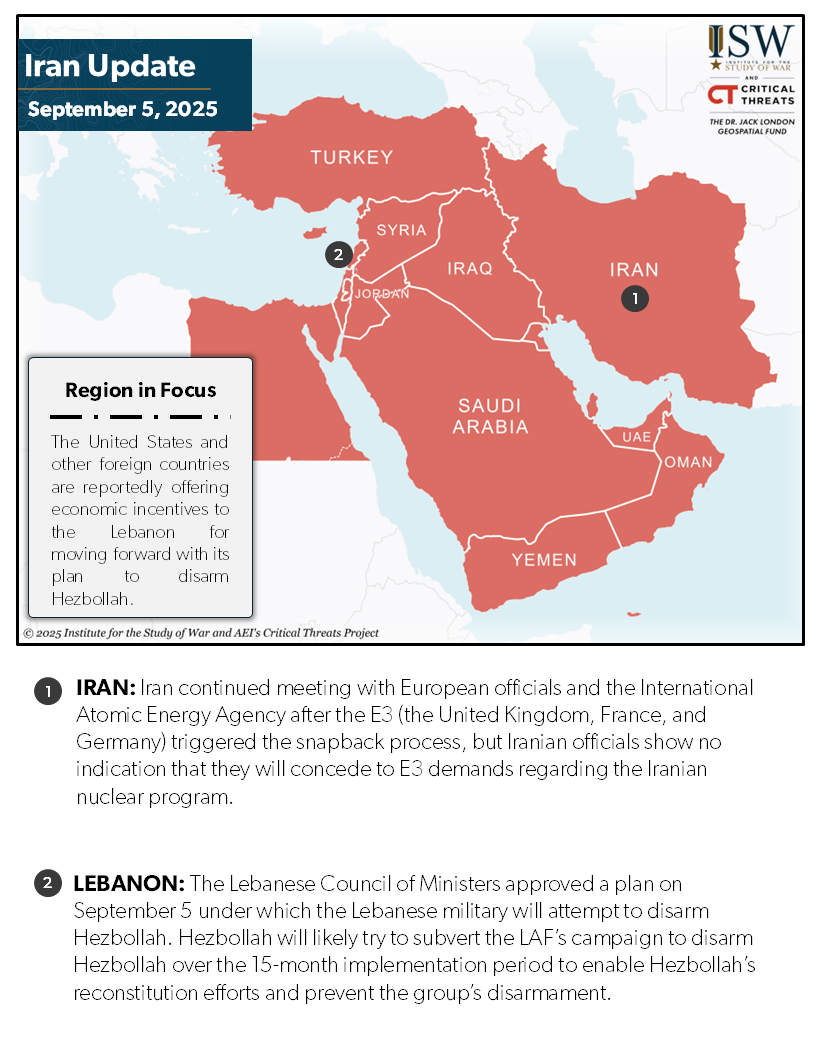
Iran continued meeting with European officials and the International Atomic Energy Agency (IAEA) after the E3 (the United Kingdom, France, and Germany) triggered the snapback process, but Iranian officials show no indication that they will concede to E3 demands regarding the Iranian nuclear program. The E3 triggered the 30-day snapback process to reimpose UN Security Council sanctions on Iran on August 28. The E3 previously told Iran that they would delay the reimposition of UN sanctions by up to six months if Iran met three key conditions, which include restoring the IAEA’s access to Iranian nuclear facilities, addressing concerns about Iran’s stockpile of enriched uranium, and engaging in direct talks with the United States. Foreign Affairs Minister Abbas Araghchi met with European Union Foreign Policy Chief Kaja Kallas on September 4 in Qatar to discuss Iran’s stockpile of highly enriched uranium (HEU) and the resumption of IAEA access to Iran’s nuclear sites. A Wall Street Journal reporter stated on September 4 that the talks produced no progress, and neither side shifted its stance during the talks. Iran and the IAEA are expected to meet in Vienna on September 5. Iranian Ambassador to the United Nations (UN) in Vienna, Reza Najafi, stated on September 5 that the discussions will define cooperation under Iran’s parliamentary law and establish the “new form of cooperation” with the agency. The Iranian parliament passed a bill on June 25 that suspended all cooperation with the IAEA. Iran recently allowed IAEA inspectors to return to Iran to monitor fuel replacement at the Bushehr Nuclear Power Plant (BNPP), but has barred them from accessing or inspecting damaged nuclear sites.
The Lebanese Council of Ministers approved a plan on September 5 under which the Lebanese military will attempt to disarm Hezbollah. The Lebanese Council of Ministers approved the Lebanese Armed Forces (LAF) plan to place all weapons under the state’s control during a cabinet session on September 5. The Lebanese Council of Ministers ordered the LAF to create a plan on August 5 that will attempt to establish a state monopoly over arms in Lebanon. The Lebanese cabinet has decided to keep the details of the LAF’s plan and the cabinet’s deliberations confidential. The LAF plan will reportedly take fifteen months to implement and will focus on clearing weapons in five geographical sectors, starting with Beirut, according to Lebanese media. It is unclear what the other four geographical sectors are. Lebanese Information Minister Paul Morcos announced that the LAF will begin implementing its plan in accordance with its available resources and logistics, which suggests that the LAF faces certain resource and logistical constraints but does not specify the constraints. Morcos noted that the LAF’s implementation process is contingent upon Israeli compliance with the US proposal. The US proposal stipulates an Israeli withdrawal from its five permanent positions in southern Lebanon within 90 days of the agreement’s implementation, and that the LAF will completely disarm Hezbollah by the end of 2025. The fifteen-month plan would not disarm Hezbollah by the end of 2025, meaning that Israel could operate in Lebanon even under the US proposal as currently written and reported. Israel has maintained that it will continue to operate in Lebanon until Hezbollah has been disarmed, however. Hezbollah has not released any official statements on the Lebanese government’s approval of the LAF plan. Hezbollah and its Shia allies symbolically withdrew from the cabinet session during discussions on the LAF plan and have vehemently opposed the plan in public statements before the approval.
|