|
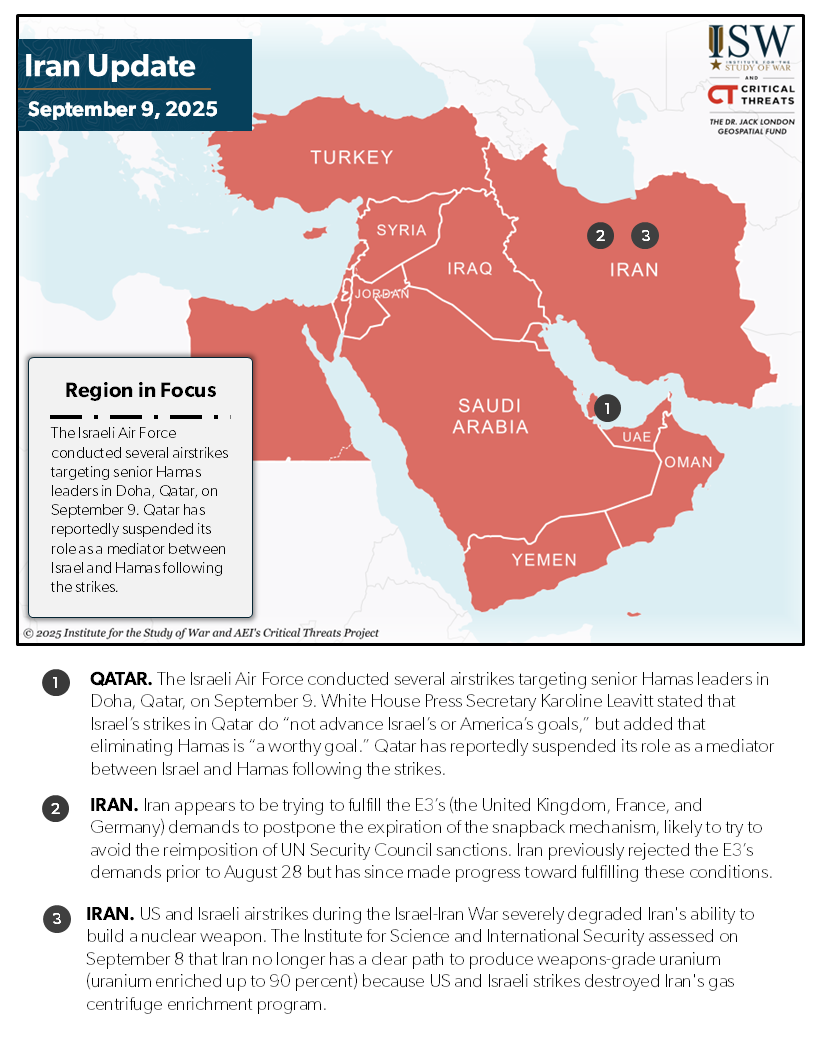
The Israeli Air Force (IAF) conducted several airstrikes targeting senior Hamas leaders in Doha, Qatar, on September 9. Several IAF fighter jets dropped at least 10 munitionson a residential building in northern Doha. Several Hamas Political Bureau members resided at the targeted building, according to the Qatari Foreign Affairs Ministry. Senior Hamas officials and ceasefire negotiators, including Hamas Shura Council and Leadership Council head Mohammad Darwish and senior Hamas official and negotiator Nizar Awadallah, were reportedly meeting at the residence to review a recent US ceasefire proposal at the time of the strikes. The Israeli strikes reportedly killed several Hamas officials, including:
- Khalil al Hayya: Hayya was the leader of Hamas in the Gaza Strip, the leader of Hamas’ ceasefire negotiation team, and a member of Hamas’ Leadership Council.
- Zaher Jabarin: Jabarin was the leader of Hamas in the West Bank, a member of Hamas’ Leadership Council, and a member of Hamas’ ceasefire negotiation team.
- Khaled Meshaal: Meshaal was a member of Hamas’ Leadership Council.
Iran appears to be trying to fulfill the E3’s (the United Kingdom, France, and Germany) demands to postpone the expiration of the snapback mechanism, likely to try to avoid the reimposition of UN Security Council (UNSC) sanctions. The E3 triggered the snapback mechanism on August 28. The snapback process lasts 30 days, which means that UNSC sanctions will automatically be reimposed on Iran on September 27 if the UNSC does not extend sanctions relief for Iran. South Korea, which is the current president of the UNSC, finalized a UNSC resolution on September 8 to extend sanctions relief for Iran.[16] South Korea was required to table such a resolution 10 days after the E3 triggered the snapback mechanism if no other UNSC member did so. Any permanent UNSC member (the United States, the United Kingdom, France, China, and Russia) can veto the South Korean resolution. The E3 previously outlined three conditions to extend the expiration date of the snapback mechanism, which is currently October 18, 2025. The three conditions are that Iran must account for its highly enriched uranium (HEU) stockpile, fully cooperate with the International Atomic Energy Agency (IAEA) regarding inspections and verification of its nuclear sites, and resume negotiations with the United States. Iran rejected these conditions prior to August 28 but has since made progress toward fulfilling these conditions.
US and Israeli airstrikes during the Israel-Iran War severely degraded Iran’s ability to build a nuclear weapon. The Institute for Science and International Security assessed on September 8 that Iran no longer has a clear path to produce weapons-grade uranium (uranium enriched up to 90 percent) because US and Israeli strikes destroyed Iran’s gas centrifuge enrichment program. The Institute assessed that US and Israeli strikes destroyed or rendered inoperable all of Iran’s 20,000 centrifuges that it had installed across its three declared enrichment facilities. The International Atomic Energy Agency (IAEA) recently reported that Iran possessed 440.9 kilograms of uranium enriched up to 60 percent before the start of the Israel-Iran War on June 12. Iran would need to further enrich its 60 percent enriched uranium to be able to build a nuclear weapon. US and Israeli strikes also targeted Iran’s centrifuge production and research and development facilities, which will almost certainly also hinder Iran’s ability to enrich uranium in the near future.
|