|
Russian forces are struggling to advance on the northern part of Ukraine’s Fortress Belt following the onset of the Russian Spring-Summer 2026 offensive. Ukrainian military observer Kostyantyn Mashovets reported on March 29 that elements of the Russian 3rd Combined Arms Army (CAA, Southern Military District [SMD]) fighting near Kryva Luka and Zakitne (east of Slovyansk, the northern tip of Ukraine’s Fortress Belt) have stalled after making tactically-significant advances in the last month (since about February 27). Mashovets noted that Russian forces have failed to advance within the last week (since about March 22) after achieving a tactical penetration of Ukrainian defenses between Kryva Luka and Riznykivka (southeast of Kryva Luka). Mashovets noted that elements of the Russian 20th and 25th CAAs (Moscow Military District [MMD] and Central Military District [CMD], respectively) in the Lyman direction and 8th CAA (SMD) and 3rd Army Corps (SMD) in the Kostyantynivka direction are advancing much more slowly than the 3rd CAA Mashovets assessed that Russian forces will only have the 3rd CAA available drive directly on Slovyansk-Kramatorsk agglomeration. A decision to conduct such an operation without mutually-supportive operations on the flanks would likely further stymie the Russian rate of advance east of Slovyansk and inflict critically high casualties for disproportionately minimal gains. Mashovets warned, however, that elements of the 3rd CAA could instead support the Russian offensive operations in the Lyman or Kostyantynivka directions instead of a direct drive on the Fortress Belt. This operation would also require Russian forces to temporarily abandon their offensive directly against the northern part of the Fortress Belt, which challenges the Kremlin’s cognitive warfare effort that aims to portray Russian forces as making simultaneous advances across the theater and to misrepresent Ukrainian defensive lines as collapsing.
The recent Russian tactical gains could support offensive operations to the north against Lyman or to the south against Kostyantynivka, but so far are insufficient for a drive directly on Slovyansk itself. ISW assessed on March 19 that Russian forces likely began their Spring-Summer 2026 offensive between March 17 and 21 after significantly intensifying mechanized and motorized assaults in various sectors of the front, including a battalion-sized mechanized assault in the Borova-Lyman direction, a period of intensified drone, artillery, and air strikes, and the movement of heavy equipment and troops on the frontline. The pace of Russian offensive operations in the Lyman direction has slowed in recent days, however, suggesting that Russian forces are unable to maintain the same intensity of their recent mechanized assaults at the cost of significant losses taken in the near term. Current weather conditions may also be slowing the Russian rate of advance. Ukrainian Joint Forces Task Force Spokesperson Colonel Viktor Trehubov assessed on March 28 that Russian forces are likely waiting for more spring foliage to emerge to provide concealment for Russian assaults and infiltration missions toward Lyman. Russian forces remain unlikely to seize Ukraine’s Fortress Belt in 2026, especially if many of the forces involved in such an operation are bogged down in Ukrainian defenses.
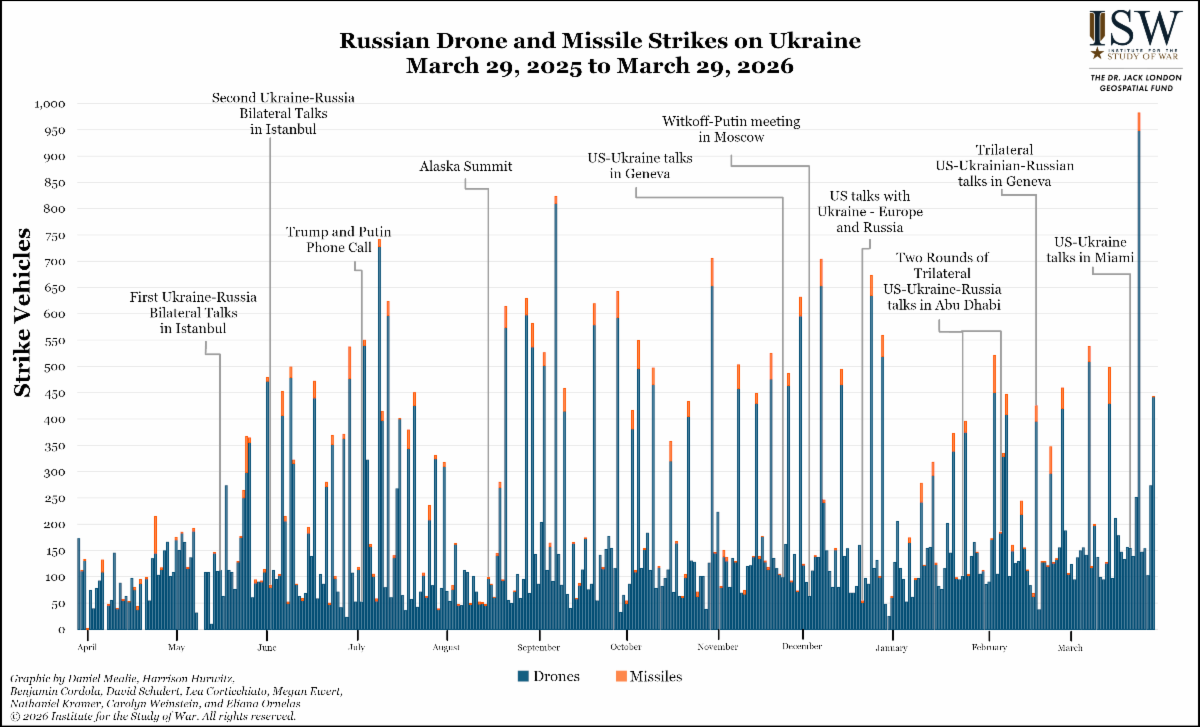
Russian forces conducted another massive strike against Ukraine on the night of March 28 to 29, striking a public recreation area and inflicting civilian casualties. The Ukrainian Air Force reported that Russian forces launched one Kinzhal aeroballistic missile and 442 Shahed, Gerbera, Italmas, and other drones — of which roughly 300 were Shaheds. The Ukrainian Air Force reported that Ukrainian forces downed 380 drones, that 16 drones struck seven locations, and that downed debris fell on 14 locations. Ukrainian officials reported that Russian strikes hit a civilian enterprise and residential areas in Chernihiv Oblast; residential areas in Kharkiv City; agricultural infrastructure and residential areas in Kyiv Oblast; a public recreation area in Mykolaiv Oblast; civilian and energy infrastructure in Odesa Oblast; and a civilian infrastructure facility in Sumy Oblast. Ukrainian officials reported that the Russian strike against the public recreation area killed one child and injured at least 10 other civilians, including eight children. Ukrainian President Volodymyr Zelensky stated on March 29 that Russian forces launched 3,000 drones, 1,450 guided aerial bombs, and 40 missiles against Ukraine in the last week (between March 22 and 29. Russian forces have launched four strike packages with over 400 projectiles against Ukraine thus far in March 2026, including the largest strike package of the war containing nearly 1,000 drones launched throughout the night and day on March 23 and 24. Russia’s increasingly large and diverse strike packages continue to highlight the critical importance of Western assistance in bolstering Ukraine’s air defense capabilities, both with high-end US-made Patriot air defense systems that can effectively counter Russian ballistic missiles and other lower-end forms of air defense, for a holistic, well-equipped air defense umbrella.
|