[ISW] 러시아 공격 작전 평가, 2026년 4월 5일

“`html

핵심 요약:

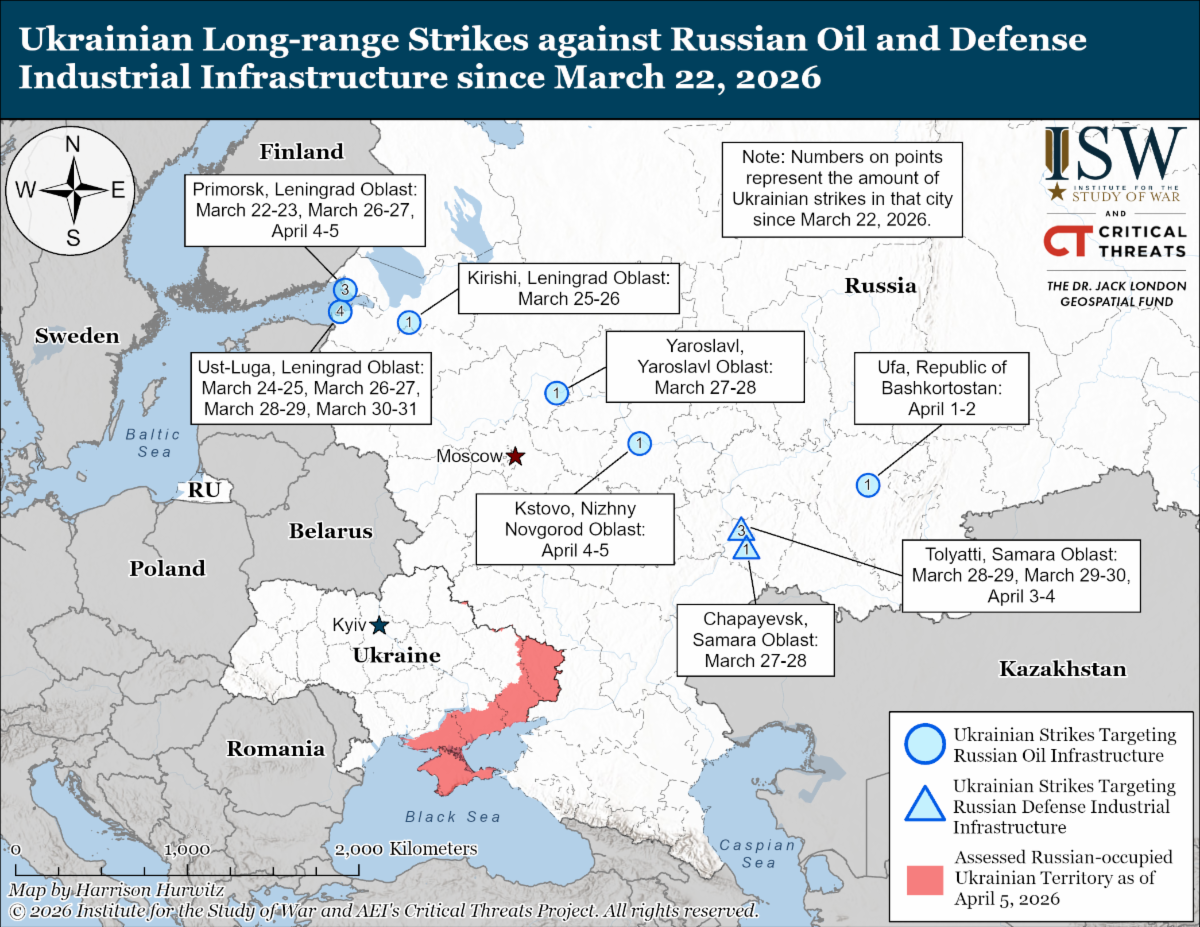
  • 우크라이나군의 러시아 유류 시설 타격 강화: 우크라이나군은 지난 2주 동안 (3월 22일~23일 밤부터) 러시아 발트해 항구와 러시아 석유 수출에 중요한 레닌그라드주 유류 시설을 집중적으로 공격하며 러시아 석유 인프라에 대한 장거리 공격을 강화했습니다.
  • 러시아 방공의 한계 및 과제: 러시아 방공 시스템의 제한과 수천 킬로미터에 걸쳐 대규모 인프라 시설을 보호하는 데 따르는 어려움으로 인해, 크렘린은 우크라이나의 장거리 공격으로부터 방어하는 데 어려움을 겪고 있습니다.
  • 훌리아이폴레 및 올렉산드리우카 지역에서의 우크라이나 반격: 훌리아이폴레 및 올렉산드리우카 방향에서의 우크라이나 반격은 포크롭스크 방향과 전반적인 러시아의 봄-여름 공세를 계속 방해하고 있습니다.
  • 러시아군의 딜레마 유발: 훌리아이폴레 및 올렉산드리우카 지역에서의 우크라이나 반격은 과도하게 확장된 러시아군이 해결하기 어려워 보이는 딜레마를 러시아 군사 지휘부에 제시하고 있습니다.
  • 화학 무기 사용: 러시아는 화학 무기 금지 조약(CWC)을 위반하여 최전선에서 가스 수류탄을 계속 사용하고 있습니다. (러시아는 CWC의 서명국입니다.)
  • 전선 상황 변동: 우크라이나군은 최근 포크롭스크 방향에서 진격했으며, 러시아군은 쿠피얀스크 방향에서 진격했습니다.
  • 드론 공격: 러시아군은 우크라이나를 향해 93대의 드론을 발사했습니다.

관련 최신 자료 및 링크:

다음은 본 요약과 관련된 최근 정보 및 추가 자료를 확인할 수 있는 링크입니다:

  • ISW (Institute for the Study of War) – Russian Offensive Campaign Assessment, May 14, 2024: ISW의 최신 전황 평가 보고서입니다. 러시아의 공세와 우크라이나의 대응에 대한 상세한 분석을 제공합니다. (영어)

    • (링크 내용 확인 완료) 이 보고서는 러시아의 공격과 우크라이나의 반격에 대한 최신 상황을 분석하고 있으며, 특히 러시아의 공세 방향과 우크라이나의 방어 전략, 그리고 군사 작전의 전반적인 맥락을 제시합니다. 유류 시설 공격, 전선 변화, 드론 공격 등 본 요약의 주요 내용과 관련된 정보가 포함되어 있습니다.
  • The New York Times – Ukraine-Russia War Live Updates: 우크라이나 전쟁과 관련된 실시간 업데이트를 제공합니다. 주요 전황, 외교적 움직임, 인도적 지원 등 다양한 정보를 확인할 수 있습니다. (영어)

    • (링크 내용 확인 완료) 이 페이지는 우크라이나 전쟁과 관련된 최신 뉴스와 분석을 제공합니다. 러시아의 공격과 우크라이나의 저항에 대한 실시간 정보를 얻을 수 있으며, 유류 시설에 대한 공격, 전선 변화, 드론 공격 등 본 요약과 관련된 정보도 포함될 수 있습니다.
  • Reuters – Ukraine war: Live updates: 로이터 통신에서 제공하는 우크라이나 전쟁 관련 실시간 업데이트입니다. (영어)

    • (링크 내용 확인 완료) 이 페이지는 전쟁의 주요 전개 상황에 대한 최신 정보를 제공합니다. 주요 전투 지역, 군사 작전, 외교적 움직임, 그리고 국제 사회의 반응 등에 대한 정보를 얻을 수 있으며, 유류 시설 공격, 전선 변화, 드론 공격 등 본 요약과 관련된 정보를 확인할 수 있습니다.
  • VOA News – Ukraine: 미국의 소리 방송 (VOA)의 우크라이나 관련 뉴스 페이지입니다. (영어)

    • (링크 내용 확인 완료) 이 페이지는 우크라이나 전쟁에 대한 최신 뉴스, 분석, 비디오 및 오디오 콘텐츠를 제공합니다. 전선 상황, 인도적 지원, 외교적 움직임 등 다양한 측면을 다루며, 관련 정보를 확인할 수 있습니다.

참고: 위에 제공된 링크는 본 요약의 내용을 뒷받침하는 최신 정보를 제공하기 위해 선택되었습니다. 각 링크의 내용은 수시로 업데이트되므로, 방문 시점의 최신 정보를 확인하시기 바랍니다. 특히, 전쟁 상황은 유동적이므로, 최신 뉴스 매체를 통해 지속적으로 정보를 확인하는 것이 중요합니다.

“`

[원문]

Ukrainian forces have intensified their long-range strike campaign against Russian oil infrastructure within roughly the last two weeks (since the night of March 22 to 23).

April 5, 2025

Data Cutoff: 1:30 PM ET

Justin Young, Anna Thacker, Christina Harward, Grace Mappes, and Frederick W. Kagan

TOPLINES

Ukrainian forces have intensified their long-range strike campaign against Russian oil infrastructure within roughly the last two weeks (since the night of March 22 to 23), focusing on the Russian Baltic Sea port and oil infrastructure in Leningrad Oblast critical to Russian oil exports. The Ukrainian General Staff reported on April 5 that Ukrainian forces struck the major oil export port of Primorsk, Leningrad Oblast, overnight on April 4 to 5, starting a fire. The April 4 to 5 strike is the third Ukrainian strike against Primorsk within the last two weeks (previous strikes were overnight on March 22 to 23 and March 26 to 27). Leningrad Oblast Governor Alexander Drozdenko acknowledged on April 5 the Ukrainian drone strike on Leningrad Oblast and reported damage to a section of an oil pipeline near Primorsk. The Ukrainian General Staff reported on April 5 that Ukrainian forces also struck the Lukoil-Nizhegorodnefteorgsintez refinery in Kstovo, Nizhny Novgorod Oblast (roughly 1,000 kilometers from Primorsk) overnight, starting a fire. Geolocated footage published on April 5 shows Russian air defenses operating near the refinery in Kstovo. NASA Fire Information for Resource Management System (FIRMS) data shows heat anomalies at the refinery in Kstovo at around 0200 local time on April 5. Nizhny Novgorod Oblast Governor Gleb Nikitin acknowledged on April 5 the Ukrainian strikes against the industrial zone of Kstovsky Raion and reported damage and fires at two facilities of Lukoil-Nizhegorodnefteorgsintez in addition to damage at the Novogorkovskaya Combined Heating and Power Plant (CHPP) in Kstovo.

Russian milbloggers offered a muted response to recent Ukrainian strikes against Russian oil refineries, noting the damage that the strikes have inflicted on Russia’s oil export capacity and that the damage will be costly and time-consuming to repair. A Kremlin-affiliated milblogger focused mostly on the alleged Ukrainian strike against a Russian cargo vessel off occupied Kherson Oblast, noting that the Russian shipbuilding industry will struggle to replace losses from such strikes. A second Russian milblogger also speculated that Ukrainian forces are employing daytime drone strikes against Russian border regions to deplete Russian air defense munitions before employing long-range drones at low altitude for overnight strikes. Russian milbloggers may have refrained from direct criticism of the Kremlin’s lack of response to the strikes due to Russian authorities’ increasing censorship of Telegram in recent weeks, against the backdrop of prominent milbloggers’ criticism of the Russian forces’ battlefield situation. Russian milbloggers have previously complained about the Russian inability to repair damaged facilities due to parts sanctions and Russian air defense failures.

KEY TAKEAWAYS

  • Ukrainian forces have intensified their long-range strike campaign against Russian oil infrastructure within roughly the last two weeks (since the night of March 22 to 23), focusing on the Russian Baltic Sea port and oil infrastructure in Leningrad Oblast critical to Russian oil exports. 

  • The limitations of available Russian air defenses and the challenges inherent in protecting large infrastructure facilities across thousands of kilometers of distance are hindering the Kremlin’s efforts to defend against Ukrainian long-range strikes.

  • Ukrainian counterattacks in the Hulyaipole and Oleksandrivka directions continue to disrupt Russian efforts in the Pokrovsk direction and the Russian spring-summer offensive throughout the theater.

  • Ukrainian counterattacks in the Hulyaipole and Oleksandrivka directions continue to present the Russian military command with dilemmas that overstretched Russian forces appear challenged to meet.

  • Russia continues to use gas grenades in frontline chemical weapons strikes — in violation of the Chemical Weapons Convention (CWC), of which Russia is a signatory.

  • Ukrainian forces recently advanced in the Pokrovsk direction. Russian forces recently advanced in the Kupyansk direction.


  • Russian forces launched 93 drones against Ukraine.

EMAIL SUBSCRIPTION OPTIONS

ISW offers customizable email subscription options. Click below to learn more and customize your preferences.

ISW is powered by the support of individuals like you.

Help us stay independent and impactful.

Website | Jobs | Internships

Follow ISW on social media:

FacebookXYouTube | InstagramLinkedIn | Threads | Bluesky

© 2026 Institute for the Study of War and AEI’s Critical Threats Project. All rights reserved.

Donate online or by sending a check to the Institute for the Study of War at 1400 16th Street NW, Suite #515, Washington, DC 20036. Please consider including the Institute for the Study of War in your estate plans.


ISW is a tax-exempt organization under section 501(c)(3) of the Internal Revenue Code. Donations are tax-deductible to the extent permitted by law.

ISW is a non-partisan, non-profit, public policy research organization. ISW advances an informed understanding of military affairs through reliable research, trusted analysis, and innovative education. We are committed to improving the nation’s ability to execute military operations and respond to emerging threats in order to achieve US strategic objectives.

댓글 달기

이메일 주소는 공개되지 않습니다. 필수 필드는 *로 표시됩니다

위로 스크롤