|
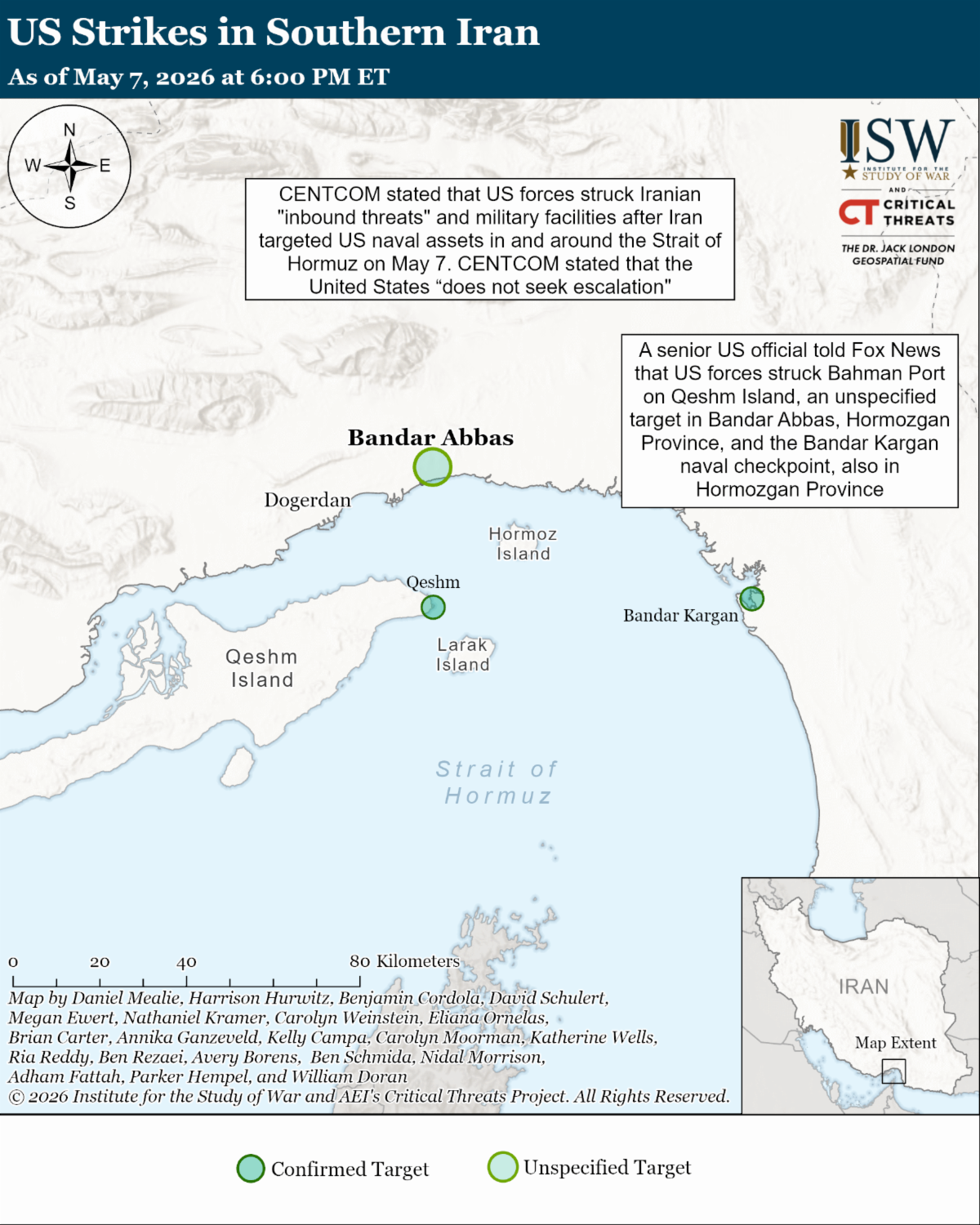
US Central Command (CENTCOM) announced on May 7 that US forces “eliminated inbound threats” and struck Iranian military facilities responsible for attacks on US forces after Iran targeted US naval assets in and around the Strait of Hormuz. CENTCOM stated that the United States “does not seek escalation.” CENTCOM reported that Iranian forces launched multiple missiles, drones, and fast attack craft at US naval assets, including the USS Truxtun, USS Rafael Peralta, and USS Mason, while the vessels were transiting the strait. CENTCOM confirmed that the munitions did not hit any US assets. US forces subsequently struck Iranian military targets responsible for the attacks, including missile and drone launch sites, command-and-control centers, and intelligence, surveillance, and reconnaissance sites. A senior US official told Fox News that US forces struck Bahman Port on Qeshm Island, an unspecified target in Bandar Abbas, Hormozgan Province, and the Bandar Kargan naval checkpoint, also in Hormozgan Province. The official added that the strikes do not indicate a resumption of the war.
Iranian media claimed that Iran fired missiles at US warships south of Chabahar Port after US forces targeted two Iranian vessels near Jask, Hormozgan Province, and Fujairah Port in the United Arab Emirates (UAE). Khatam ol Anbia Central Headquarters Spokesperson Ebrahim Zolfaghari warned Emirati civilians to “stay away from oil and military centers” following the attacks. The recent strikes follow a series of Iranian attacks against the UAE on May 4 and 5, including a strike on the Fujairah Petroleum Industrial Zone, a key port that the UAE uses to bypass the strait. ISW-CTP will continue to monitor this situation and provide further analysis in its May 8 morning thread on X.
The United States and Iran remain divided over key issues, particularly issues related to Iran’s nuclear program and Iranian efforts to assert sovereignty over the Strait of Hormuz. The Wall Street Journal, citing senior US officials, reported on May 6 that the US Government has seven main demands. These demands include the dismantlement of Fordow, the Esfahan Nuclear Technology Center, and Natanz, a ban on underground nuclear activities, on-demand inspections, a 20-year moratorium on enrichment, an Iranian commitment not to seek a nuclear weapon, the removal of all enriched nuclear material from Iran, and the reopening of the Strait of Hormuz. Iranian officials continue to reject many of these demands, however. Parliamentary National Security and Foreign Policy Commission Vice Chairman Behnam Saeedi stated on May 7 that Iran’s red lines include enrichment, the Strait of Hormuz, complete sanctions relief, and the release of frozen Iranian assets. Saeedi added that negotiations will fail if the United States does not accept Iran’s “right” to enrichment. Unspecified individuals familiar with the matter told the Wall Street Journal on May 6 that key issues, including the length of any enrichment moratorium, the possible removal of Iran’s HEU from Iran, and Iran’s assertion of sovereignty over the Strait of Hormuz, “remain unresolved and are expected to complicate any talks.”
|