|
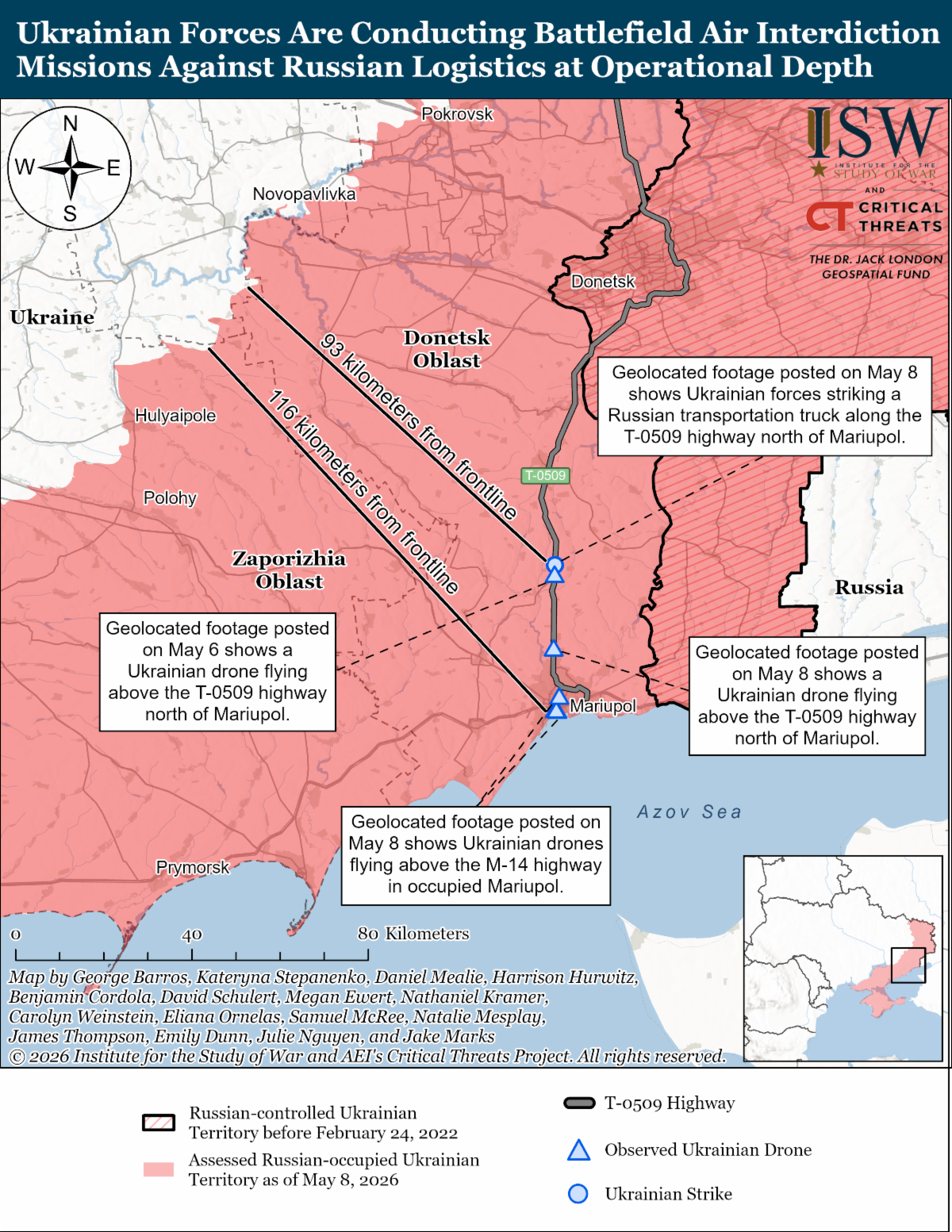
Ukrainian forces are reconnoitering and interdicting Russian ground lines of communication (GLOCs) in and near occupied Mariupol, Donetsk Oblast (about 105 kilometers from the frontline), demonstrating increased capabilities as part of Ukraine’s intensifying mid-range strike campaign. The Ukrainian 1st Azov National Guard Corps reported on May 8 that it struck Russian military targets near occupied Mariupol, Donetsk Oblast (roughly 105 kilometers from the frontline) and is interdicting Russian logistics at depths of up to 160 kilometers from drone operator positions. Geolocated footage published on May 6 and 8, including from the 1st Azov Corps, confirms that Ukrainian forces flew drones and struck a truck along the T-0509 Mariupol-Donetsk City highway (also called the H-20 highway) at a point approximately 95 kilometers from the frontline. Additional geolocated footage from the 1st Azov Corps shows Ukrainian drones operating at points along the T-0509 highway about 95 to 104 kilometers from the frontline and within Mariupol itself along the M-14 Mariupol-Berdyansk-Melitopol highway. The T-0509 supplies Russian forces operating along the frontline north of Mariupol and further northeast, supporting the ongoing Russian offensive against Ukraine’s Fortress Belt.
Russian forces likely do not maintain positions in Kupyansk after struggling for months to support a small and isolated group of servicemembers that infiltrated into the city. A Russian milblogger reported on May 7 that a group of roughly 20 Russian soldiers who had reportedly remained encircled in the Kupyansk City Hospital since December 2025 fought “their last battle” and “held their positions until the very end” after a Ukrainian airstrike destroyed the hospital and killed most of the surviving personnel, implying that Russian forces no longer hold positions in central Kupyansk. Ukrainian Joint Forces Task Force Spokesperson Colonel Viktor Trehubov reported on March 28 that Ukrainian forces identified only six active Russian call signs in Kupyansk representing roughly 12 to 18 Russian personnel in the city center. Trehubov later stated on April 21 that roughly 10 Russian call signs remained active in Kupyansk. Several Russian sources reported that fighting in Kupyansk continues in the town’s northwestern parts as of May 8, suggesting no active combat in the city center. The Russian infiltration zone depicted on ISW’s map likely overestimates the current true extent of Russian presence in central Kupyansk. These reports indicate that Ukrainian forces likely eliminated any enduring Russian positions in the Kupyansk city center. ISW has not observed granular evidence to adjust our control of terrain in central Kupyansk beyond the Central District Hospital as of May 8, however. ISW will continue collecting and verifying data and will update its control of terrain assessment as the evidence permits.
Ukraine and Russia agreed to a three-day ceasefire from May 9 to 11 for the May 9 Victory Day parade and a prisoner of war exchange. US President Donald Trump, Ukrainian President Volodymyr Zelensky, and Kremlin Presidential Aide Yuriy Ushakov announced on May 8 that Ukraine and Russia are instituting a three-day ceasefire and an exchange of 1,000 prisoners-of-war (POWs) from each side. Zelensky noted that Ukraine has "clearly communicated" to Russia the "principle of symmetry" in Ukraine’s actions. Zelensky signed a decree on May 8 specifically "to allow" Russia to hold its May 9 Victory Day parade in Moscow, stipulating that Ukraine will not strike Moscow’s Red Square for the parade’s duration, starting at 1000 local time on May 9.
|