|
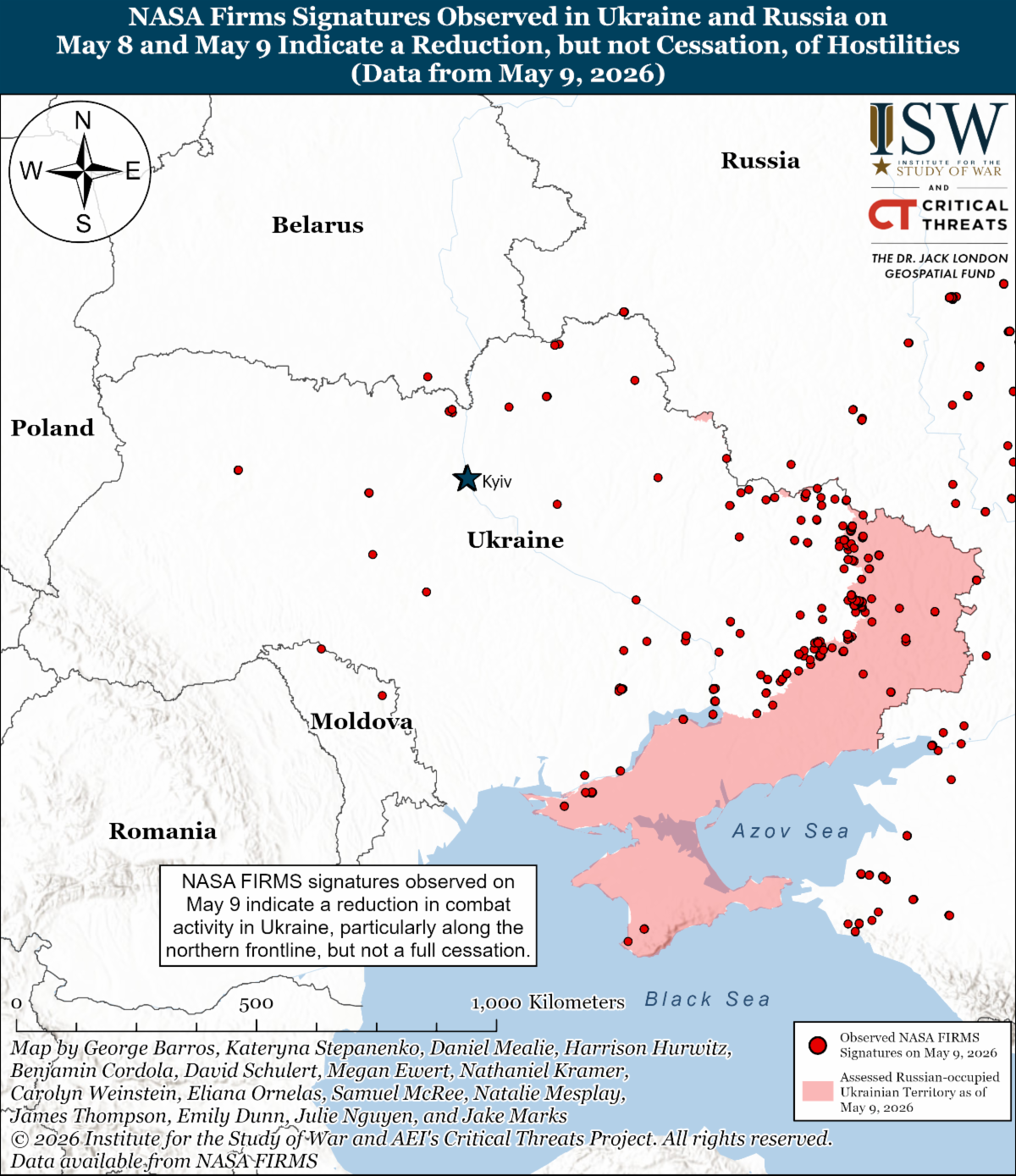
Russian and Ukrainian forces continued limited offensive operations across the theater throughout the first day of the May 9 – 11 ceasefire. Both Ukrainian and Russian officials issued competing accusations that the other side violated the ceasefire on May 9. The Ukrainian General Staff reported on May 9 that there were 51 combat engagements after the ceasefire went into effect. Ukrainian officials reported that Russian drones struck residential infrastructure in Kharkiv and Kherson oblasts during the day on May 9. The Russian Ministry of Defense (MoD) accused Ukraine of violating the ceasefire 8,970 times, including launching 12 ground attacks, 1,173 artillery, MLRS, and mortar strikes, and 7,151 drone strikes. The Ukrainian Air Force reported on May 9 that Russian forces launched one Iskander-M missile and 43 Shahed, Gerbera, Italmas, and Parodyia drones against Ukraine after 1800 on May 8, but it is unclear whether these strikes took place before or after the ceasefire went into effect at midnight on May 9. Observed National Aeronautics and Space Administration Fire Information for Resource Management System (NASA FIRMS) signatures from May 8 and 9 and Ukrainian and Russian reporting indicate that there was a reduction in hostilities across the theater, particularly in northern Ukraine, but not a cessation of hostilities. Russian and Ukrainian sources reported that the overall operational tempo across certain areas of the frontline decreased despite persistent tactical combat missions that violated the ceasefire.
Russian forces used the ceasefire to conduct rotations, reinforcements, redeployments, and logistics throughout the theater, likely to support imminent future offensive operations. Ukrainian military sources reported on May 9 that Russian forces used the ceasefire for regrouping, rotations, logistics, and position fortification in the Kupyansk, Lyman, and Slovyansk directions and in northern Kharkiv Oblast. The Ukrainian 7th Rapid Reaction Corps of the Air Assault Forces reported on May 9 that Ukrainian forces observed redeployed elements of the 90th Tank Division (41st Combined Arms Army [CAA], Central Military District [CMD]) operating in the Pokrovsk direction. ISW first observed reports on May 4 that the 90th Tank Division had redeployed from the Oleksandrivka and Novopavlivka directions, and the reduction of tempo on May 9 may have supported the division’s redeployment. The 7th Corps noted that the Russian military command has recently begun establishing command posts in Myrnohrad (east of Pokrovsk) to support Russian attacks toward Rodynske (north of Myrnohrad). A source reporting on the Russian Western Grouping of Forces claimed on May 9 that the ceasefire is allowing Russian forces to advance and consolidate positions northwest of Lyman in areas where Ukrainian drone activity has previously prevented Russian forces from fortifying these positions. Russian forces have repeatedly used ceasefires to regroup, conduct rotations, and improve logistics along the frontline. Russian forces will likely continue to take advantage of any reduction in operational tempo on May 10 and 11 to further regroup and reinforce positions as to resume reinvigorated offensive operations once the ceasefire period ends.
|