|
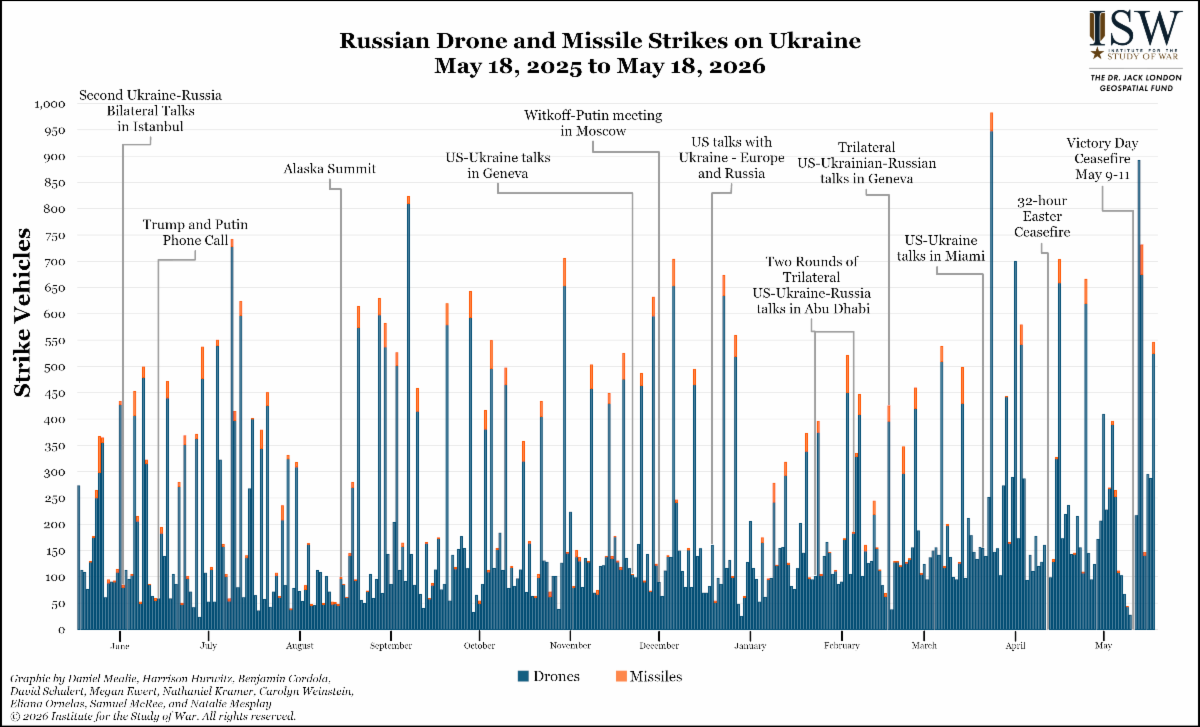
Russian forces conducted a large-scale strike against Ukraine with 546 drones and missiles, including 14 ballistic missiles, on the night of May 17 to 18. The Ukrainian Air Force reported that Russian forces launched 14 Iskander-M ballistic missiles/S-400 air defense missiles from Rostov Oblast and occupied Crimea; eight Iskander-K cruise missiles from occupied Crimea; and 524 Shahed-type, Gerbera-type, and Italmas-type strike drones and Parodiya decoy drones from the directions of Bryansk, Kursk, and Oryol cities; Millerovo, Rostov Oblast; Primorsko-Akhtarsk, Krasnodar Krai; occupied Donetsk City; and occupied Hvardiiske, Crimea. The Ukrainian Air Force reported that Ukrainian forces downed four Iskander-K cruise missiles and 503 drones, that 18 missiles and 16 drones struck 34 locations, and that downed debris had fallen on 11 locations as of 08:30 local time. The Ukrainian Air Force noted that the strikes primarily targeted Dnipro City and Dnipropetrovsk Oblast. Ukrainian President Volodymyr Zelensky reported that Russian strikes against Dnipro City and Dnipropetrovsk Oblast significantly damaged civilian infrastructure and also targeted energy and residential infrastructure. Ukrainian authorities stated that Russian forces struck Odesa City, including a Chinese-owned ship that was approaching the port.
Ukraine’s new domestically produced guided glide bomb will likely allow Ukrainian forces to expand their battlefield air interdiction (BAI) campaign against Russian forces and assets in the near and operational rear. Ukrainian Defense Minister Mykhailo Fedorov reported on May 18 that a Ukrainian defense company developed and tested Ukraine’s first domestically produced KAB guided glide bomb, which is now ready for combat use. Fedorov reported that the glide bomb has a payload of 250 kilograms and can destroy targets tens of kilometers away from the launch location. Ukraine’s new guided glide bomb capabilities will likely allow Ukrainian forces to expand their BAI campaign against Russian targets in the near and operational rear, mirroring Russia’s use of guided glide bombs to generate BAI effects by striking Ukrainian logistics. Ukrainian forces have been successfully interdicting Russian logistics at the tactical and operational levels with drones, and the guided glide bomb will allow Ukrainian forces to strike hardened targets with a larger payload. Russian forces have also used glide bombs with extended ranges to keep valuable aviation assets further from the frontline and safe from Ukrainian air defenses — a tactic Ukraine is likely to try to emulate with the guided glide bombs given Ukraine’s limited aircraft stocks.
The Russian economy continues to feel the strain of the compounding effects of over four years of war coupled with Ukraine’s long-range strike campaign against Russian oil infrastructure. Russian Minister of Economic Development Maxim Reshetnikov stated in an interview with Russian outlet RBK on May 18 that several factors pushed the Russian government to revise its expectations for GDP growth over the upcoming three-year period, including labor shortages and "external conditions" like ongoing sanctions against Russia and the war in the Middle East. Reshetnikov also credited the changes to the structure of Russia’s planned federal spending and the Russian Central Bank’s key interest rate forecasts. Reshetnikov acknowledged that labor shortages are constraining the Russian economy, in contrast with Russian President Vladimir Putin’s ongoing attempts to characterize Russia’s low unemployment rate as a sign of economic health. Reshetnikov claimed that Russia does not expect inflation to accelerate as the economy grows, however, ignoring how labor shortages are fueling inflation. Reshetnikov also failed to acknowledge how Russia’s yearslong military recruitment efforts have removed many individuals from the civilian labor market and worsened the labor shortage. Russia will likely continue to suffer from worsening labor shortages as it prioritizes replacing its losses on the battlefield with new recruits over supporting and growing its domestic economy.
|