|
Russian President Vladimir Putin and the People’s Republic of China’s (PRC) President Xi Jinping failed to reach an agreement on the Power of Siberia-2 pipeline and signed only comparatively minor bilateral agreements during Putin’s official visit to the PRC. Putin and Xi held a joint press conference on May 20 in which the leaders praised deep relations between Russia and the PRC and how Russia and the PRC actively cooperate in energy, noting that Russia is one of the PRC’s largest oil suppliers. Kremlin Presidential Aide Yuriy Ushakov stated that Russia and China reached agreements on energy projects and “something else very important,” but did not specify what it was, and the parties notably failed to reach an agreement on the construction of the Power of Siberia-2 (PS-2) pipeline. Russia and the PRC have been in disagreement about the PS-2 since at least 2024, as Russia faces a more immediate need for the pipeline to substitute income from exports lost since Russia’s full-scale invasion of Ukraine in 2022, and the PRC is using its upper hand to extract concessions from Russia on the issue. Putin and Xi signed a joint statement on further strengthening their comprehensive partnership and strategic interaction, and on deepening good-neighborly friendship and cooperation, about 40 intergovernmental, interagency, and corporate documents, mainly aimed at deepening economic cooperation, as well as a joint declaration on the Establishment of a Multipolar World and a New Type of International Relations. The agreements signed were relatively small in comparison to the Kremlin’s hopes that Putin’s visit would culminate in a signed deal on the PS-2. Ushakov highlighted on May 18 the PS-2 pipeline as one of the priority items for Putin’s official visit to the PRC, and Putin’s failure to secure a signed agreement demonstrates the current limits of Russo-Sino cooperation.
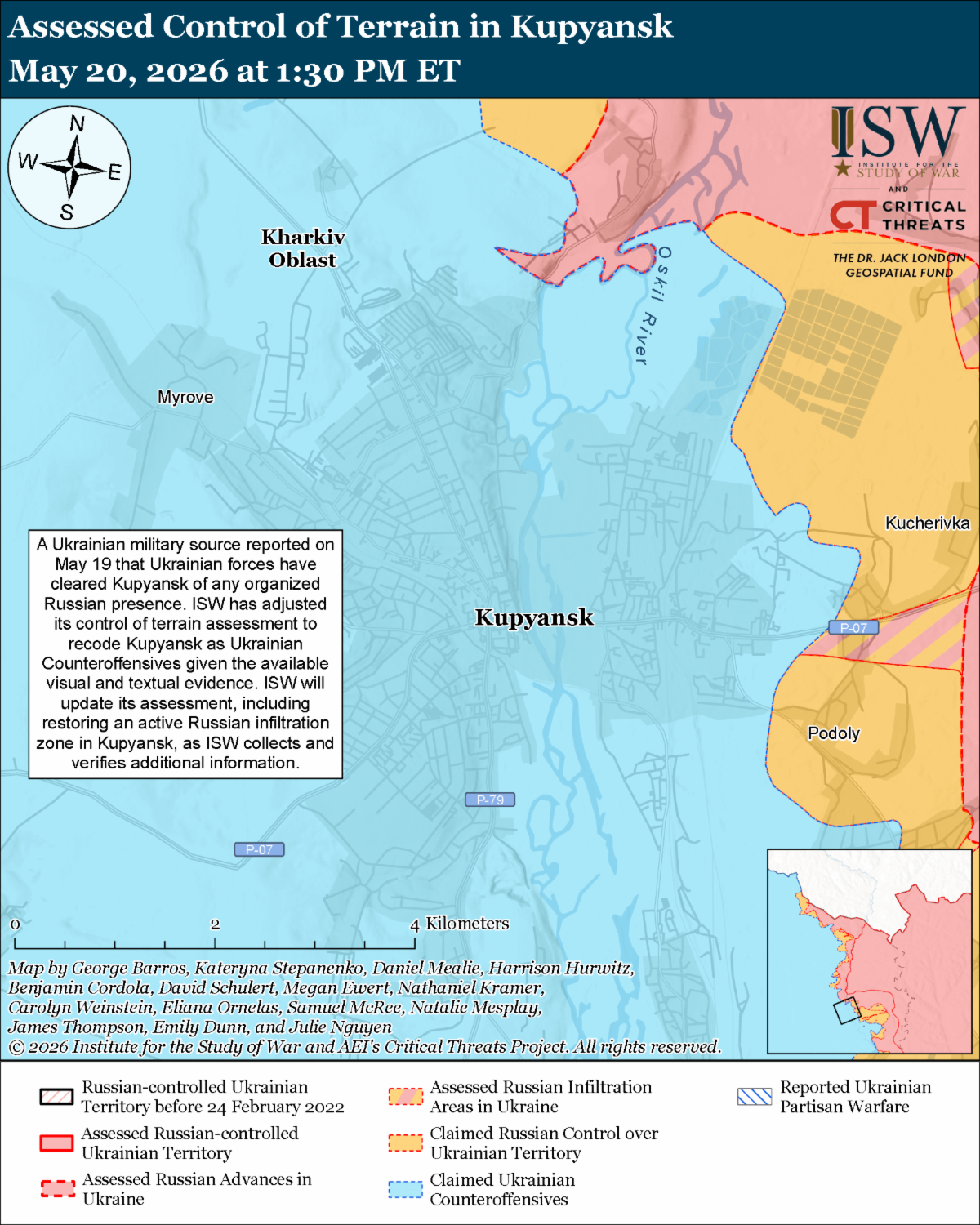
Ukrainian forces appear to be regaining the tactical initiative in different sectors of the frontline in Ukraine. Ukrainian forces have conducted a series of counterattacks in different areas across the theater in recent months, having made their most significant gains on the battlefield since Ukraine’s incursion into Kursk Oblast in August 2024. Ukrainian counterattacks recaptured much of Kupyansk starting in November 2025, liberated over 400 square kilometers in southern Ukraine in winter and spring 2026, and most recently liberated several settlements in western Zaporizhia Oblast since late April 2026. Ukrainian counterattacks in southern Ukraine have created cascading operational and strategic effects against Russia’s ongoing Spring-Summer 2026 offensive against the Fortress Belt, which has forced Russia to choose between defending against Ukrainian counterattacks or allocating manpower and resources to priority sectors. Ukraine’s intensified mid-range strike campaign against Russian logistics, military equipment, and manpower since early 2026 has also degraded Russian forces’ ability to conduct offensive operations across the theater and has also likely supported recent Ukrainian advances. Ukrainian Commander-in-Chief General Oleksandr Syrskyi stated on May 15 in an exclusive interview with Ukrainian defense outlet Militarnyi that precise Ukrainian strikes, the destruction of Russian reserves, and constant pressure on Russian assault units have allowed Ukrainian forces to increasingly seize the tactical initiative and force Russian forces to react to a Ukrainian-defined operational tempo. Syrskyi did not provide absolute figures but noted that the number of Ukrainian offensive actions exceeded those of Russian forces as of May 14, which may indicate Ukraine contesting the initiative at the tactical level and engaging in more active counterattacks.
|