[ISW] 이란 업데이트 특별 보고서, 2026년 5월 20일

“`html

핵심 내용 요약:

  • 이란의 호르무즈 해협 통제 시도: 이란은 휴전 기간을 이용하여 석유 수입국들에게 양자 통과 협정을 체결하도록 강요하고, 협정에 참여하지 않는 선박들에게 “안보” 명목의 요금을 부과하여 호르무즈 해협에 대한 통제를 정상화하려 시도하고 있습니다. 이는 사실상 마피아와 유사한 보호 행위로, 이란 해군이 선박을 “보호”한다는 명목으로 금전을 갈취하는 행태입니다.
  • 유럽의 “안보” 주둔의 무력함: 이란의 정상화 시도는 일부 국가들이 제안한 전후 유럽 국가들의 “안보” 주둔으로는 막을 수 없을 것입니다. 이란은 호르무즈 해협에 대한 주권을 공식 또는 사실상 인정하는 방식으로 전쟁이 종결될 경우, “안보 부대”를 무력으로 저지하려 할 가능성이 높습니다.
  • 정상화 시도의 결과: 이란이 이러한 구조를 성공적으로 정상화하면, 해협을 통과하는 선박의 수가 점차 전쟁 이전 수준으로 증가할 것입니다. 이는 제한된 접근으로 인한 경제적 비용을 줄여, 미국 동맹국들이 해협을 재개방하도록 동원해야 하는 주요 논거를 약화시킵니다. 하지만 이란의 노력이 성공할지는 미지수입니다.
  • 미국의 이란 유조선 단속: 세 명의 미국 관리는 월스트리트 저널에 따르면, 미국은 5월 14일 말라카 해협을 통과한 후 5월 19일과 20일 사이에 미국 제재 대상인 이란 연계 유조선 M/T Skywave (IMO: 9328716)를 압수했습니다. 또한, 미 해병대는 5월 20일 이란 항구에 접근하려 한 혐의로 이란 국적 유조선 M/T Celestial Sea (IMO: 9397030)를 별도로 나포했습니다.
  • IRGC의 위협: 이슬람 혁명 수비대 (IRGC)는 5월 20일 미국-이스라엘의 이란 공격이 재개될 경우 “지역을 훨씬 넘어선” 전쟁으로 확대하겠다고 위협했습니다. 이 위협은 거의 확실히 미국-이스라엘의 공격 재개를 막기 위한 것이지만, 향후 잠재적 분쟁에 대한 IRGC의 계획을 반영할 수도 있습니다. 이란은 해외 테러 공격, 다른 요충지에서의 해운 방해, 장거리 탄도 미사일 발사 등 이러한 위협을 실행할 수 있는 몇 가지 능력을 보유하고 있습니다.
  • 파키스탄의 입장: 파키스탄은 파키스탄-사우디 아라비아 방위 협정의 의무를 다하고 미국과 이란 사이의 중재를 돕는 방식으로 자체적인 정치적 및 안보적 이익을 확보하려 노력하고 있습니다.
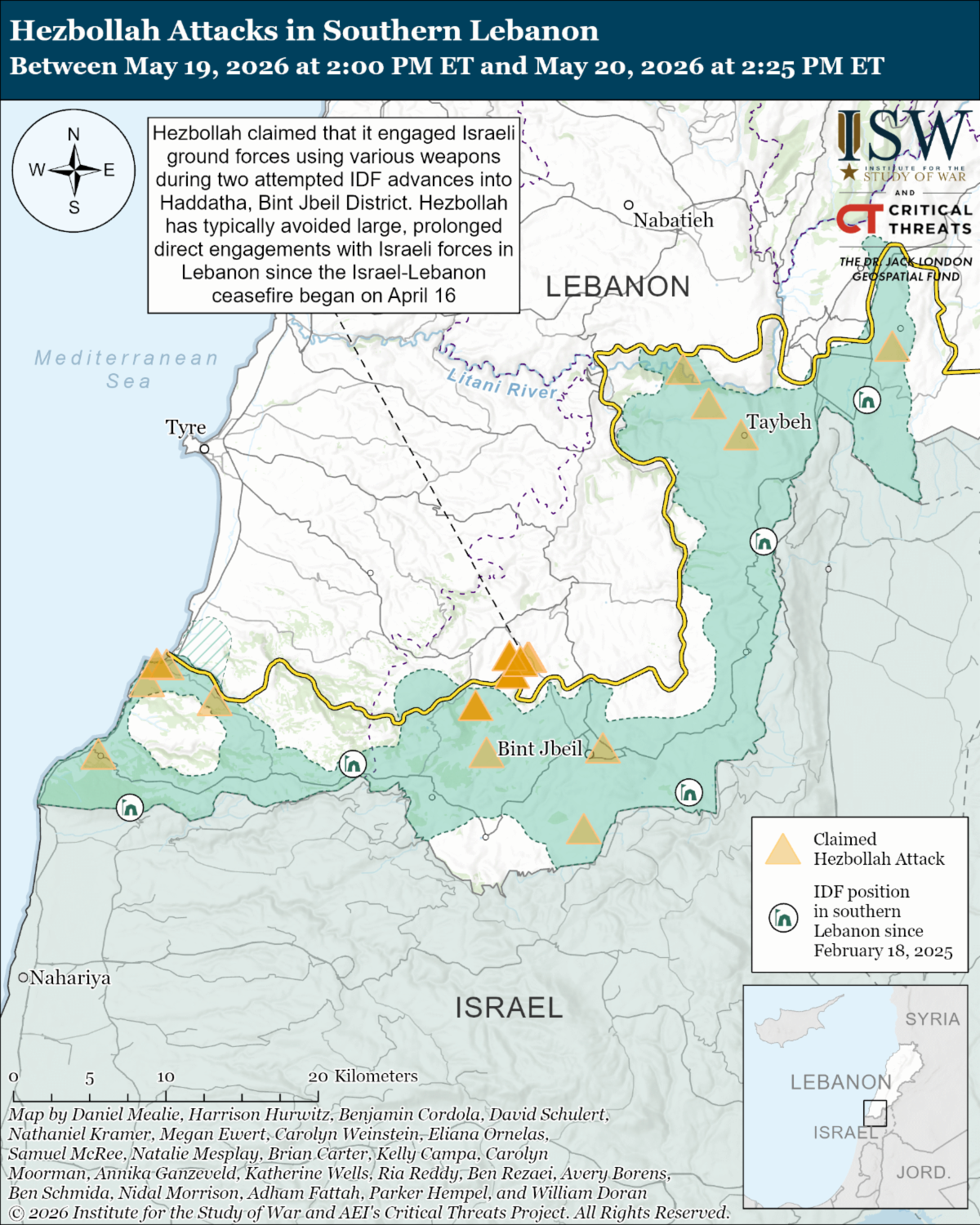
  • 헤즈볼라의 저항: 헤즈볼라는 5월 19일과 20일, 빈트 주바일 지역 하다타에 대한 IDF의 공격을 격퇴했습니다. 이어진 헤즈볼라의 방어는 휴전 이후 IDF와 헤즈볼라 사이의 최초의 장기 교전이었습니다.

최신 관련 자료 및 링크:

참고: 위 링크는 현재까지 유효하며, 관련 내용에 대한 최신 정보를 제공할 수 있습니다. 각 링크의 내용은 변동될 수 있으므로, 방문 시점의 정보를 확인하시기 바랍니다. 기사 내용의 영어는 번역되어 있습니다.

“`

[원문]

Iran is likely using the ceasefire period to normalize Iranian control over the Strait of Hormuz by compelling oil-importing countries to establish a bilateral transit agreement with Iran while

May 20, 2026

Data Cutoff: 2:00 PM ET

Ria Reddy, Adham Fattah, Will Doran, Parker Hempel, Carolyn Moorman, Nidal Morrison, Katherine Wells, and Brian Carter 

As the Middle East crisis evolves, ISW urgently needs your support.

Help us stay independent and impactful.

TOPLINES

Iran is likely using the ceasefire period to normalize Iranian control over the Strait of Hormuz by compelling oil-importing countries to establish a bilateral transit agreement with Iran while charging fees from vessels that are not part of the bilateral deals. The transit agreements and fee system use a multi-tiered system, according to Iranian officials speaking to Reuters on May 20. Iranian strategic partners, like Russia and China, are prioritized at the top tier, while countries with close ties to Iran, like India and Pakistan, can operate within negotiated transit agreements. Other countries are handled on a case-by-case basis, and any vessel that has links to Iranian adversaries is denied access entirely. Finally, ships that do not fall under a bilateral agreement are required to pay fees, which are reportedly around $150,000. The Iranian Islamic Revolutionary Guards Corps (IRGC) runs the scheme. These fees are framed as “security” fees, but the fees are in reality part of a mafia-esque protection racket in which the vessels pay Iran so that the Iranian navy can “secure” the vessels against an attack by the Iranian navy or Iranian shore-based missiles and drones.

A successful Iranian effort to normalize this structure would gradually increase the number of vessels moving through the strait to near pre-war levels. This reduces the visible economic costs of restricted access and therefore weakens the primary argument for mobilizing US allies to help reopen the strait. Such a decrease in the price of oil would be reliant on a number of other factors, including market reactions and the risk calculus of the shipping companies involved. It is unclear how long a decrease would take, and Iranian efforts to normalize control would need to bear fruit before any mobilization against Iranian activities in the strait. A NATO official told Bloomberg on May 19, for example, that at least some European countries are concerned about the economic consequences of the strait’s closure, and some European states support an effort to reopen the strait if the situation fails to change by July 2026. This creates a clear incentive for Iran to normalize traffic flows under its own framework before external pressure from the United States and its allies intensifies.

KEY TAKEAWAYS

  • Iran is likely using the ceasefire period to normalize Iranian control over the Strait of Hormuz by compelling oil-importing countries to establish a bilateral transit agreement with Iran while charging fees from vessels that are not part of the bilateral deals. These fees are framed as “security” fees, but the fees are in reality part of a mafia-esque protection racket in which the vessels pay Iran so that the Iranian navy can “secure” the vessels against an attack by the Iranian navy or Iranian shore-based missiles and drones.  

  • Iran’s normalization scheme could not be disrupted by a post-war “security” deployment by European states, as some countries have suggested. Iran would likely attempt to stop, perhaps with force, any post-war “security force” if the war ends with an official or de facto recognition of Iranian sovereignty over the Strait.

  • A successful Iranian effort to normalize this structure would gradually increase the number of vessels moving through the strait to near pre-war levels. This reduces the visible economic costs of restricted access and therefore weakens the primary argument for mobilizing US allies to help reopen the strait. It is not a given that this effort will be successful, however.

  • Three US officials told the Wall Street Journal that US forces seized a US-sanctioned, Iranian-linked oil tanker, the M/T Skywave (IMO: 9328716), between May 19 and 20 after it transited the Strait of Malacca on May 14. US Marines separately boarded the Iranian-flagged oil tanker M/T Celestial Sea (IMO: 9397030) on May 20 on suspicion of attempting to reach an Iranian port.

  • The Islamic Revolutionary Guards Corps (IRGC) threatened on May 20 to expand the war “far beyond the region” if US-Israeli strikes on Iran resume. This threat almost certainly seeks to deter renewed US-Israeli strikes but could also reflect IRGC planning for a potential future conflict. Iran does possess several capabilities with which it could operationalize these threats, including by conducting terror attacks abroad, disrupting shipping in other chokepoints, or firing ballistic missiles at longer range.

  • Pakistan is attempting to secure its own political and security interests by fulfilling its end of the Pakistan-Saudi Arabia defense agreement and helping mediate between the United States and Iran.


  • Hezbollah defended against an IDF assault into Haddatha, Bint Jbeil District, on May 19 and 20. The protracted Hezbollah defense is the first prolonged engagement between the IDF and Hezbollah since the ceasefire began.

Website | Jobs | Internships

Follow ISW on social media:

FacebookXYouTube | InstagramLinkedIn | Threads | Bluesky

© 2026 Institute for the Study of War and AEI’s Critical Threats Project. All rights reserved.

Donate online or by sending a check to the Institute for the Study of War at 1400 16th Street NW, Suite #515, Washington, DC 20036. Please consider including the Institute for the Study of War in your estate plans.

ISW is a tax-exempt organization under section 501(c)(3) of the Internal Revenue Code. Donations are tax-deductible to the extent permitted by law.

ISW is a non-partisan, non-profit, public policy research organization. ISW advances an informed understanding of military affairs through reliable research, trusted analysis, and innovative education. We are committed to improving the nation’s ability to execute military operations and respond to emerging threats in order to achieve US strategic objectives.

댓글 달기

이메일 주소는 공개되지 않습니다. 필수 필드는 *로 표시됩니다

위로 스크롤