[ISW] 러시아 공세 작전 평가, 2026년 5월 19일

“`html

핵심 내용 요약:

  • 러시아는 우크라이나 동맹국에 대한 힘을 과시하고, 격화되는 전장 약세를 감추기 위해 예고 없는 전략 핵 훈련을 실시하고 있습니다.
  • 러시아군은 5월 19일부터 21일까지 기습 핵 훈련을 실시했을 가능성이 높으며, NATO의 의사 결정에 영향을 미치고 러시아의 약점을 가리기 위한 오랜 서술을 확대하고 있습니다.
  • 러시아는 발트 국가에 대한 미래의 공격 가능성을 위한 정보 환경 조성을 강화하고 있습니다.
  • 전장 사상자가 증가하는 가운데, 일회성 가입 보너스가 최근 인상되었음에도 불구하고 러시아 계약 군인 모집은 계속 감소하고 있습니다.
  • 중국 인민해방군(PLA)은 2025년에 중화인민공화국(PRC)에서 러시아 군인을 훈련시킨 것으로 알려졌으며, 이는 러시아와 그 동맹국들이 우크라이나 전쟁을 군사적 학습과 시험에 활용하고 있음을 보여줍니다.
  • 블라디미르 푸틴 러시아 대통령은 5월 19일부터 20일까지 공식 방문을 위해 중국에 도착했습니다.
  • 우크라이나군은 최근 하르키우주 북부와 쿠피얀스크 및 훌리아이폴레 방향으로 진격했습니다.
  • 러시아군은 밤사이 우크라이나를 향해 209대의 드론을 발사했습니다.

최신 자료 및 관련 링크:

아래는 위에서 언급된 내용과 관련된 최신 정보와 분석을 제공하는 몇 가지 자료입니다:

  • Institute for the Study of War (ISW) – 러시아 공격 캠페인 평가, 5월 21일 2024 (영문): ISW의 최신 보고서는 러시아의 군사적 활동, 특히 핵 훈련, 정보 작전, 전선 상황에 대한 자세한 분석을 제공합니다. (ISW 보고서에 따르면 러시아가 우크라이나 동맹국에 대한 힘을 과시하고, 전장 약세를 감추기 위해 핵 훈련을 실시하고 있다는 내용이 포함되어 있습니다. 또한, 러시아가 발트 국가에 대한 공격 가능성을 높이기 위한 정보 작전을 수행하고 있으며, 푸틴의 중국 방문과 관련된 내용도 다루고 있습니다.)
  • BBC News – 우크라이나 전쟁: 최신 상황 (영문): BBC News는 우크라이나 전쟁의 전반적인 상황, 전황 변화, 그리고 러시아의 드론 공격과 같은 중요한 사건들을 보도합니다. (BBC 뉴스에서는 러시아군의 드론 공격, 우크라이나군의 반격, 그리고 푸틴 대통령의 중국 방문 등과 관련된 정보를 확인할 수 있습니다.)
  • Reuters – 러시아, 우크라이나에서 추가 영토 점령 발표, 전투 격화 (영문): 로이터는 전선 상황, 러시아군의 진격, 그리고 전투의 격화에 대한 최신 소식을 제공합니다. (로이터 기사에서는 하르키우 지역에서의 전투 상황, 러시아군의 진격, 그리고 우크라이나군의 저항에 대한 정보를 얻을 수 있습니다.)
  • VOA News – 우크라이나 (영문): VOA는 우크라이나 전쟁에 대한 다양한 시각과 정보를 제공합니다. (VOA 뉴스에서는 러시아의 핵 훈련, 중국과의 관계, 그리고 전선 상황에 대한 최신 뉴스와 분석을 접할 수 있습니다.)
  • Council on Foreign Relations – 우크라이나 갈등 추적 (영문): CFR의 갈등 추적은 우크라이나 전쟁의 전개 상황을 시각적으로 보여주고, 관련 정보를 제공합니다. (CFR에서는 우크라이나 전쟁의 지리적 변화, 주요 사건, 그리고 관련 국가들의 입장을 파악할 수 있습니다.)

주의사항: 위에 제시된 링크들은 현재 시점에서 유효하며, 해당 자료들의 내용이 정확한지 확인하기 위해 직접 방문하여 확인하는 것이 좋습니다. 또한, 전쟁 상황은 매우 유동적이므로, 최신 정보를 지속적으로 확인하는 것이 중요합니다.

“`

[원문]

Russia is using unannounced strategic nuclear exercises to posture strength against Ukraine’s allies and distract from mounting battlefield weaknesses.

May 19, 2026

Data Cutoff: 12:15 PM ET

Samuel Shafiro, Jakub Kostka, Jennie Olmsted, Grace Mappes, Kateryna Shymkiv, Diana Nasreddine, Anjou Kang-Stryker, and Karolina Hird

TOPLINES

Russia is using unannounced strategic nuclear exercises to posture strength against Ukraine’s allies and distract from mounting battlefield weaknesses. The Russian Ministry of Defense (MoD) announced May 19 that the Russian Strategic Missile Forces, Northern and Pacific Fleets, Long Range Aviation Command, and some elements of the Leningrad and Central Military Districts (LMD and CMD, respectively) will conduct an exercise from May 19 to May 21 on preparing and using nuclear force in response to a threat of aggression. The Russian MoD stated that several nuclear units will launch ballistic and cruise missiles at ranges within Russia. The MoD reported that the exercise will involve over 64,000 personnel and over 7,800 pieces of military equipment, including over 200 missile launchers, over 140 aircraft, 73 surface ships, and 13 submarines, including eight strategic missile submarines. The BBC’s Russian Service assessed on May 19, citing data from the Bulletin of Atomic Scientists, that the exercise will likely involve the majority of Russia’s estimated roughly 320 nuclear-capable intercontinental ballistic missile (ICBM) launchers. The MoD stated that the exercise will also involve joint Russian and Belarusian operations with Russian nuclear weapons deployed in Belarus. The Belarusian MoD stated on May 18 that Russian and Belarusian forces began a joint exercise on the use of nuclear weapons. Russia did not previously announce the May 19 to 21 nuclear exercise and is conducting it significantly earlier in the year than its typical air, land, and sea nuclear exercises (informally called the Grom exercises), which Russia has conducted annually in October since 2022. Russian forces last conducted surprise nuclear exercises in Summer 2024, focused on non-strategic (tactical) nuclear weapons, likely to influence Western policy debates about the provision of long-range weapons to Ukraine. The Kremlin is also reiterating longstanding threats against NATO to correspond with these exercises. Russian Deputy Foreign Minister Sergei Ryabkov claimed on May 19 that Russia and NATO are increasingly likely to engage in a direct clash with catastrophic consequences and accused NATO countries of provoking Russia in the nuclear sphere and escalating rhetoric about the Russian threat. Ryabkov claimed that Russian military planners will not ignore NATO’s nuclear weapons development and claimed that Western countries have not set conditions for substantive dialogue on arms control.

Russian forces are likely conducting the surprise May 19 to 21 nuclear exercises and amplifying longstanding narratives aimed at influencing NATO decision-making and masking Russia’s own weaknesses. Russian forces have so far failed to make meaningful gains in their ongoing spring-summer 2026 offensive, Ukrainian forces have contested the tactical initiative in several areas of the frontline, and Russian forces have failed to defend the Russian deep rear against increasingly devastating Ukrainian strikes. Russian officials may be accusing NATO countries of escalatory behavior coterminously with the exercise in an attempt to exercise reflexive control, a tactic that relies on shaping an adversary with targeted rhetoric and information operations in such a way that the adversary voluntarily takes actions that are advantageous to Russia, to divide Ukraine from its European partners and diminish support for Ukraine’s defensive effort.

KEY TAKEAWAYS

  • Russia is using unannounced strategic nuclear exercises to posture strength against Ukraine’s allies and distract from mounting battlefield weaknesses.

  • Russian forces are likely conducting the surprise May 19 to 21 nuclear exercises and amplifying longstanding narratives aimed at influencing NATO decision-making and masking Russia’s own weaknesses.

  • Russia is escalating its efforts to set informational conditions for possible future aggression against the Baltic states.

  • Russian contract recruitment continues to decline as battlefield casualties rise, despite recent increases to one-time signing bonuses.

  • The Chinese People’s Liberation Army (PLA) reportedly trained Russian military personnel in the People’s Republic of China (PRC) in 2025, underscoring how Russia and its allies are using the war in Ukraine for military learning and testing.

  • Russian President Vladimir Putin arrived in China on May 19 for an official visit through May 20.

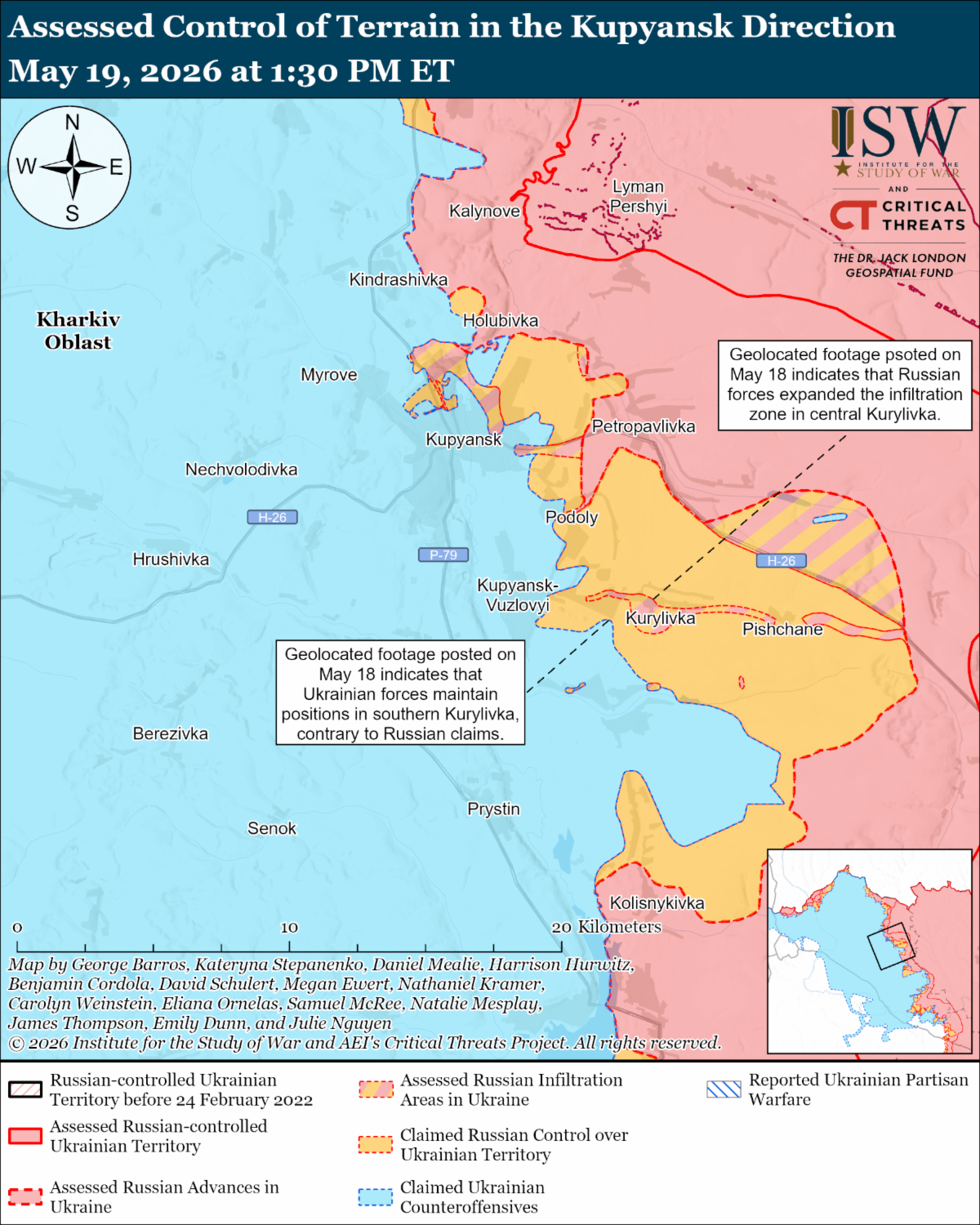
  • Ukrainian forces recently advanced in northern Kharkiv Oblast and in the Kupyansk and Hulyaipole directions. 

  • Russian forces launched 209 drones toward Ukraine overnight.  

EMAIL SUBSCRIPTION OPTIONS

ISW offers customizable email subscription options. Click below to learn more and customize your preferences.

ISW is powered by the support of individuals like you.

Help us stay independent and impactful.

Website | Jobs | Internships

Follow ISW on social media:

FacebookXYouTube | InstagramLinkedIn | Threads | Bluesky

© 2026 Institute for the Study of War and AEI’s Critical Threats Project. All rights reserved.

Donate online or by sending a check to the Institute for the Study of War at 1400 16th Street NW, Suite #515, Washington, DC 20036. Please consider including the Institute for the Study of War in your estate plans.


ISW is a tax-exempt organization under section 501(c)(3) of the Internal Revenue Code. Donations are tax-deductible to the extent permitted by law.

ISW is a non-partisan, non-profit, public policy research organization. ISW advances an informed understanding of military affairs through reliable research, trusted analysis, and innovative education. We are committed to improving the nation’s ability to execute military operations and respond to emerging threats in order to achieve US strategic objectives.

댓글 달기

이메일 주소는 공개되지 않습니다. 필수 필드는 *로 표시됩니다

위로 스크롤