[ISW] 이란 업데이트 특별 보고서, 2026년 5월 21일

“`html

핵심 내용 요약:

  • 이란은 미국과 이란 사이의 간극을 좁히기 위한 중재 노력에도 불구하고, 최신 미국 제안에 대한 답변을 제출하지 않았습니다. 5월 21일, 미국과 이란 관리 모두 핵무기와 호르무즈 해협이 협상의 두 가지 “난관”으로 남아 있다고 밝혔습니다. 이란 관리들은 특히 고농축 우라늄(HEU) 비축량을 해외로 보내야 하는지에 대해 잠재적인 핵 양보에 대한 의견이 분분해 보입니다. 보도에서는 이란 유출자들의 직위나 동기를 밝히지 않았지만, Mojtaba의 지시와 그 이후의 부인에 대한 유출 내용으로 보아 이란 정권 내에서 핵 양보에 대한 이견이 있음을 시사합니다.
  • 이란 관리들은 핵 문제에 대한 분열과는 대조적으로 호르무즈 해협 통과에 대한 이란의 통제를 공식화하라는 요구를 중심으로 뭉쳤습니다. 호르무즈 해협에 대한 이란의 요구는 이란 관리들이 자신들이 전쟁에서 승리했다고 믿고 있음을 보여줍니다. 이는 호르무즈 해협에 대한 이란의 통제를 공식화하는 것이 다른 국가의 주권 영토에 대한 영유권 주장과 같기 때문입니다.
  • 이란은 페르시아 만에서 자국의 보호비 명목으로 선박들이 이란군의 공격을 피하기 위해 이란이 선호하는 메커니즘을 통해 호르무즈 해협을 통과할 때 대가를 지불하거나, 협력하거나, 허가를 받도록 하는 시스템에 대한 지지를 계속해서 구축하려 시도하고 있습니다.
  • 이란은 휴전 기간을 이용하여 드론 및 미사일 프로그램을 재건하고 있습니다. 이란의 드론 프로그램은 탄도 미사일 프로그램에 비해 장기간에 걸쳐 훼손하기가 훨씬 어렵습니다. 드론 프로그램은 탄도 미사일 프로그램에 비해 덜 복잡하고 더 쉽게 생산할 수 있는 시스템에 의존합니다. 탄도 미사일 프로그램은 (예를 들어 고체 연료용 플래닛 믹서와 같이) 극도로 전문화된 장비를 갖춘 거대한 시설을 필요로 합니다.
  • 중국(PRC)과 러시아는 이란의 드론 및 미사일 프로그램을 재건하는 데 도움을 주고 있습니다. CNN에 따르면, 정보 평가에 정통한 미국 관리들은 중국이 미사일 부품을 보냈다고 밝혔습니다. 이 미사일 부품이 이란에 도달했다는 증거는 없습니다.

관련 최신 자료 및 링크:

“`

[원문]

Iran has not submitted a response to the latest US proposal as multiple mediators continue efforts to narrow gaps between the United States and Iran.

May 21, 2026

Data Cutoff: 2:00 PM ET

Ben Rezaei, Katherine Wells, Carolyn Moorman, Avery Borens, and Brian Carter

As the Middle East crisis evolves, ISW urgently needs your support.

Help us stay independent and impactful.

TOPLINES

Iran has not submitted a response to the latest US proposal as multiple mediators continue efforts to narrow gaps between the United States and Iran. Both US and Iranian officials said on May 21 that nuclear weapons and the Strait of Hormuz remain the two “sticking points” on negotiations. Axios reported on May 20 that Pakistan and Qatar drafted a revised memo to bridge US-Iran gaps, while other mediators, including Saudi Arabia, Turkey, and Egypt, have supported the effort. Iranian media reported on May 21 that Iran is still reviewing the proposal and has not yet responded. Iranian media added that Iran is discussing the Iranian text’s overarching framework, some details, and confidence-building measures as guarantees. It stated that the text has narrowed some gaps “to some extent,” but that further progress depends on whether the United States moves away from military threats.

Iranian officials appear divided over potential nuclear concessions, especially whether Iran should send its highly enriched uranium (HEU) stockpile abroad. Two unspecified senior Iranian sources told Reuters on May 21 that Iranian Supreme Leader Mojtaba Khamenei issued a directive that Iran’s HEU should remain inside Iran. The sources added that top Iranian officials believe that sending the HEU stockpile abroad would leave Iran more vulnerable to future US and Israeli attacks. An unspecified US official and another unspecified senior Iranian official denied the existence of a directive from Mojtaba on May 21, however. The senior Iranian official confirmed that Iran’s consistent position is to down-blend the stockpile inside Iran, however. Iranian Foreign Affairs Ministry Spokesperson Esmail Baghaei stated on May 21 that the negotiations focus on ending the war on all fronts, including in Lebanon, “at this stage,” and that media claims about nuclear issues, including enriched materials or enrichment, “are merely media speculation and lack credibility.”

The reporting does not clarify the seniority of the Iranian leakers or clarify their motives, but the leaks about the alleged directive from Mojtaba and subsequent denials suggest disagreement within the Iranian regime over nuclear concessions. Top US officials, including Vice President JD Vance and Secretary of State Marco Rubio, have highlighted the “fractures” in the regime in recent days and have noted that these fractures are causing challenges as negotiations continue. ISW-CTP continues to assess that Islamic Revolutionary Guards Corps (IRGC) Commander Major General Ahmad Vahidi plays a dominant role in policy formation. Vahidi and those around him reportedly previously opposed discussions over the nuclear issue, while the Iranian negotiating team led by Mohammad Bagher Ghalibaf and Iranian Foreign Affairs Minister Abbas Araghchi discussed the nuclear issue during the first round of US-Iran talks in Islamabad. The Associated Press also noted that Ghalibaf and Araghchi faced “criticism” for showing too much willingness to make concessions in Islamabad. Ghalibaf and Araghchi reportedly discussed the nuclear issue “contrary to instructions from Tehran.” Such instructions, ISW-CTP noted at the time, could have only come from Vahidi or the supreme leader. The leaks and denials about Mojtaba’s directive on May 21 are emblematic of this debate, which has been playing out since April.

KEY TAKEAWAYS

  • Iran has not submitted a response to the latest US proposal as multiple mediators continue efforts to narrow gaps between the United States and Iran. Both US and Iranian officials said on May 21 that nuclear weapons and the Strait of Hormuz remain the two “sticking points” on negotiations. Iranian officials appear divided over potential nuclear concessions, especially whether Iran should send its highly enriched uranium (HEU) stockpile abroad. The reporting does not clarify the seniority of the Iranian leakers or clarify their motives, but the contents of the leaks about the alleged directive from Mojtaba and subsequent denials suggest disagreement within the Iranian regime over nuclear concessions. 

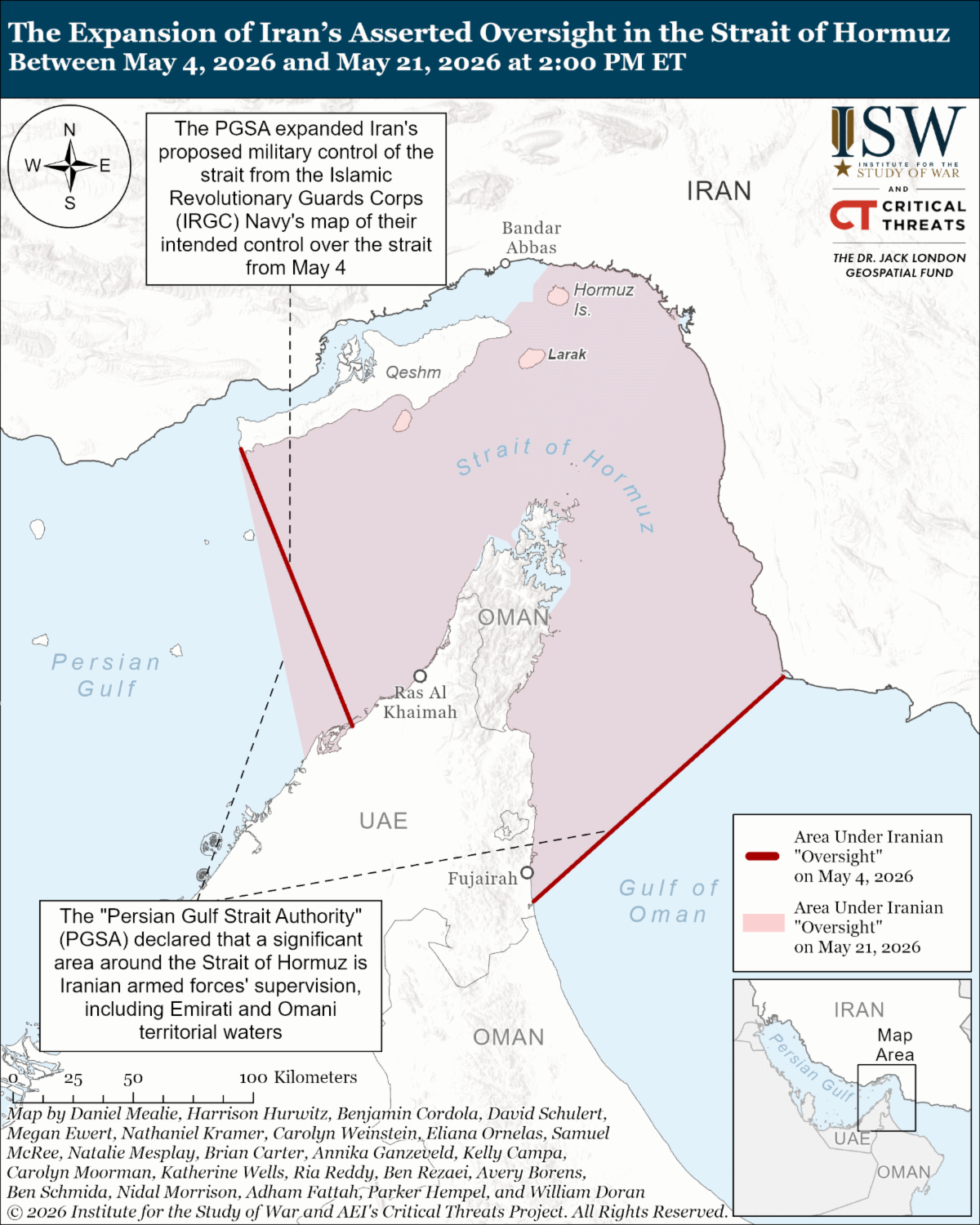
  • Iranian officials have coalesced around demands to formalize Iranian control over Strait of Hormuz transit, in contrast to their apparent division over the nuclear file. Iran’s demands over the Strait of Hormuz demonstrate that Iranian officials believe they won the war because formalizing Iranian control over the Strait of Hormuz is a territorial claim on the sovereign territory of another country.

  • Iran continues to attempt to build support for its protection racket in the Persian Gulf, in which vessels must pay, coordinate with, or receive permission from Iran’s preferred mechanism to transit the Strait of Hormuz in order to avoid attacks from Iranian forces.

  • Iran is continuing to use the ceasefire period to reconstitute its drone and missile program. Iran’s drone program is far more difficult to degrade for long periods of time compared to the ballistic missile program. The drone program relies on less complex and more easily-produced systems compared to the ballistic missile program, which requires huge facilities with extremely specialized equipment (like planetary mixers for solid fuel, for example).

  • The People’s Republic of China (PRC) and Russia are helping Iran reconstitute its drone and missile program. The PRC has sent missile components, according to US officials familiar with intelligence assessments, speaking to CNN. There is no evidence that these missile components reached Iran.

Website | Jobs | Internships

Follow ISW on social media:

FacebookXYouTube | InstagramLinkedIn | Threads | Bluesky

© 2026 Institute for the Study of War and AEI’s Critical Threats Project. All rights reserved.

Donate online or by sending a check to the Institute for the Study of War at 1400 16th Street NW, Suite #515, Washington, DC 20036. Please consider including the Institute for the Study of War in your estate plans.

ISW is a tax-exempt organization under section 501(c)(3) of the Internal Revenue Code. Donations are tax-deductible to the extent permitted by law.

ISW is a non-partisan, non-profit, public policy research organization. ISW advances an informed understanding of military affairs through reliable research, trusted analysis, and innovative education. We are committed to improving the nation’s ability to execute military operations and respond to emerging threats in order to achieve US strategic objectives.

댓글 달기

이메일 주소는 공개되지 않습니다. 필수 필드는 *로 표시됩니다

위로 스크롤