[ISW] 러시아 공세 캠페인 평가, 2025년 9월 9일

“`html

핵심 요약

  • 러시아의 영토 점령은 2025년 봄에 비해 최근 4개월 동안 비용이 감소했습니다. 러시아군은 점령한 평방 킬로미터당 사상자 비율이 낮아졌기 때문입니다.

  • 러시아군의 평방 킬로미터당 사상자 비율은 2025년 첫 4개월 동안 최고조에 달했습니다. 러시아군은 2024년 가을에 시작된 공세 작전의 강도 높은 속도를 유지하기 위해 싸웠습니다.

  • 2025년 첫 4개월 동안 러시아의 진격 속도가 둔화되기 시작했습니다. 러시아의 사상자는 꾸준히 유지되었고, 그 결과 2025년 1월부터 4월까지 러시아의 사상자 비율이 높아졌습니다.

  • 러시아군은 2025년 5월에 더 빠른 진격을 시작했고, 최근 4개월 동안 더 빠른 속도로 진격을 유지했습니다. 러시아의 사상자가 약간 감소했지만, 러시아군은 여전히 ​​발걸음으로 전진하고 있습니다.

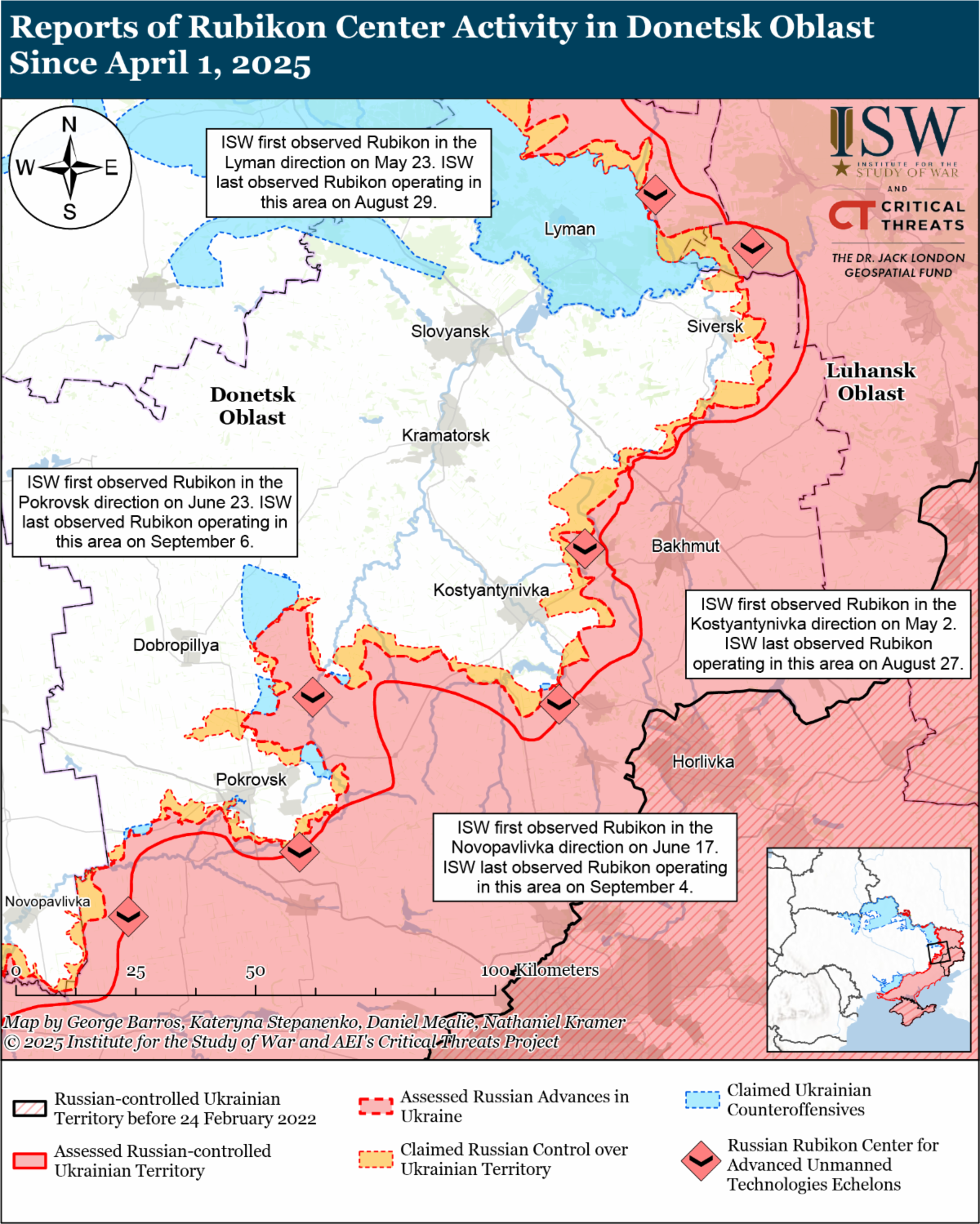
  • 러시아의 사상자 비율은 러시아가 전장 항공 차단(BAI)의 일부 효과를 창출하기 위해 UAV(무인 항공기) 사용에 대한 새로운 강조를 통해 우크라이나에서 감소했을 가능성이 있습니다. 이는 주로 러시아 루비콘 첨단 무인 기술 센터의 UAV 운영자들이 주도했습니다.

  • 최근 러시아 여론 조사는 러시아 국민의 전쟁 지지율이 높은 수준을 유지하고 있음을 시사합니다. 사상자가 증가하고 전장에서의 진격이 비교적 느림에도 불구하고 말입니다.

  • 우크라이나는 러시아 에너지 기반 시설에 대한 공격을 계속하고 있습니다.

  • 우크라이나군은 9월 8일 점령된 도네츠크시 인근 및 내부에 있는 3개의 러시아 지휘소를 상대로 합동 공격을 감행한 것으로 알려졌습니다.

  • 러시아 국무원 관계자들은 핀란드를 위협하기 위한 크렘린이 조직한 상향식 노력을 벌이고 있습니다.

  • 러시아군은 도네츠크주 이동식 연금 분산 지점에 대한 공격을 감행하여 주로 노인 민간인 수십 명이 사망하고 부상을 입었습니다.

  • 우크라이나군은 최근 코스티안티니우카-드루지키우카 전술 지역에서 진격했습니다. 러시아군은 최근 노보파블리우카 인근에서 진격했습니다.


최신 자료 및 관련 링크

  • 우크라이나 전쟁 상황 분석 (최신 정보): 전쟁 관련 최신 상황, 전황, 각국의 입장 및 분석 등을 다루는 뉴스 기사나 보고서를 제공합니다. (예: ISW(Institute for the Study of War) 보고서, 주요 외신 보도 등).
    ISW (Institute for the Study of War) – ISW는 매일 우크라이나 전쟁의 최신 상황을 분석하는 보고서를 발간합니다. 이 보고서들은 지리적, 군사적 측면을 포함하여 상세한 분석을 제공하며, 위에 언급된 내용들의 근거를 파악하는데 도움이 될 수 있습니다. (주의: 해당 링크는 영어로 제공됩니다.)
  • 러시아군 전술 및 UAV 활용: 러시아군의 전술 변화, 특히 UAV(무인 항공기) 활용에 대한 분석 자료. 루비콘 센터와 같은 기관의 역할에 대한 정보 포함.
    Kyiv Post – How Russia is using drone attacks – 러시아의 드론 공격에 대한 Kyiv Post 기사 (주의: 해당 링크는 영어로 제공됩니다.)
  • 러시아 내 여론 동향: 러시아 국내의 전쟁 관련 여론 조사 결과 및 분석 자료. 전쟁 지지율, 사상자 증가에 대한 반응 등을 다룹니다.
    (예: 러시아 독립 여론 조사 기관 레바다 센터 (Levada Center)의 자료. 레바다 센터는 종종 러시아 내 여론 조사를 실시하며, 전쟁에 대한 러시아인들의 태도를 파악하는데 도움이 됩니다.) (주의: 레바다 센터의 자료는 러시아어로 제공될 수 있습니다.)
  • 우크라이나 내 에너지 기반 시설 공격: 우크라이나 에너지 기반 시설에 대한 러시아의 공격 관련 뉴스 및 분석.
    Reuters – Ukraine says Russian missiles hit energy infrastructure in several regions – Reuters 기사 (주의: 해당 링크는 영어로 제공됩니다.)
  • 전선 상황 및 군사 작전: 도네츠크시, 코스티안티니우카-드루지키우카, 노보파블리우카 등 전선 지역의 최근 군사 작전 및 진격 상황에 대한 정보. (예: 구글 맵을 활용한 전황 지도, 군사 전문가의 분석).
    ISW (Institute for the Study of War) – 위에 언급된 ISW 보고서들은 전선 상황 및 군사 작전에 대한 최신 정보를 제공합니다.

참고: 위에 제공된 링크들은 예시이며, 상황에 따라 관련 정보를 제공하는 다른 자료를 참고하는 것이 좋습니다. 또한, 정보의 출처를 항상 확인하고, 여러 출처를 통해 교차 검증하는 것이 중요합니다.

“`

[원문]

Russian territorial gains have become less costly over the last four months compared to Spring 2025 as Russian forces are sustaining a lower casualty rate per square kilometer seized.

September 9, 2025

Information Cutoff: 7:00 pm ET

Jennie Olmsted, Christina Harward, Angelica Evans, Olivia Gibson, Daria Novikov, and Karolina Hird

TOPLINES

Russian territorial gains have become less costly over the last four months compared to Spring 2025 as Russian forces are sustaining a lower casualty rate per square kilometer seized. Ukrainian Commander-in-Chief General Oleksandr Syrskyi reported on September 9 that Russian forces have suffered 299,210 casualties since January 2025. ISW assesses that Russian forces gained a total of 1,910.39 square kilometers of territory in Ukraine in May, June, July, and August 2025, and the Ukrainian General Staff’s daily Russian casualty reports indicate that Russian forces suffered 130,160 casualties in that same time frame, averaging to 68 casualties per square kilometer seized between May and August 2025. ISW assesses that Russian forces seized 499.28 square kilometers in May 2025; 465.8 square kilometers in June 2025; 445.88 square kilometers in July 2025; and 499.43 in August 2025. Ukrainian General Staff data indicates that Russian forces suffered 35,370 casualties in May 2025; 32,680 in June 2025; 33,230 in July 2025; and 28,880 in August 2025. This means that Russian forces averaged roughly 71 casualties per square kilometer in May 2025; 70 casualties per square kilometer in June 2025; 75 casualties per square kilometer in July 2025; and 68 casualties per square kilometer in August 2025. Russian casualty rates per square kilometer gained have substantially decreased over the last four months compared to January through April 2025, when Russian forces were losing 99 casualties per square kilometer.

Russian casualty rates per square kilometer peaked in the first four months of 2025 as Russian forces fought to maintain the intensified pace of offensive operations they began in the Fall of 2024. Russian forces lost an estimated average of 59 casualties per square kilometer gained during the first four months of their intensified 2024 offensive campaign (between September and December 2024). Russian forces concentrated their offensive operations in western Donetsk Oblast and counteroffensive operations in Kursk Oblast in Fall 2024 and made tactically significant advances in the Kursk, Pokrovsk, Kurakhove (now Novopavlivka), and Velyka Novosilka (now Velykomykhailivka) areas. Russian forces were still frequently using armored vehicles to advance during Fall 2024, which likely helped preserve some Russian lives. Russian forces were mainly advancing in small infantry assaults during Fall 2024, as they were as of August 2025, but Russian forces largely abandoned use of armored vehicles in late 2024 and early Spring 2025, and this change in tactics likely contributed to increased Russian casualty rates in the first few months of 2025.

Russian advances began to slow during the first four months of 2025 as Russian casualties remained consistent, resulting in a higher Russian casualty rate between January and April 2025. Russian forces suffered an average of 99 casualties per square kilometer gained in January, February, March, and April 2025. Russian advances significantly increased in March 2025 with the elimination of the Ukrainian salient in Kursk Oblast, which coincided with the temporary cessation of US intelligence sharing with Ukraine, although Russian advances on average decreased between January, February, and April 2025. Russian gains also slowed as Russian forces came up against better-defended Ukrainian positions in and around larger towns such as Kupyansk, Chasiv Yar, Toretsk, and Pokrovsk during Spring 2025. Russian gains slowed by 45 percent between January and April 2025 compared to gains between September and December 2024, although Russian casualty rates only decreased by 10 percent during those four months. Russian forces also began to more frequently use unarmored vehicles such as motorcycles and open-air buggies during this time, and therefore began to suffer a higher killed-in-action (KIA) to wounded-in-action (WIA) ratio.

KEY TAKEAWAYS

  • Russian territorial gains have become less costly over the last four months compared to Spring 2025 as Russian forces are sustaining a lower casualty rate per square kilometer seized.
  • Russian casualty rates per square kilometer peaked in the first four months of 2025 as Russian forces fought to maintain the intensified pace of offensive operations they began in Fall 2024.
  • Russian advances began to slow during the first four months of 2025 as Russian casualties remained consistent, resulting in a higher Russian casualty rate between January and April 2025.
  • Russian forces began to make quicker gains in May 2025 and have sustained a faster rate of advance over the last four months as Russian casualties marginally decreased, although Russian forces continue to advance at footpace.
  • Russian casualty rates have likely decreased in Ukraine due to Russia’s renewed emphasis on using UAVs to generate some effects of battlefield air interdiction (BAI), largely led by UAV operators of Russia’s Rubikon Center for Advanced Unmanned Technologies.
  • Recent Russian polling suggests that support among the Russian population for the war remains high despite growing casualties and relatively slow advances on the battlefield.
  • Ukraine continues to strike Russian energy infrastructure.
  • Ukrainian forces reportedly conducted a combined strike against three Russian command posts in and near occupied Donetsk City on September 8.
  • Russian State Duma officials are engaging in a top-down Kremlin-organized effort to threaten Finland.
  • Russian forces conducted a strike against a mobile pension dispersal point in Donetsk Oblast that killed and wounded dozens of mostly elderly civilians.
  • Ukrainian forces recently advanced in the Kostyantynivka-Druzhkivka tactical area. Russian forces recently advanced near Novopavlivka.

NEW EMAIL SUBSCRIPTION OPTIONS

ISW has launched newly customizable email subscription options. Existing subscribers have been auto enrolled in all lists. Click below to learn more about these options and customize your preferences.

ISW is powered by the support of individuals like you.

Help us stay independent and impactful.

Website | Jobs & Internships

Follow ISW on social media:

FacebookXYouTube | InstagramLinkedIn | Threads | Bluesky

© 2025, Institute for the Study of War

Donate online or by sending a check to the Institute for the Study of War at 1400 16th Street NW, Suite #515, Washington, DC 20036. Please consider including the Institute for the Study of War in your estate plans.


ISW is a tax-exempt organization under section 501(c)(3) of the Internal Revenue Code. Donations are tax-deductible to the extent permitted by law.

ISW is a non-partisan, non-profit, public policy research organization. ISW advances an informed understanding of military affairs through reliable research, trusted analysis, and innovative education. We are committed to improving the nation’s ability to execute military operations and respond to emerging threats in order to achieve US strategic objectives.

댓글 달기

이메일 주소는 공개되지 않습니다. 필수 필드는 *로 표시됩니다

위로 스크롤