[ISW] 이란 업데이트, 2025년 9월 9일

“`html

핵심 요약:

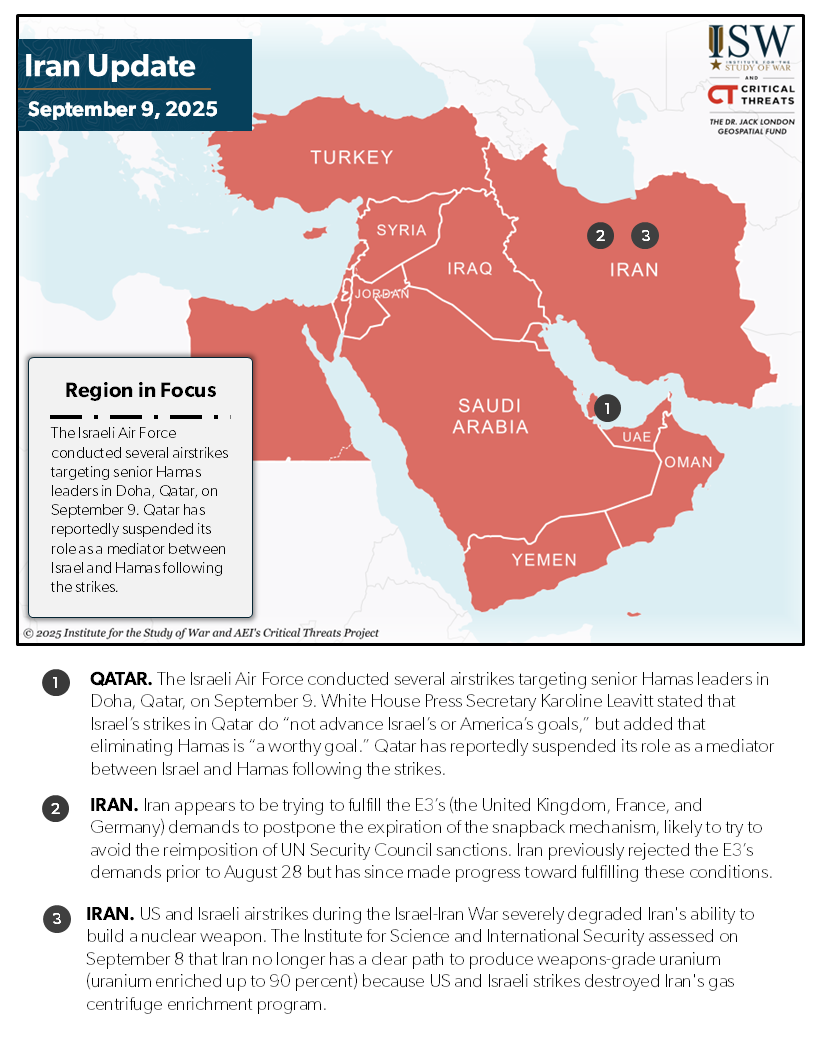
  • 도하에서 하마스 지도자 공격: 이스라엘 공군은 9월 9일 카타르 도하에서 하마스 고위 지도자들을 겨냥한 여러 차례의 공습을 감행했습니다. 백악관 대변인 Karoline Leavitt는 카타르 내 이스라엘의 공격이 “이스라엘이나 미국의 목표를 진전시키지 못한다”고 말했지만, 하마스 제거는 “가치 있는 목표”라고 덧붙였습니다. 보도에 따르면 카타르는 이 공습 이후 이스라엘과 하마스 간의 중재 역할을 중단했습니다.
  • 스냅백 제재 회피를 위한 이란의 노력: 이란은 스냅백 메커니즘의 만료를 연기하기 위해 E3(영국, 프랑스, 독일)의 요구를 충족시키려 노력하는 것으로 보이며, 이는 유엔 안전보장이사회 제재의 재부과를 피하기 위한 시도로 추정됩니다. 이란은 8월 28일 이전에 E3의 요구를 거부했으나 이후 이러한 조건을 충족하기 위해 진전을 보였습니다.
  • 이란 핵 프로그램: 이스라엘-이란 전쟁 중 미국과 이스라엘의 공습은 이란의 핵무기 제조 능력을 심각하게 저하시켰습니다. 과학 및 국제 안보 연구소는 9월 8일, 미국과 이스라엘의 공습으로 이란의 가스 원심분리기 농축 프로그램이 파괴되었기 때문에 이란은 더 이상 무기급 우라늄(90%까지 농축된 우라늄)을 생산할 명확한 경로를 가지고 있지 않다고 평가했습니다.

최신 자료 및 관련 링크:

참고: 제공된 링크들은 현재 시점 (2024년 9월 11일) 기준으로 관련 정보를 담고 있습니다. 뉴스 기사의 경우, 시간의 흐름에 따라 내용이 변경될 수 있습니다.

“`

[원문]

The Israeli Air Force (IAF) conducted several airstrikes targeting senior Hamas leaders in Doha, Qatar, on September 9.

September 9, 2025

Information Cutoff: 2:00 pm ET

Adham Fattah, Avery Borens, Ria Reddy, Ben Rezaei, Ben Schmida, Nidal Morrison, Parker Hempel, Henry Jenks, Andie Parry, and Annika Ganzeveld 

TOPLINES

The Israeli Air Force (IAF) conducted several airstrikes targeting senior Hamas leaders in Doha, Qatar, on September 9. Several IAF fighter jets dropped at least 10 munitionson a residential building in northern Doha. Several Hamas Political Bureau members resided at the targeted building, according to the Qatari Foreign Affairs Ministry. Senior Hamas officials and ceasefire negotiators, including Hamas Shura Council and Leadership Council head Mohammad Darwish and senior Hamas official and negotiator Nizar Awadallah, were reportedly meeting at the residence to review a recent US ceasefire proposal at the time of the strikes. The Israeli strikes reportedly killed several Hamas officials, including:

  • Khalil al Hayya: Hayya was the leader of Hamas in the Gaza Strip, the leader of Hamas’ ceasefire negotiation team, and a member of Hamas’ Leadership Council.

  • Zaher Jabarin: Jabarin was the leader of Hamas in the West Bank, a member of Hamas’ Leadership Council, and a member of Hamas’ ceasefire negotiation team.

  • Khaled Meshaal: Meshaal was a member of Hamas’ Leadership Council.

Iran appears to be trying to fulfill the E3’s (the United Kingdom, France, and Germany) demands to postpone the expiration of the snapback mechanism, likely to try to avoid the reimposition of UN Security Council (UNSC) sanctions. The E3 triggered the snapback mechanism on August 28. The snapback process lasts 30 days, which means that UNSC sanctions will automatically be reimposed on Iran on September 27 if the UNSC does not extend sanctions relief for Iran. South Korea, which is the current president of the UNSC, finalized a UNSC resolution on September 8 to extend sanctions relief for Iran.[16] South Korea was required to table such a resolution 10 days after the E3 triggered the snapback mechanism if no other UNSC member did so. Any permanent UNSC member (the United States, the United Kingdom, France, China, and Russia) can veto the South Korean resolution. The E3 previously outlined three conditions to extend the expiration date of the snapback mechanism, which is currently October 18, 2025. The three conditions are that Iran must account for its highly enriched uranium (HEU) stockpile, fully cooperate with the International Atomic Energy Agency (IAEA) regarding inspections and verification of its nuclear sites, and resume negotiations with the United States. Iran rejected these conditions prior to August 28 but has since made progress toward fulfilling these conditions.

US and Israeli airstrikes during the Israel-Iran War severely degraded Iran’s ability to build a nuclear weapon. The Institute for Science and International Security assessed on September 8 that Iran no longer has a clear path to produce weapons-grade uranium (uranium enriched up to 90 percent) because US and Israeli strikes destroyed Iran’s gas centrifuge enrichment program. The Institute assessed that US and Israeli strikes destroyed or rendered inoperable all of Iran’s 20,000 centrifuges that it had installed across its three declared enrichment facilities. The International Atomic Energy Agency (IAEA) recently reported that Iran possessed 440.9 kilograms of uranium enriched up to 60 percent before the start of the Israel-Iran War on June 12. Iran would need to further enrich its 60 percent enriched uranium to be able to build a nuclear weapon. US and Israeli strikes also targeted Iran’s centrifuge production and research and development facilities, which will almost certainly also hinder Iran’s ability to enrich uranium in the near future.

KEY TAKEAWAYS

  • Israeli Strikes Targeting Hamas Leaders in Doha: The Israeli Air Force conducted several airstrikes targeting senior Hamas leaders in Doha, Qatar, on September 9. White House Press Secretary Karoline Leavitt stated that Israel’s strikes in Qatar do “not advance Israel’s or America’s goals,” but added that eliminating Hamas is “a worthy goal.” Qatar has reportedly suspended its role as a mediator between Israel and Hamas following the strikes.  

  • Iranian Efforts to Avoid Snapback Sanctions: Iran appears to be trying to fulfill the E3’s (the United Kingdom, France, and Germany) demands to postpone the expiration of the snapback mechanism, likely to try to avoid the reimposition of UN Security Council sanctions. Iran previously rejected the E3’s demands prior to August 28 but has since made progress toward fulfilling these conditions. 

  • Iranian Nuclear Program: US and Israeli airstrikes during the Israel-Iran War severely degraded Iran’s ability to build a nuclear weapon. The Institute for Science and International Security assessed on September 8 that Iran no longer has a clear path to produce weapons-grade uranium (uranium enriched up to 90 percent) because US and Israeli strikes destroyed Iran’s gas centrifuge enrichment program. 

NEW EMAIL SUBSCRIPTION OPTIONS

ISW has launched newly customizable email subscription options. Existing subscribers have been auto enrolled in all lists. Click below to learn more about these options and customize your preferences.

ISW is powered by the support of individuals like you.

Help us stay independent and impactful.

Website | Jobs & Internships

Follow ISW on social media:

FacebookXYouTube | InstagramLinkedIn | Threads | Bluesky

Donate online or by sending a check to the Institute for the Study of War at 1400 16th Street NW, Suite #515, Washington, DC 20036. Please consider including the Institute for the Study of War in your estate plans.

ISW is a tax-exempt organization under section 501(c)(3) of the Internal Revenue Code. Donations are tax-deductible to the extent permitted by law.

ISW is a non-partisan, non-profit, public policy research organization. ISW advances an informed understanding of military affairs through reliable research, trusted analysis, and innovative education. We are committed to improving the nation’s ability to execute military operations and respond to emerging threats in order to achieve US strategic objectives.

댓글 달기

이메일 주소는 공개되지 않습니다. 필수 필드는 *로 표시됩니다

위로 스크롤