|
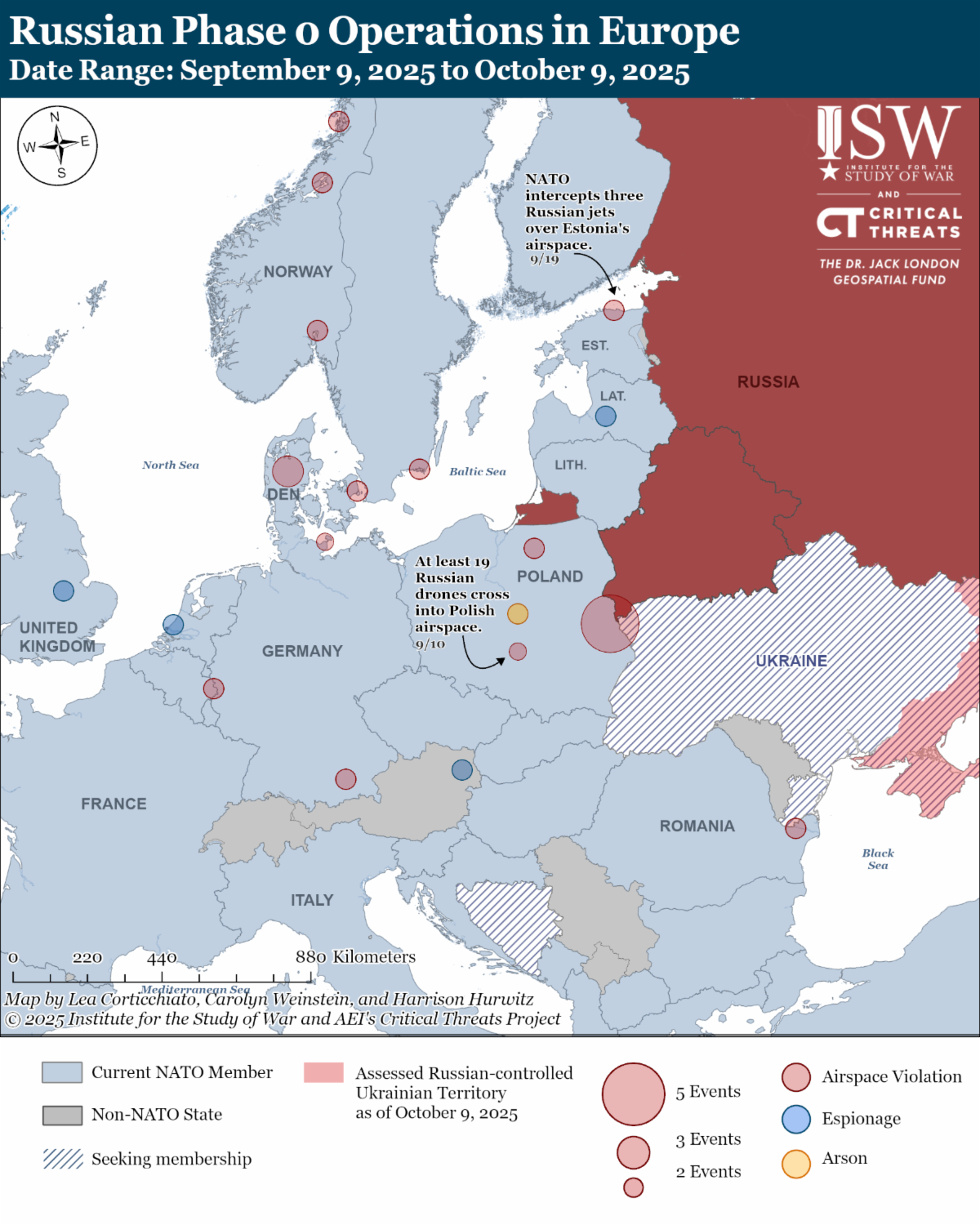
EU and NATO states continue to take steps to increase European defenses against covert and overt Russian attacks. The European Parliament overwhelmingly voted on October 9 in favor of a resolution condemning Russia’s recent “escalatory actions” in violating Polish, Estonian, Latvian, Lithuanian, and Romanian airspace. The resolution passed the parliament with 469 votes in favor, 97 against, and 38 abstentions. The parliament noted that Russia bears full and unequivocal responsibility for the actions in Polish, Estonian, and Romanian airspace. The European Parliament denounced Russia’s deliberate drone incursions aimed at critical infrastructure in Denmark, Sweden, and Norway. The resolution did not mention the recent drone flights over the Munich Airport, but German officials recently attributed the incursions to Russia. The resolution encouraged initiatives enabling EU states to take action against airspace violations, including by shooting down the threats, and welcomed the EU’s “drone wall” and Eastern Flank Watch initiatives. The resolution called for the EU to “substantively” increase its defense and industrial cooperation with Ukraine, especially in the fields of drone technology and countermeasures. European parliament members advocated for sanctions against entities in the People’s Republic of China (PRC) supplying dual-use goods and military items that are essential for Russia’s production of drones and missiles, and called for punitive measures against all states enabling Russian actions, such as Belarus, North Korea, and Iran. The European Parliament stated that the range of Russia’s sabotage and “hybrid” activities against the EU amounts to state-sponsored terrorism, “even if they fall below the threshold of an armed attack.” ISW assesses, however, that Russia has been increasingly engaging in covert and overt attacks against Europe and that Russia has entered “Phase 0” — the informational and psychological condition setting phase — of its campaign to prepare for a possible NATO-Russia war in the future.
The Financial Times (FT) reported on October 9 that four NATO officials stated that NATO states are discussing more forceful responses to Russia’s increasingly provocative actions. Proposals reportedly include arming reconnaissance drones that collect intelligence on Russian military activity, reducing limits on pilots’ ability to shoot down Russian threats, and conducting NATO exercises at more remote and unguarded areas near the Russian border. Two NATO official sources told the FT that the talks aim to streamline rules of engagement among NATO states, as some require pilots to visually confirm threats before engaging, while others allow pilots to open fire based on radar data or perceived danger, given the direction or speed of the object. The officials stated that the talks aim to raise the costs for Russia and to clearly define countermeasures.
Ukrainian President Volodymyr Zelensky added more details about Russia’s use of its shadow fleet to conduct recent drone incursions into European airspace. Zelensky stated on October 9 that intelligence indicates that the Russian shadow fleet consists of more than 500 tankers and that Russian special services were on board the Russian Borocay tanker that French authorities stopped off the coast of France on September 30 and seized on October 1. Maritime-focused news outlet Maritime Executive reported on September 23 that the Boracay was one of three Russian-linked vessels near the coordinated drone incursion that shut down the Copenhagen Airport on September 22.
|