|
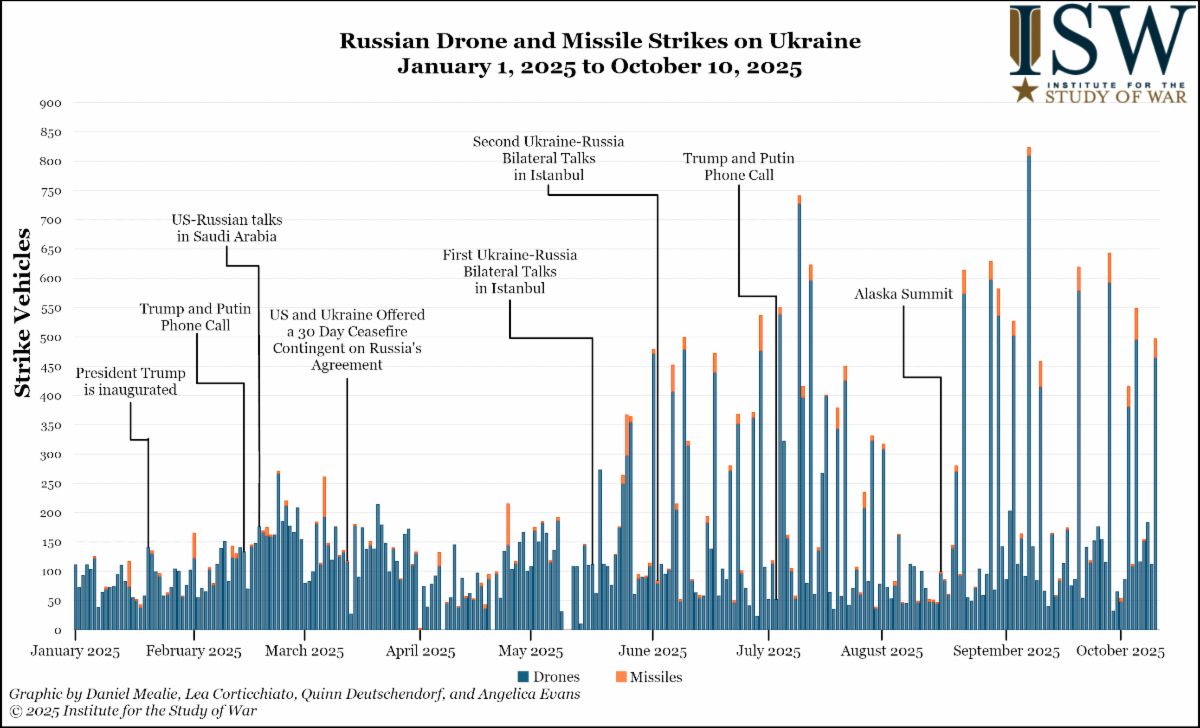
Russian forces launched a large, combined drone and missile strike against Ukraine on the night of October 9 to 10, primarily targeting energy infrastructure and civilian targets. The Ukrainian Air Force reported that Russian forces launched two Kh-47M2 Kinzhal aeroballistic missiles from Lipetsk Oblast; 14 Iskander-M/KN-23 ballistic missiles and 12 Iskander-K cruise missiles from Rostov and Bryansk oblasts and occupied Crimea; four Kh-59/69 cruise missiles; and 465 Shahed-type, Gerbera-type, and other drones – of which roughly 200 were Shahed-type drones – from the directions of Kursk and Oryol cities; Millerovo and Shakhty, Rostov Oblast; Shatalovo, Smolensk Oblast; and Primorsko-Akhtarsk, Krasnodar Krai. The Ukrainian Air Force reported that Ukrainian forces downed 405 drones; one Kh-47M2 Kinzhal aeroballistic missile; four Iskander-M/KN-23 ballistic missiles; nine Iskander-K cruise missiles; and one Kh-59/69 cruise missile, and that four missiles were “lost” or suppressed, likely by Ukrainian electronic warfare (EW). The Ukrainian Air Force reported that 13 missiles and 60 drones struck 19 locations, and downed debris fell on seven locations.
Ukrainian President Volodymyr Zelensky reported that Russian strikes injured over 20 civilians and killed a child in Zaporizhzhia City. Zelensky stated that the Russian strikes caused power outages in Kyiv City and Oblast and Donetsk, Chernihiv, Cherkasy, Kharkiv, Sumy, Poltava, Odesa, and Dnipropetrovsk oblasts, and that Russian forces also targeted Zaporizhia, Kirovohrad, and Kherson oblasts. Ukrainian Foreign Minister Andriy Sybiha noted that October 10 is also the third anniversary of the first major Russian strike on Ukrainian energy infrastructure in 2022, underscoring Russia’s annual efforts to undermine Ukrainian morale by striking energy infrastructure during the fall and winter. Poltava Oblast Military Administration Head Volodymyr Kohut reported that Russian strikes against energy infrastructure left 16,578 households in Poltava Oblast without electricity. Kyiv City Military Administration Head Timur Tkachenko reported that the Russian strikes left 5,800 apartment buildings and homes without power and water in the city. Russia has increasingly used recent strikes to target smaller regional Ukrainian energy facilities with more limited air defenses, likely in an effort to capitalize on Ukraine’s limited number of Patriot air defense systems. ISW continues to assess that Russia is prioritizing strikes against civilian and energy infrastructure to continue its long-standing campaign to degrade Ukraine’s energy security ahead of winter 2025-2026 and demoralize the Ukrainian populace. Russia’s ongoing and ever-intensifying long-range strike campaign against Ukraine is just one indicator of Russian President Vladimir Putin’s disinterest in peace.
The Kremlin continues parallel efforts to curry favor with the United States while deflecting blame onto Ukraine and Europe for stalling negotiations on ending the war in Ukraine. Russian President Vladimir Putin claimed on October 10 that Russia and the United States have an understanding of how to resolve Russia’s war in Ukraine peacefully but caveated that these are complex issues that take time to solve. Putin also claimed that he and US President Donald Trump agreed during talks in Alaska in August 2025 that both would need to consult with colleagues and allies regarding peace in Ukraine before continuing negotiations. Kremlin Spokesperson Dmitry Peskov claimed that “Ukraine’s reluctance to respond to Russia’s proposals” has stalled the Istanbul negotiation process. Russian Presidential Aide Yuriy Ushakov told Russian business outlet Kommersant in an interview published on October 10 entitled “Russia made concessions at the Anchorage talks,” that Putin articulated his willingness to make concessions on resolving Russia’s war in Ukraine and that Russia “made certain concessions [in Anchorage].” Ushakov noted Russia’s readiness to “take certain steps” toward the peace initiative but claimed that “this concession” is contingent upon the United States working with Europe and Ukraine. Ushakov’s statement appears at odds with the article’s title, given that Ushakov asserts that it would be a “mistake” for Russia to discuss any concession to Ukraine at this moment. It remains unclear why Kommersant would choose to title the article “Russia made concessions at the Anchorage talks,” as the Kremlin has consistently messaged its unwillingness to make concessions to its domestic audience and has devoted significant resources to justifying its unyielding demands to the Russian population. The Kremlin may be leveraging Kommersant’s article to gauge the Russian population’s reaction to any future Russian concessions in Ukraine, although it is unlikely that the Kremlin intends to follow through with any real concessions. ISW continues to assess that the Kremlin remains committed to currying favor with the United States as part of a dual effort to normalize bilateral relations with the United States for economic and political gain while inhibiting the peace initiative in Ukraine. ISW similarly continues to assess that Russia seeks to continue its long-standing effort to discredit Ukraine and Europe and undermine Western cohesion.
|