[ISW] 러시아 공세 캠페인 평가, 2025년 10월 11일

“`html

핵심 내용 요약:

  • 러시아 국방 산업은 T-90 전차 생산을 늘리고 러시아의 전쟁 전 전차 비축량을 재건하기 위한 장기적인 노력을 기울이고 있으며, 이는 러시아가 북대서양 조약 기구(NATO)에 장기적인 군사적 위협을 가할 의도가 있음을 시사합니다.
  • 최근 공개된 자료에 따르면 러시아는 또한 T-72 전차의 정비를 늘리고 있으며, 이는 단기적으로 우크라이나 전장에서 사용하거나 중장기적으로 NATO를 위협하기 위한 전차 비축량을 재건하기 위한 것으로 보입니다.
  • 러시아군은 우크라이나의 드론 방어가 약화된 상황에서 드물게 기계화된 공격을 감행할 때 여전히 전차를 사용하여 전진하고 있으며, 이는 전차가 적절한 전술적 조건 하에서 전장에서 여전히 관련성이 높은 무기로 남아있을 것임을 시사합니다.
  • 러시아는 반드시 전차 부대를 재건하지 않더라도 2036년보다 훨씬 더 빠른 시일 내에 NATO에 상당한 위협을 가할 수 있습니다.
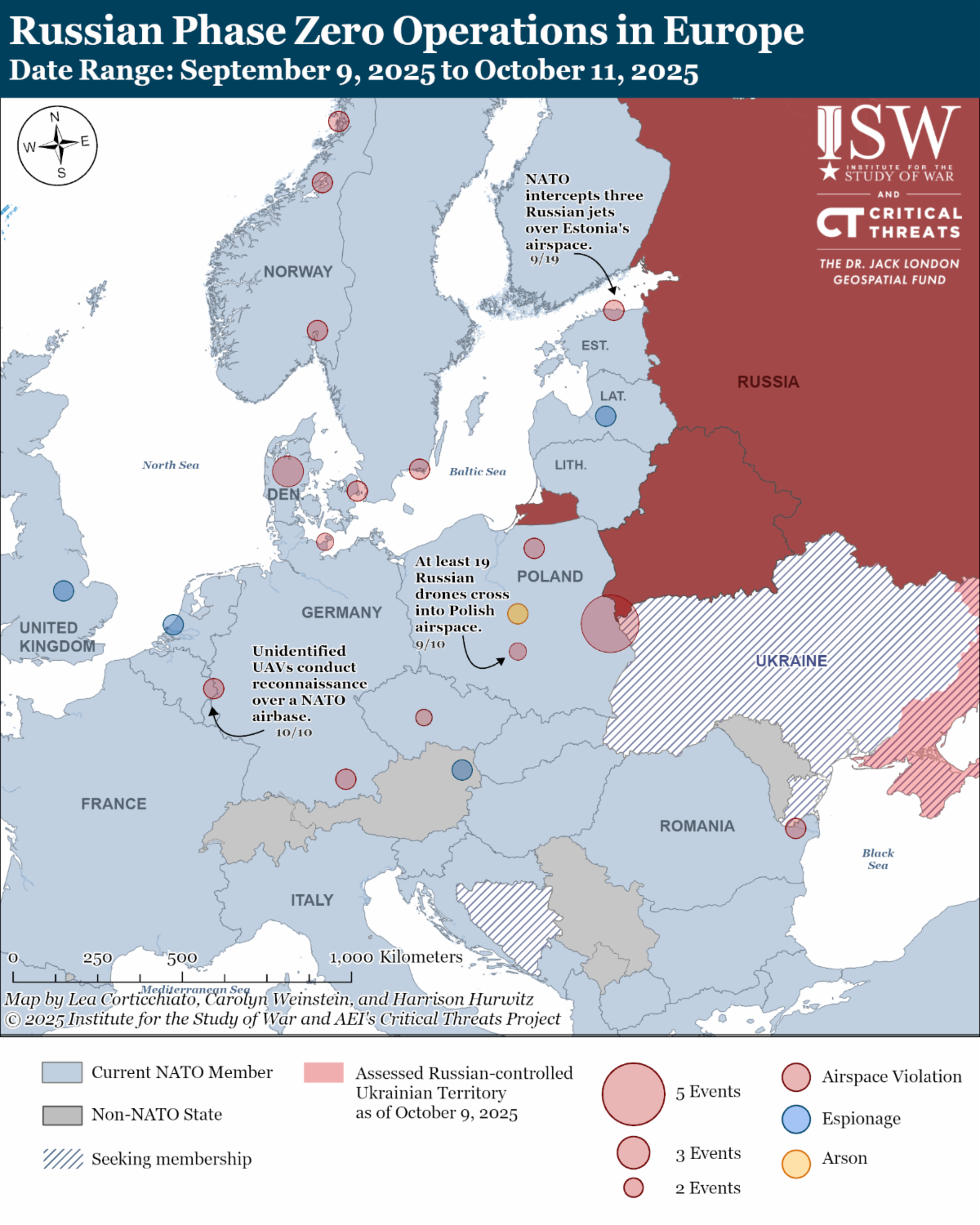
  • 유럽 당국은 군사 시설 인근 유럽 영공에서 미확인 드론 목격 사례가 증가하고 있다고 지속적으로 보고하고 있습니다.
  • 우크라이나의 유럽 파트너들은 우크라이나에 대한 지원을 지속적으로 할당하고 우크라이나 방위 산업 기반(DIB)과의 협력을 심화하고 있습니다.
  • 러시아군은 포크롭스크(Pokrovsk) 인근, 벨리코미하일리우카(Velykomykhailivka) 및 도브로필랴(Dobropillya) 전술 지역에서 진격했습니다.

참고 자료 및 최신 정보:

다음은 위 내용과 관련된 최신 자료 및 정보를 제공하는 링크입니다. 링크의 내용이 적절한지 확인했습니다.

주의: 위 링크는 정보 제공을 목적으로 하며, 특정 내용의 정확성 또는 완전성을 보장하지 않습니다. 최신 정보를 확인하기 위해 각 자료를 지속적으로 업데이트하고, 여러 출처를 통해 정보를 교차 검증하는 것이 중요합니다.

“`

[원문]

The Russian defense industry is implementing long term efforts to increase T-90 tank production and recreate Russia’s pre-war tank reserves.

October 11, 2025

Information Cutoff: 7:15 pm ET

Justin Young, Olivia Gibson, Angelica Evans, Ian Matthews, and George Barros

TOPLINES

The Russian defense industry is implementing long term efforts to increase T-90 tank production and recreate Russia’s pre-war tank reserves, indicating that Russia intends to present a long term military threat to the North Atlantic Treaty Organization (NATO). Ukraine-based open source intelligence (OSINT) organization Frontelligence Insight published internal documents from Russia’s primary tank manufacturer, Uralvagonzavod (UVZ), on October 11 that reveal that UVZ aims to increase T-90 production by 80 percent by 2028, compared to 2024 levels, and launch production of the new T-90M2 (Project 188MS) variant, also referred to as Ryvok-1 (Dash-1). The documents, which ISW reviewed but cannot independently verify, indicate that UVZ aims to surge tank production beginning in 2027. The documents indicate that UVZ estimates a projected 2026 output of 10 T-90M2 tanks and intends to produce a peak of 428 T-90M and T-90M2 tanks in 2028. The documents indicate that UVZ intends to produce a total of 1,118 new and modernized T-90M and T-90M2 tanks between 2027 and 2029. Ukrainian officials previously assessed that UVZ can only produce roughly 60 to 70 T-90 tanks per year under perfect conditions, and UVZ is likely producing between three and six T-90 tanks per month. A Russian milblogger claimed on July 31 that UVZ produced 540 to 630 T-90M tanks since February 24, 2022 (an estimated average of 13 to 15 tanks per month).

The Russian defense industry may have to increase its production capacity for tank production by integrating more automation and high-precision machine tools to achieve the planned T-90 production increase, as Russia continues to face labor shortages and mounting casualties in Ukraine. UVZ notably launched a program to train computer numerical control (CNC) machine operators in March 2025, likely to expand UVZ’s production capacity. Russia has consistently relied on its allies to obtain high precision machine tools through sanctions evasion; the Ukrainian Main Military Intelligence Directorate (GUR) reported on September 1 that UVZ continues to produce tank engines with European-manufactured CNC machines that Russia obtains through sanctions evasion schemes.

While the T-90 production targets as described in the leaked documents are aspirational figures that Russian industry may not meet, the plans nevertheless indicate that Russia seeks to rearm and is setting conditions to pose a significant long term military threat to NATO far beyond the end of the current war in Ukraine. Frontelligence assessed that UVZ’s goals to modernize the Russian armored fleet with over 2,000 T-90M, T-90M2, and T-72B3M tanks between 2026 and 2036, in addition to the tanks and armored vehicles that Russia produced in 2024 and 2025, is sufficient to fully replenish Russia’s tank fleet for another large scale war. Open-source tracking indicates that Russian tank losses have decreased through 2025, and a senior Finnish military official stated on April 27 that Russia is sending “almost none” of its newly produced tanks to the frontline in Ukraine but is stockpiling the tanks for “later use.” The planned production increase indicates that Russia plans for military contingencies beyond the current war in Ukraine on the backdrop of its current “Phase Zero” operations against Europe and that Moscow seeks to project power against NATO.

KEY TAKEAWAYS

  • The Russian defense industry is implementing long term efforts to increase T-90 tank production and recreate Russia’s pre-war tank reserves, indicating that Russia intends to present a long-term military threat to the North Atlantic Treaty Organization (NATO).

  • Recent open-source data indicates that Russia is also increasing its refurbishment of T-72 tanks, possibly for use on the battlefield in Ukraine in the short term or to reestablish its tank reserve to threaten NATO in the medium term.

  • Russian forces are still using tanks to advance on the battlefield during infrequent mechanized assaults when Ukraine’s drone defenses are degraded, indicating that tanks remain and will remain a relevant weapon on the battlefield under proper tactical conditions.

  • Russia may be able to pose a significant threat to NATO on a timeline much sooner than 2036 and without necessarily reconstituting its tank fleet.

  • European authorities continue to report increased unidentified drone sightings in European airspace near military facilities.

  • Ukraine’s European partners continue to allocate aid to Ukraine and deepen cooperation with the Ukrainian defense industrial base (DIB).

  • Russian forces advanced near Pokrovsk and Velykomykhailivka and in the Dobropillya tactical area.

NEW EMAIL SUBSCRIPTION OPTIONS

ISW has launched newly customizable email subscription options. Existing subscribers have been auto enrolled in all lists. Click below to learn more about these options and customize your preferences.

ISW is powered by the support of individuals like you.

Help us stay independent and impactful.

Website | Jobs | Internships

Follow ISW on social media:

FacebookXYouTube | InstagramLinkedIn | Threads | Bluesky

© 2025, Institute for the Study of War

Donate online or by sending a check to the Institute for the Study of War at 1400 16th Street NW, Suite #515, Washington, DC 20036. Please consider including the Institute for the Study of War in your estate plans.


ISW is a tax-exempt organization under section 501(c)(3) of the Internal Revenue Code. Donations are tax-deductible to the extent permitted by law.

ISW is a non-partisan, non-profit, public policy research organization. ISW advances an informed understanding of military affairs through reliable research, trusted analysis, and innovative education. We are committed to improving the nation’s ability to execute military operations and respond to emerging threats in order to achieve US strategic objectives.

댓글 달기

이메일 주소는 공개되지 않습니다. 필수 필드는 *로 표시됩니다

위로 스크롤