[ISW] 이란 업데이트, 2025년 10월 13일

“`html

핵심 내용 요약:

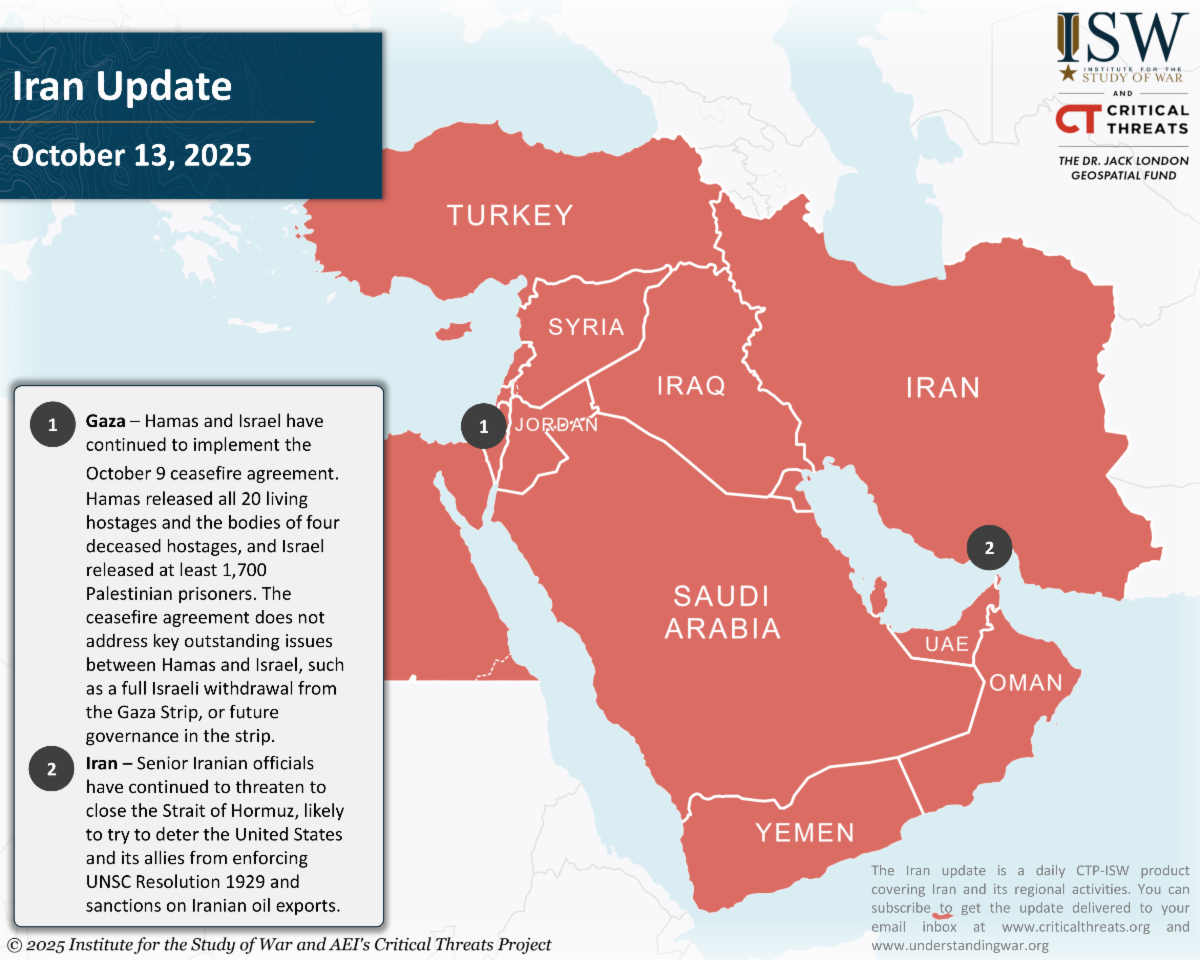
  • 하마스-이스라엘 휴전: 하마스와 이스라엘은 10월 9일 휴전 합의를 계속 이행했습니다. 하마스는 생존한 인질 20명 전원과 사망한 인질 4구의 시신을 석방했으며, 이스라엘은 10월 13일 최소 1,700명의 팔레스타인 수감자를 석방했습니다. 그러나 휴전 합의는 하마스의 무장 해제, 가자 지구에서 이스라엘의 완전한 철수, 가자 지구의 미래 통치와 같은 하마스와 이스라엘 사이의 주요 미결 문제를 다루지 않았습니다.
  • 이란의 호르무즈 해협 폐쇄 위협: 이란 고위 관리들은 호르무즈 해협 폐쇄를 위협하는 발언을 지속적으로 해왔습니다. 이는 미국과 동맹국들이 유엔 안보리 결의안 1929 및 이란 원유 수출 제재를 시행하는 것을 막기 위한 시도로 보입니다. 유엔 안보리 결의안 1929는 유엔 회원국들에게 “금지된 재래식 무기 또는 민감한 핵 또는 미사일 품목을 포함한 금지된 화물을 운반하는 것으로 의심되는 [이란] 선박을 자국 영토에서 검사”할 것을 요구합니다.

관련 최신 자료 및 링크:

참고: 위 자료들은 현재 시점(2024년 5월 10일) 기준으로 관련 내용을 담고 있으며, 시간이 지남에 따라 내용이 변경될 수 있습니다. 최신 정보를 얻기 위해서는 추가적인 검색 및 확인이 필요합니다.

“`

[원문]

Hamas and Israel have continued to implement the October 9 ceasefire agreement. Hamas released all 20 living hostages and the bodies of four deceased hostages, and Israel released at least 1,700 Pales

October 13, 2025

Information Cutoff: 2:00 pm ET

Avery Borens, Kelly Campa, Katherine Wells, Ria Reddy, and Annika Ganzeveld

TOPLINES

Hamas and Israel have continued to implement the October 9 ceasefire agreement. Hamas and Israel agreed to a ceasefire and hostage-prisoner exchange on October 9, and the Israeli government approved the agreement on October 10. The agreement called for Hamas to release all remaining hostages and Israel to release Palestinian prisoners held in Israel. Hamas released all 20 living hostages and the bodies of four deceased hostages on October 13. It is unclear when Hamas will release the remaining 24 deceased hostages. Israel previously stated that an unspecified international organization would help locate the remaining deceased hostages if Hamas did not release them by October 13. Israel released at least 1,700 Palestinian prisoners on October 13. The ceasefire agreement also calls for humanitarian aid to be delivered to the Gaza Strip. Egypt sent approximately 400 aid trucks to the Gaza Strip on October 12. The aid will be distributed after Israel inspects the trucks. Humanitarian organizations are expected to deliver approximately 600 trucks of aid per day to the Gaza Strip.

US President Donald Trump traveled to Israel and Egypt to discuss the ceasefire with regional leaders. Trump addressed the Israeli Knesset on October 13 and told reporters that “the war is over.” Trump departed Israel to attend a summit in Sharm al Sheikh, Egypt, on October 13 to discuss outstanding aspects of the US plan with Egyptian President Abdel Fattah al Sisi and other Arab and regional leaders, including Palestinian Authority President Mahmoud Abbas. Trump, Sisi, Qatari Emir Tamim bin Hamad al Thani, and Turkish President Recep Tayyip Erdogan signed a ceasefire plan during the summit. Trump said that the document, which the White House referred to as the “Gaza Peace Plan,” will “spell out rules and regulations” for the ceasefire. The US plan calls for representatives from the United States, Egypt, Qatar, and Turkey to coordinate the implementation of the ceasefire between Israel and Hamas. Two hundred US military personnel will deploy to Israel to assist with the implementation of the ceasefire alongside forces from Egypt, Qatar, Turkey, and the United Arab Emirates. The ceasefire agreement does not address key outstanding issues between Hamas and Israel, such as Hamas’ disarmament, a full Israeli withdrawal from the Gaza Strip, and future governance in the Gaza Strip. Hamas and Israel concluded talks on Trump’s peace plan after both parties agreed to the first phase of the plan, and will not resume negotiations on outstanding issues until the first phase is implemented.

KEY TAKEAWAYS

  • Hamas-Israel Ceasefire: Hamas and Israel have continued to implement the October 9 ceasefire agreement. Hamas released all 20 living hostages and the bodies of four deceased hostages, and Israel released at least 1,700 Palestinian prisoners on October 13. The ceasefire agreement does not address key outstanding issues between Hamas and Israel, such as Hamas’ disarmament, a full Israeli withdrawal from the Gaza Strip, and future governance in the strip.

  • Iranian Threats to Close the Strait of Hormuz: Senior Iranian officials have continued to threaten to close the Strait of Hormuz, likely to try to deter the United States and its allies from enforcing UNSC Resolution 1929 and sanctions on Iranian oil exports. UNSC Resolution 1929 calls on UN member states to “inspect any [Iranian] vessel on their territory suspected of carrying prohibited cargo, including banned conventional arms or sensitive nuclear or missile items.”

NEW EMAIL SUBSCRIPTION OPTIONS

ISW has launched newly customizable email subscription options. Existing subscribers have been auto enrolled in all lists. Click below to learn more about these options and customize your preferences.

ISW is powered by the support of individuals like you.

Help us stay independent and impactful.

Website | Jobs | Internships

Follow ISW on social media:

FacebookXYouTube | InstagramLinkedIn | Threads | Bluesky

Donate online or by sending a check to the Institute for the Study of War at 1400 16th Street NW, Suite #515, Washington, DC 20036. Please consider including the Institute for the Study of War in your estate plans.

ISW is a tax-exempt organization under section 501(c)(3) of the Internal Revenue Code. Donations are tax-deductible to the extent permitted by law.

ISW is a non-partisan, non-profit, public policy research organization. ISW advances an informed understanding of military affairs through reliable research, trusted analysis, and innovative education. We are committed to improving the nation’s ability to execute military operations and respond to emerging threats in order to achieve US strategic objectives.

댓글 달기

이메일 주소는 공개되지 않습니다. 필수 필드는 *로 표시됩니다

위로 스크롤