[ISW] 이란 업데이트, 2025년 10월 14일

“`html

핵심 요약:

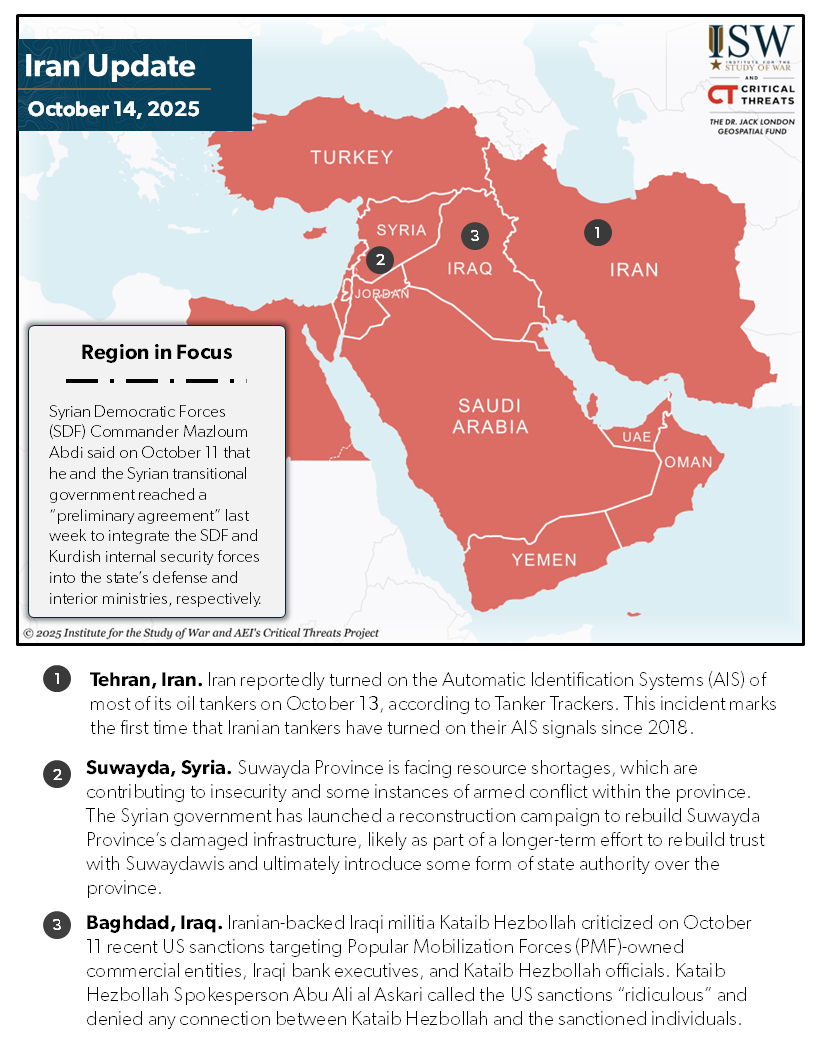
  • SDF 통합: 시리아 민주군 (SDF) 사령관 마즐룸 압디는 10월 11일, 자신과 시리아 과도 정부가 지난 주에 SDF와 쿠르드 내부 치안 부대를 각각 국방부 및 내무부에 통합하는 “예비 합의”에 도달했다고 밝혔습니다. 그러나 시리아 과도 정부와 SDF는 아직 시리아의 분권화된 거버넌스 모델에 대해 합의하지 못했습니다. 이러한 의견 불일치는 SDF의 시리아 국가 통합을 지연시키거나 방해할 수 있습니다.

    관련 최신 자료:

  • 이란 유조선 활동: Tanker Trackers에 따르면, 이란은 10월 13일, 대부분의 유조선의 자동 식별 시스템 (AIS)을 켰습니다. 이는 2018년 이후 이란 유조선이 AIS 신호를 켠 첫 번째 사례입니다.

    관련 최신 자료:

  • 미국의 이란 지원 이라크 민병대에 대한 제재: 이란의 지원을 받는 이라크 민병대인 카타이브 헤즈볼라는 인기동원군 (PMF) 소유의 상업 기업, 이라크 은행 임원, 카타이브 헤즈볼라 관계자를 대상으로 한 미국의 최근 제재를 비판했습니다. 카타이브 헤즈볼라 대변인 아부 알리 알 아스카리는 미국의 제재를 “우스꽝스러운” 것으로 칭하며 카타이브 헤즈볼라와 제재 대상 개인 간의 연관성을 부인했습니다.

    관련 최신 자료:

“`

[원문]

Syrian Democratic Forces (SDF) Commander Mazloum Abdi said on October 11 that he and the Syrian transitional government reached a “preliminary agreement”

October 14, 2025

Information Cutoff: 2:00 pm ET

Kelly Campa, Carolyn Moorman, Avery Borens, Ben Rezaei, Adham Fattah, and Annika Ganzeveld

TOPLINES

Syrian Democratic Forces (SDF) Commander Mazloum Abdi said on October 11 that he and the Syrian transitional government reached a “preliminary agreement” last week to integrate the SDF and Kurdish internal security forces into the state’s defense and interior ministries, respectively. Abdi met with Syrian President Ahmed al Shara, Defense Minister Major General Marhaf Abu Qasra, and US officials in Damascus on October 7 to agree to a ceasefire following an outbreak of violence between government forces and the SDF in Aleppo City. Abdi previously agreed to integrate all forces in northeastern Syria into state security forces in a framework agreement that he reached with Shara in March, but neither side has implemented most of the terms of the agreement. Abdi referred to the new agreement as a “preliminary agreement” and “oral agreement,” which suggests that the new agreement may represent a renewed commitment by the SDF to integrate its forces into the state and will probably necessitate further negotiations on specific implementation mechanisms. A prominent People’s Protection Units (YPG) commander led a delegation of SDF and Autonomous Administration of North and East Syria (AANES) officials to discuss “joint military and security cooperation” with Abu Qasra and Syrian Interior Minister Anas Khattab in Damascus on October 13. The Kurdish and Syrian government officials presumably discussed mechanisms to implement the new agreement.

Shara and Abdi appear to have reached at least a partial agreement about certain elements of the SDF’s integration into the new Syrian army. Abdi told AFP that the SDF will be “restructured through its integration” into the Defense Ministry but did not provide further details. Shara and Abdi have disagreed thus far over how the SDF would join the military. The SDF has consistently demanded that it integrate into the Syrian army as a “bloc” and retain its attributes, including its female units and commanders. It is unclear if Shara and Abdi have fully addressed this issue. An unspecified "informed” source told Syria TV on October 13 that Shara and Abdi agreed to establish three divisions and several brigades “from the SDF” as army units in Hasakah, Raqqa, and Deir ez Zor provinces. CTP-ISW cannot confirm this claim, but such an agreement would be consistent with the SDF’s demand to remain deployed in northeastern Syria. Abdi may also have been referring to a recent US proposal to form a joint SDF-government force to fight the Islamic State of Iraq and al Sham (ISIS). Abdi said that the SDF accepted this proposal.

The Syrian transitional government and the SDF have not yet agreed on a model for decentralized governance in Syria, however. Such disagreements may continue to delay or prevent the SDF’s integration into the Syrian state. Abdi said that he and the Syrian government share an “understanding on the principle of decentralization" but that the SDF and government “have not agreed on it” and are “still discussing finding a common formula acceptable to all." The Syrian transitional government has consistently rejected decentralization and federalism and has accused the SDF of promoting "separatism." The two parties’ disagreement over decentralization has been one of the principal disagreements that has delayed the SDF’s integration into the Syrian state.

KEY TAKEAWAYS

  • SDF Integration: Syrian Democratic Forces (SDF) Commander Mazloum Abdi said on October 11 that he and the Syrian transitional government reached a “preliminary agreement” last week to integrate the SDF and Kurdish internal security forces into the state’s defense and interior ministries, respectively. The Syrian transitional government and the SDF have not yet agreed on a model for decentralized governance in Syria, however. Such disagreements may continue to delay or prevent the SDF’s integration into the Syrian state.

  • Iranian Oil Tanker Activity: Iran reportedly turned on the automatic identification systems (AIS) of most of its oil tankers on October 13, according to Tanker Trackers. This incident marks the first time that Iranian tankers have turned on their AIS signals since 2018.

  • US Sanctions on Iranian-backed Iraqi militias: Iranian-backed Iraqi militia Kataib Hezbollah criticized recent US sanctions targeting Popular Mobilization Forces (PMF)-owned commercial entities, Iraqi bank executives, and Kataib Hezbollah officials. Kataib Hezbollah Spokesperson Abu Ali al Askari called the US sanctions “ridiculous” and denied any connection between Kataib Hezbollah and the sanctioned individuals.

NEW EMAIL SUBSCRIPTION OPTIONS

ISW has launched newly customizable email subscription options. Existing subscribers have been auto enrolled in all lists. Click below to learn more about these options and customize your preferences.

ISW is powered by the support of individuals like you.

Help us stay independent and impactful.

Website | Jobs | Internships

Follow ISW on social media:

FacebookXYouTube | InstagramLinkedIn | Threads | Bluesky

Donate online or by sending a check to the Institute for the Study of War at 1400 16th Street NW, Suite #515, Washington, DC 20036. Please consider including the Institute for the Study of War in your estate plans.

ISW is a tax-exempt organization under section 501(c)(3) of the Internal Revenue Code. Donations are tax-deductible to the extent permitted by law.

ISW is a non-partisan, non-profit, public policy research organization. ISW advances an informed understanding of military affairs through reliable research, trusted analysis, and innovative education. We are committed to improving the nation’s ability to execute military operations and respond to emerging threats in order to achieve US strategic objectives.

댓글 달기

이메일 주소는 공개되지 않습니다. 필수 필드는 *로 표시됩니다

위로 스크롤