|
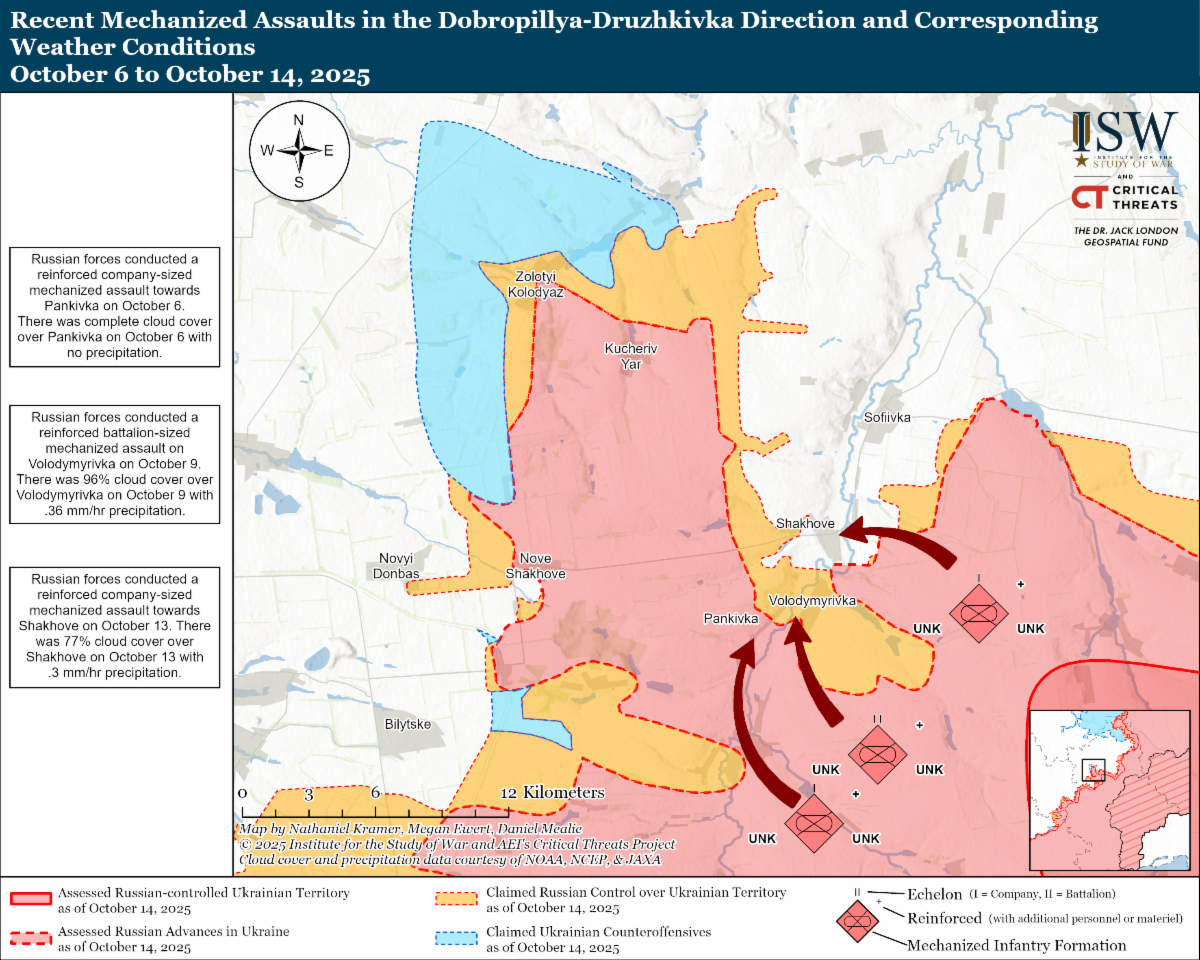
Russian forces have conducted three company- and battalion-sized mechanized assaults in priority areas of Donetsk Oblast over the last two weeks, marking an inflection in recent Russian armor usage in Ukraine. Russian forces largely stopped conducting reinforced company-sized mechanized assaults in late 2024 and have only conducted a handful of battalion-sized mechanized assaults during 2025. Russian forces, before October 2025, most recently conducted a battalion-sized mechanized assault in western Zaporizhia Oblast in April 2025. Russian forces have largely favored leveraging small groups of infantry to conduct infiltration missions and make slow advances throughout the frontline over conducting mechanized assaults during the first nine months of 2025. Russian forces are still leveraging infantry to advance but have conducted several comparatively larger mechanized assaults in their priority Kostyantynivka-Druzhkivka and Dobropillya tactical areas of Donetsk Oblast in recent weeks.
Russian forces appear to be conducting larger mechanized assaults during rainy and foggy weather conditions, which complicate Ukrainian drone operations. The Ventusky weather radar recorded moderate to slightly heavy rainfall during the morning of October 9 and light rainfall on the morning of October 13 at the respective locations of the Russian mechanized assaults. Another weather monitoring service indicated that the Dobropillya area had several hours of cloudy conditions and fog on the morning of October 6. Several Ukrainian military sources throughout Fall 2025 have discussed how Russian forces have exploited rainy weather conditions that limit Ukraine’s drone operations. An OSINT analyst on X (formerly known as Twitter) reported that Russian forces have also taken advantage of a period of limited Ukrainian drone activity caused by windy weather to create a “bridge“ through a river in the Lyman direction, indicating that Russian forces are attempting to seize on poor weather conditions to set up logistics as well as make advances in several frontline areas. The analyst noted that Russian forces moved five tanks, one infantry fighting vehicle (IFV), and self-propelled artillery over the bridge while Ukrainian drones were not able to operate. The lingering dampness and poor conditions that immediately follow rainfall likely degraded Ukrainian drone capabilities for several hours.
Kremlin officials continue to apply the same narratives to the Baltic states that Russia has used to justify its invasions of former Soviet states in the past three decades. Russian State Duma Chairperson Vyacheslav Volodin claimed on October 14 that Latvian authorities are “persecuting” Russian speakers in Latvia and that Russia must protect its “compatriots” in the Baltic states. Russian Liberal Democratic Party (LDPR) Head and Duma Deputy Leonid Slutsky also claimed that Russians in Latvia are part of the Russian World (Russkiy Mir). The Kremlin’s Russian World framework is an intentionally vague ideological idea that Russian President Vladimir Putin has defined as including any former territory of the Kyivan Rus, the Kingdom of Muscovy, the Russian Empire, the Soviet Union, and the contemporary Russian Federation, as well as any people who feel kinship or belonging with Russia. Russia has long claimed that Russia has a duty to protect its “compatriots abroad” and used this narrative to justify its invasions of Moldova, Georgia, and Ukraine. Kremlin narratives about Russia’s “compatriots” in the Baltics and the wider Russian World are part of the Kremlin’s years-long efforts to set conditions to justify possible Russian aggression against NATO in the future.
|