|
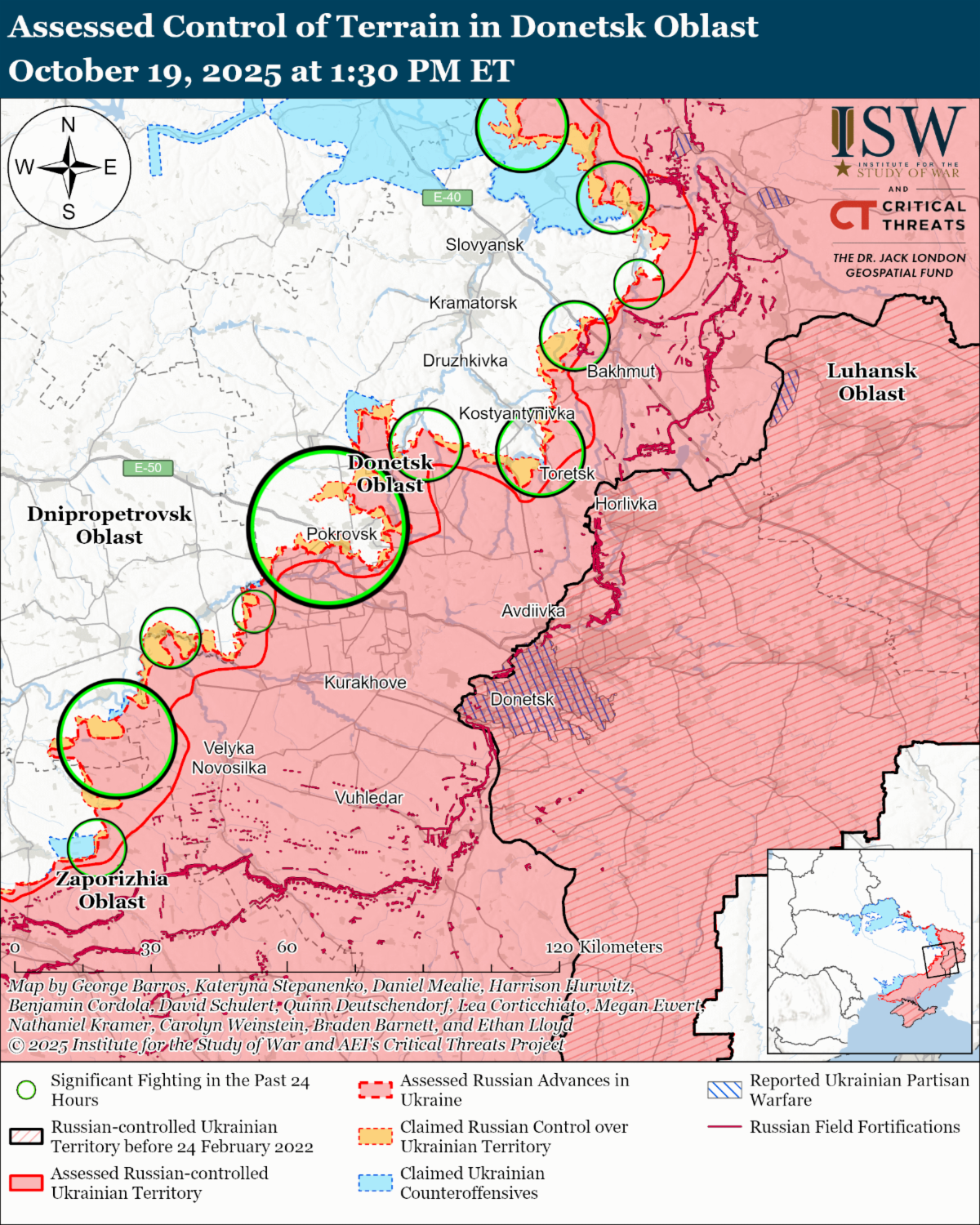
Russian President Vladimir Putin reportedly reiterated his demand that Ukraine cede all of Donetsk Oblast as a condition for ending the war, and suggested that Russia would be willing to "surrender" parts of occupied southern Ukraine. Ceding Donetsk Oblast to Russia would set conditions for Russia to renew its aggression against Ukraine from more advantageous positions at a time of its choosing. Two senior officials told The Washington Post in an article published on October 18 that Putin told US President Trump on October 16 that Ukraine must cede the remainder of unoccupied Donetsk Oblast to Russia "as a condition for ending the war" and that he "would be willing to surrender parts" of occupied Zaporizhia and Kherson oblasts in exchange. The exact terms of Putin’s reported offer are unclear. It is possible that Putin may have been referring to Ukrainian-controlled parts of Zaporizhia and Kherson oblasts that Russia illegally annexed and does not occupy. Putin previously demanded the remainder of Donetsk Oblast in exchange for a ceasefire in August 2025, and ISW has continuously assessed that ceding the remainder of Donetsk Oblast disproportionately favors Russia. Donetsk Oblast contains territory that is strategically vital for Ukraine’s defense and defense industrial base (DIB), including the fortress belt — Ukraine’s main defensive line in Donetsk Oblast since 2014, which Ukraine has developed into a significant logistical and defense industrial hub. Russian forces currently have no available means of rapidly enveloping or penetrating the fortress belt, which would likely take several years to seize at their current rate of advance. Ceding Donetsk Oblast to Russia would allow Russian forces to avoid a long and bloody struggle and continue fighting into deep rear areas of Ukraine from new positions along the Donetsk Oblast border.
Russian officials and pro-Kremlin sources are attempting to portray limited Russian offensive operations in the Kherson direction as an ongoing offensive to recapture Kherson City — efforts that are incompatible with Putin’s claimed readiness to make territorial concessions in southern Ukraine. Kherson Oblast occupation governor Vladimir Saldo claimed on October 19 that Russian forces control an industrial part of Kherson City in east (left) bank Kherson Oblast and several dacha areas on the Dnipro River Delta islands, so "therefore the [seizure] of Kherson [City] itself has already begun." The administrative boundaries of Kherson City are limited to west (right) bank Kherson Oblast, so it is unclear which areas of east bank Kherson Oblast Saldo is referring to. Russian forces withdrew from all of west bank Kherson Oblast as of November 2022 following a successful Ukrainian counteroffensive and interdiction campaign. Kremlin newswire TASS framed Saldo’s statement to imply that Russian forces have begun a new concerted offensive effort to seize Kherson City itself — a significant undertaking that would require Russian forces to ford the Dnipro River and dedicate more manpower and materiel than is currently operating in the Kherson direction. Russian State Duma Defense Committee Member Andrei Kolesnik claimed that Russian forces will seize Kherson City as it is a "constituent entity" that "must be returned to Russia," but noted that Russian forces will not do so "anytime soon." ISW has yet to observe any indicators to assess that Russian forces are likely preparing for or have launched a renewed significant offensive operation against west bank Kherson Oblast.
Ukrainian President Volodymyr Zelensky announced that Ukraine made bilateral energy proposals to the United States. Ukrainian President Volodymyr Zelensky announced on October 19 that Ukraine made proposals to the United States for gas infrastructure, nuclear power generation, and several other unspecified projects to contribute to Europe’s energy independence from Russia.
|