|
Iran has reportedly mined the Strait of Hormuz with about a dozen Maham 3 and Maham 7 limpet mines. US officials told CBS News that Iran has laid at least a dozen Maham 3 and Maham 7 mines, but a separate US official told CBS that Iran has laid fewer than a dozen mines in the strait. The Maham 3 is a high-explosive “moored, buoyant, anti-shipping” naval mine with a maximum depth of 100 meters, according to the Collective Awareness to Unexploded Ordnance (CAT-UXO) organization. The Maham 3 is equipped with magnetic and acoustic sensors, which it uses to target vessels. The Maham 3 can determine a ship’s presence from around three meters in all directions, according to CAT-UXO. The Maham 7 is a high-explosive “bottom influence” mine that sits on the seafloor and is equipped with magnetic and acoustic sensors that it uses to target medium-sized ships, landing crafts, and small submarines. The Maham 7 is lightweight and can be deployed by surface vessels as well as via parachute from aircraft or helicopters. The number of mines that Iran has reportedly laid is relatively consistent with a March 10 Wall Street Journal report that Iran had laid fewer than ten mines. Chairman of the Joint Chiefs of Staff General Dan Caine said on March 19 that US Central Command (CENTCOM) has destroyed 44 Iranian minelaying vessels.
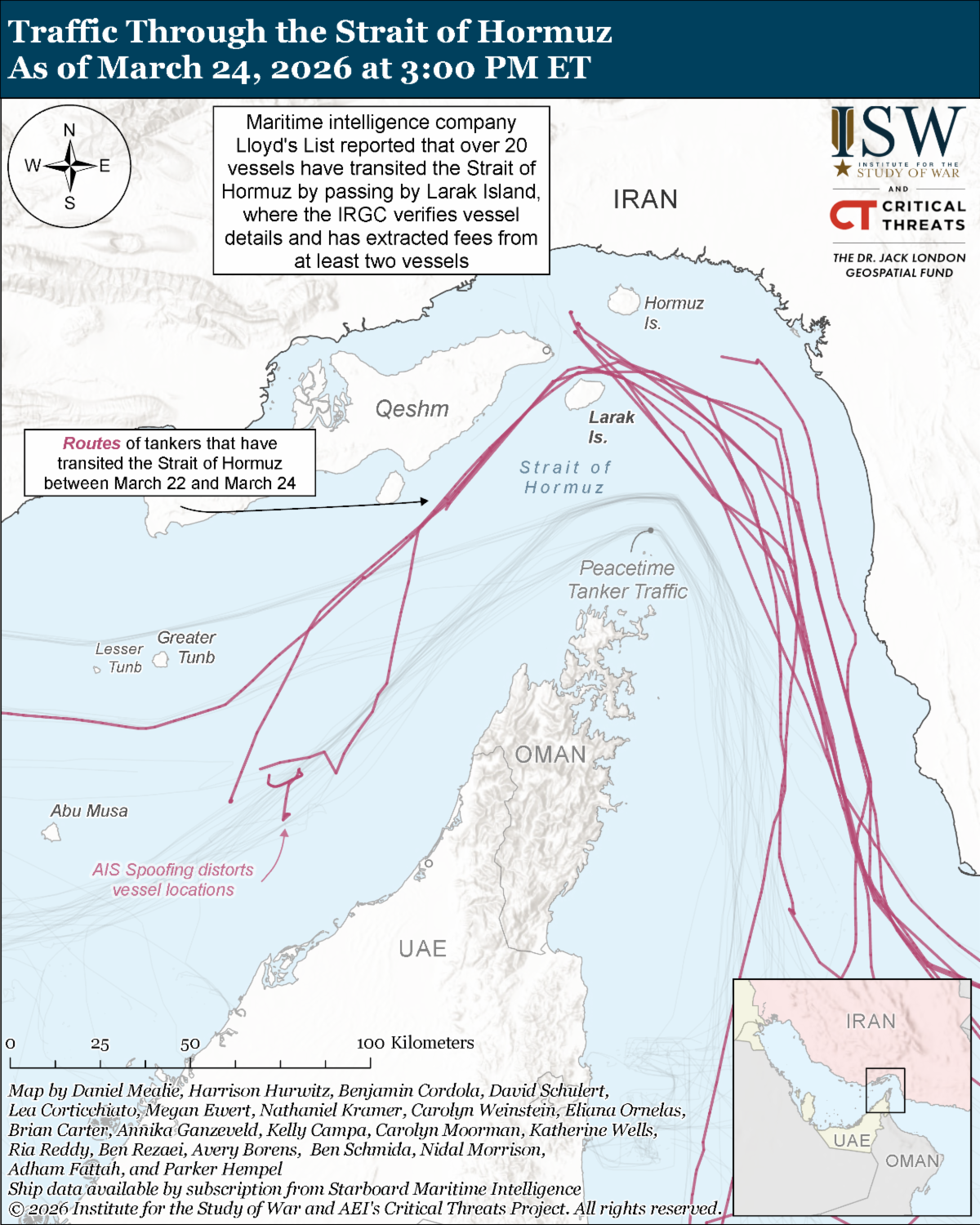
Iran is reportedly requiring some vessels to pay a fee to transit the Strait of Hormuz. Maritime intelligence company Lloyd’s List reported on March 23 that over 20 vessels have taken a “Tehran-approved route” to transit the Strait of Hormuz through Iranian territorial waters since the war began. A senior reporter at Lloyd’s List reported that vessels that transit through the approved route pass by Larak Island, where the Islamic Revolutionary Guard Corps (IRGC) verifies vessel details and, in some cases, requires vessels to pay a fee. Lloyd’s List reported that at least two vessels, including a Chinese state-owned feeder tanker, have paid Iran a fee in exchange for safe passage through the strait, with one fee reported to have been around $2 million USD.
Iranian President Masoud Pezeshkian appointed former IRGC Deputy Commander and Expediency Discernment Council Secretary Mohammad Bagher Zolghadr as the Supreme National Security Council (SNSC) secretary on March 24, replacing Ali Larijani. Pezeshkian reportedly appointed Zolghadr with Iranian Supreme Leader Mojtaba Khamenei’s approval. Zolghadr is a hardline figure with deep connections to Iran’s military and judicial apparatuses. Zolghadr commanded the IRGC Ramadan Headquarters during the Iran-Iraq War. Zolghadr served as the IRGC coordination deputy between 1989 and 1997 and IRGC deputy commander between 1997 and 2005. Zolghadr was heavily critical of former reformist President Mohammad Khatami and was one of the primary architects of former hardline President Mahmoud Ahmadinejad’s election in 2005. Zolghadr served as the security deputy in the Interior Ministry during Ahmadinejad’s term and later served as the Armed Forces General Staff deputy for Basij affairs, playing a large role in suppressing the 2009 Green Movement. The UN sanctioned Zolghadr in 2007 for his involvement in developing Iran’s nuclear and missile programs. Ali Larijani’s brother, Sadegh Amoli Larijani, appointed Zolghadr as Expediency Discernment Council secretary in 2021.
|