|
Russia continues to expand its military cooperation with Iran to facilitate Iranian strikes on US and Israeli forces in the Middle East. The Financial Times (FT) reported on March 25, citing Western intelligence reports, that Russia is close to completing a phased shipment of unspecified drones, medicine, and food to Iran. Two officials briefed on the intelligence told FT that Russia and Iran began discussing drone delivering soon after the US-Israeli campaign began, and that subsequent deliveries started processing in early March. The officials stated that they expect Russia to complete the deliveries by the end of March. A Western security official told FT that the specific drone type that Russia agreed to send to Iran is unclear, but that Russia is likely only in a position to deliver models such as the Geran-2. Current and former Western officials told FT that Russia denied Iran’s request for S-400 air defense systems. Russia has reportedly already been providing Iran with modified Shahed drone components and satellite imagery to assist recent Iranian strikes on US forces in the Middle East and US allies in the region. ISW continues to assess that Russia sees aiding Iran’s strike campaign as an effort to weaken the United States, as Russia has self-defined the United States as one of its primary geopolitical adversaries.
Ukrainian counterattacks continue to make gains in southern Ukraine, creating operational and strategic effects against Russian forces going into the Spring-Summer 2026 offensive against the Fortress Belt. The Ukrainian Air Assault Forces Command reported on March 26 that Ukrainian forces liberated Berezove (southeast of Oleksandrivka), eliminating a Russian salient. Ukrainian forces have made significant tactical gains in southern Ukraine since late January 2026 and notably retook more territory than Russian forces seized in February 2026. Ukrainian officials have reported that Ukrainian forces have liberated over 400 square kilometers in the Oleksandrivka and Hulyaipole directions from late January 2026 to mid-March 2026 in two separate drives. ISW has observed evidence to assess that Ukrainian forces have liberated at least 334.06 square kilometers in southern Ukraine since January 1, 2026, but ISW’s conservative mapping methodology underestimates Ukrainian advances. Ukrainian forces’ dual tactical efforts to halt and push back Russian gains in southern Ukraine are having cascading effects on other sectors of the front, forcing Russian forces to choose between defending against the Ukrainian counterattacks and allocating manpower and materiel for offensive operations elsewhere on the frontline. The Russian military command had to redeploy elite airborne (VDV) and naval infantry units from Donetsk Oblast to southern Ukraine in early March 2026 in response to Ukrainian counterattacks, likely disrupting plans for the Spring-Summer 2026 offensive against the Fortress Belt. Russian forces have previously failed to conduct simultaneous offensives in different sectors of the front, and it is unlikely that they will be able to make significant efforts to advance in the Fortress Belt area while contending with Ukraine’s recent successes in the Hulyaipole and Oleksandrivka directions.
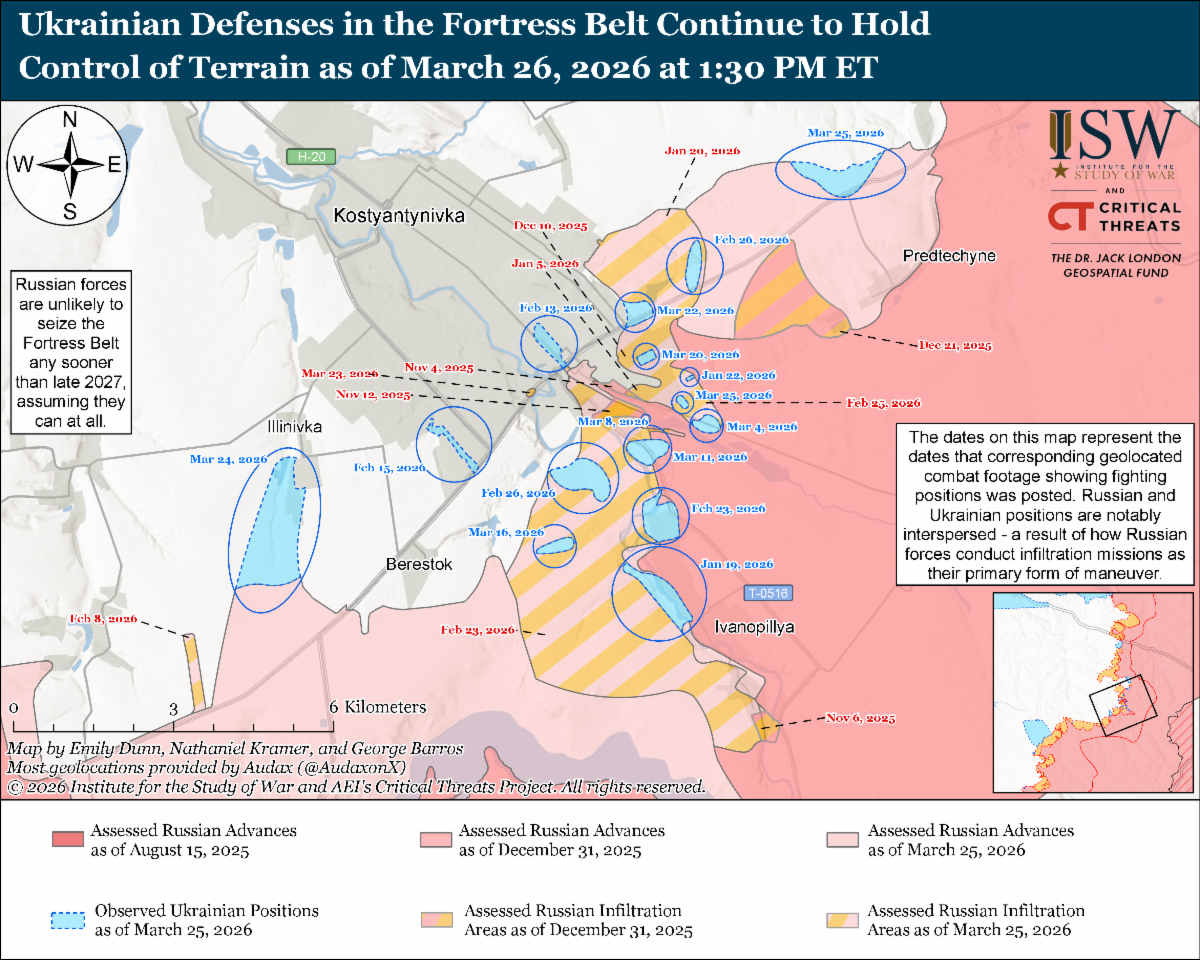
Russian forces are unlikely to seize Ukraine’s Fortress Belt in 2026. Russian forces likely began their Spring-Summer 2026 offensive against Ukraine’s Fortress Belt with a significant increase in mechanized and motorized assaults in various sectors of the front between March 17 and 21, and a period of intensified strikes, and the movement of heavy equipment and troops on the frontline. Ukraine’s Fortress Belt is a concentration of four heavily fortified and large cities in Donetsk Oblast, with a total pre-war population of over 380,000, that run north to south along the H-20 Kostyantynivka-Slovyansk highway. Russian forces tried and failed to seize the Fortress Belt in 2014 and 2022, and such an operation in the fifth year of the war will likely be a multi-year effort with significant personnel and materiel losses. Russian forces have also shown no ability to rapidly envelop, penetrate, or otherwise seize cities the size of those in the Fortress Belt and took almost two years to seize Pokrovsk — a significantly smaller town in comparison with a pre-war population of 60,000. Russian officials are already setting expectations in the domestic information space for slow advances and high casualties, with Russian State Duma Defense Committee Chairperson Andrei Kartapolov claiming on March 26 that it is too soon to talk about a "triumphant spring offensive." Kartapolov claimed that fighting on the front is difficult and specifically noted that fighting in Kostyantynivka is complicated due to the city’s size and Ukraine’s defensive fortifications. The Kremlin knows that Russian forces’ seizure of the Fortress Belt on the battlefield is not inevitable and is therefore demanding that Ukraine cede the unoccupied parts of Donetsk Oblast. The Kremlin seeks such a concession to save Russia the personnel and materiel resources and to put Russia in a more advantageous position to possibly re-invade in the future.
|