|
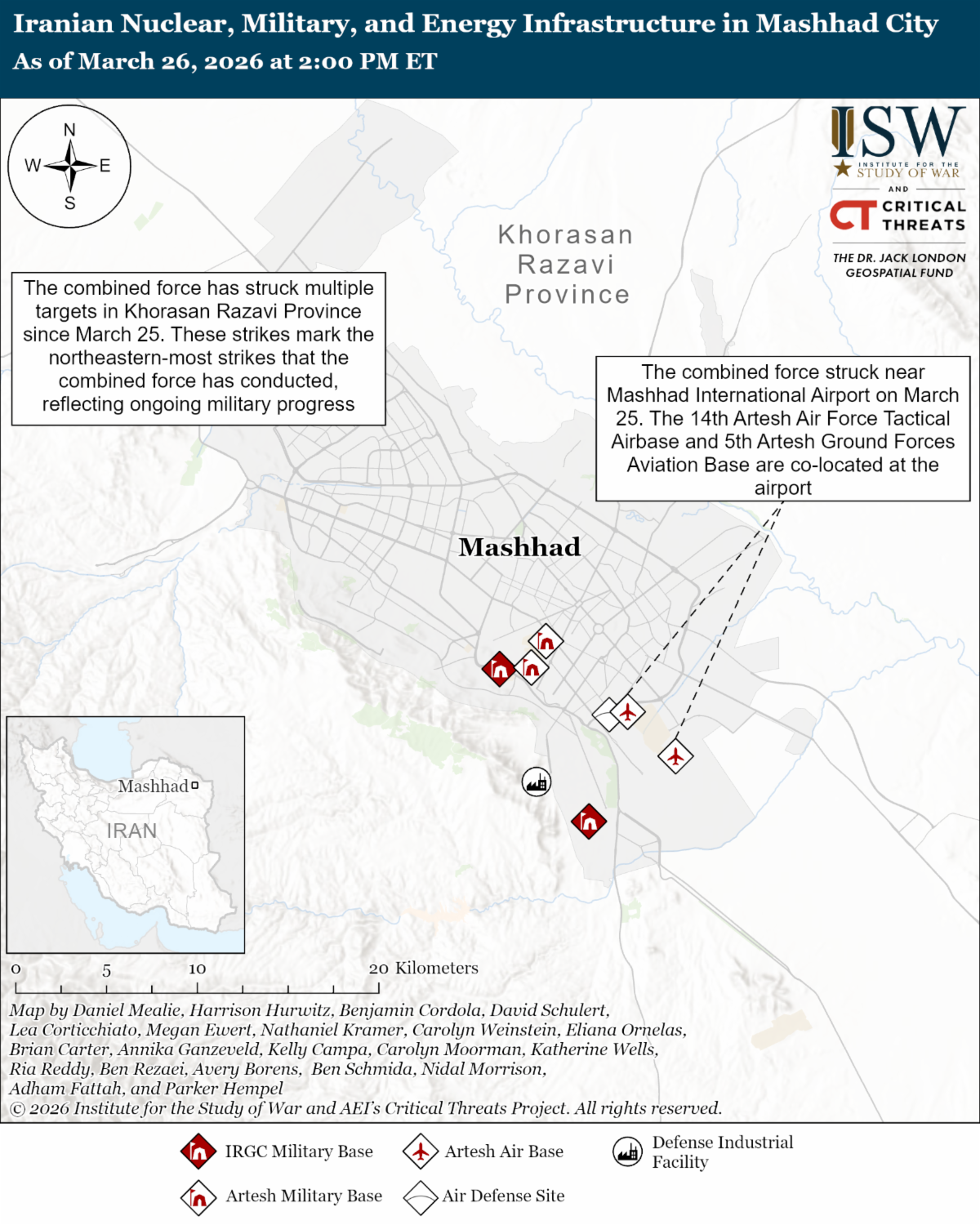
The combined force conducted strikes around Mashhad, Khorasan Razavi Province, on March 25 and 26, marking the northeastern-most strikes conducted so far in the war. The combined force has slowly swept across Iran west to east and is now getting to some of the furthest targets of the campaign. An Iranian OSINT account and anti-regime media footage of strikes near Mashhad International Airport on March 25. The 14th Artesh Air Force Tactical Airbase and 5th Artesh Ground Forces Aviation Base are co-located at the Mashhad International Airport. The IDF previously struck an Iranian refueling aircraft at Mashhad International Airport during the 12-Day War. Anti-regime media also posted footage of smoke plumes rising in Mashhad, suggesting that the combined force may have struck additional targets in the area. Mashhad is the second most-populated city in Iran.
The IDF has continued targeting senior Iranian commanders to disrupt Iranian command and control and operations broadly. The IDF announced on March 26 that it killed Islamic Revolutionary Guards Corps (IRGC) Navy Commander Rear Admiral Alireza Tangsiri in Bandar Abbas, Hormozgan Province. Tangsiri had served as IRGC Navy commander since August 2018. Tangsiri previously served as IRGC Navy deputy commander from 2010 to 2018 and the Bandar Abbas-based IRGC 1st Saheb ol Zaman Naval District commander. The Saheb ol Zaman Naval District has the central mission of controlling the Strait of Hormuz. Its area of operations includes the IRGC Navy headquarters and command center as well as the 2nd Imam Sajjad Special Forces Brigade, the 16th Assef Coastal Missile Group, the 112th Zolfaghar Surface Combat Brigade, and underground fortifications on Abu Musa. The IDF also killed IRGC Navy Intelligence Deputy Behnam Rezaei in Bandar Abbas, Hormozgan Province. Rezaei reportedly was responsible for regional intelligence collection and coordination. Tangsiri oversaw IRGC Navy operations, including attacks on international shipping and threats to US forces in the region. The United States sanctioned Tangsiri in June 2019 for acting on behalf of the IRGC and his role in threatening to close the Strait of Hormuz and overseeing IRGC Navy activities responsible for the sabotage of vessels in international waters.
The IRGC has reportedly continued to consolidate power within the Iranian regime and play an increasingly central role in key leadership decisions. Anti-regime media reported on March 26 that the IRGC pressured Iranian President Masoud Pezeshkian to appoint Mohammad Bagher Zolghadr as the Supreme National Security Council (SNSC) secretary, citing unspecified sources. Zolghadr is a hardline figure with deep ties to Iranian military and judicial establishments. The sources said that IRGC Commander Brigadier General Ahmad Vahidi was among the IRGC officers who pressured Pezeshkian. The sources also said that there are no clear signs that Supreme Leader Mojtaba Khamenei influenced the decision to appoint Zolghadr, raising continued questions about how involved Mojtaba is in key decisions. The sources added that Pezeshkian and other senior officials opposed Zolghadr’s appointment. The reported IRGC role in Zolghadr’s appointment comes after a small group of IRGC officer intervened aggressively in the supreme leader succession process to ensure that Mojtaba replaced his father. Statements from US and Israeli security officials indicate that this group of IRGC officers have gained significant influence since Mojtaba became supreme leader.
|