[ISW] 러시아 공격 작전 평가, 2026년 3월 27일

“`html

핵심 내용 요약:

  • 푸틴, 러시아 경제 지원 요청: 블라디미르 푸틴 러시아 대통령이 러시아 최고 기업인들에게 러시아 정부 지원을 위한 자금 제공을 요청한 것으로 알려졌습니다. 이는 크렘린이 경제적 어려움에 직면하여 경제적 지원이 절실하며, 전쟁 지원을 위해 자산 국유화 조건을 설정할 수 있음을 시사합니다.
  • 올리가르히 자산 국유화 위협: 푸틴의 러시아 최고 기업인 자금 지원 요청은 집권 후 러시아 재벌들에게 자산 국유화를 하지 않겠다고 약속한 것을 어길 수 있는 위협으로 보입니다.
  • 우크라이나-사우디아라비아 방위 협력: 우크라이나와 사우디아라비아는 3월 27일 방위 협력 협정을 체결했습니다.
  • 우크라이나의 러시아 석유 인프라 공격 지속: 우크라이나군은 3월 26일부터 27일 밤까지 발트해 인근 러시아 석유 인프라에 대한 장거리 공격을 이어갔습니다. 이는 레닌그라드주(Leningrad Oblast) 내 러시아 석유 인프라에 대한 5일 동안 4번째 공격입니다.
  • 라트비아, 러시아의 인지전 경고: 라트비아는 3월 27일 러시아가 발트 3국이 우크라이나가 발트 3국 영토에서 러시아를 공격하도록 허용했다는 거짓 주장을 펼치는 인지전(cognitive warfare)을 시작했다고 경고했습니다.
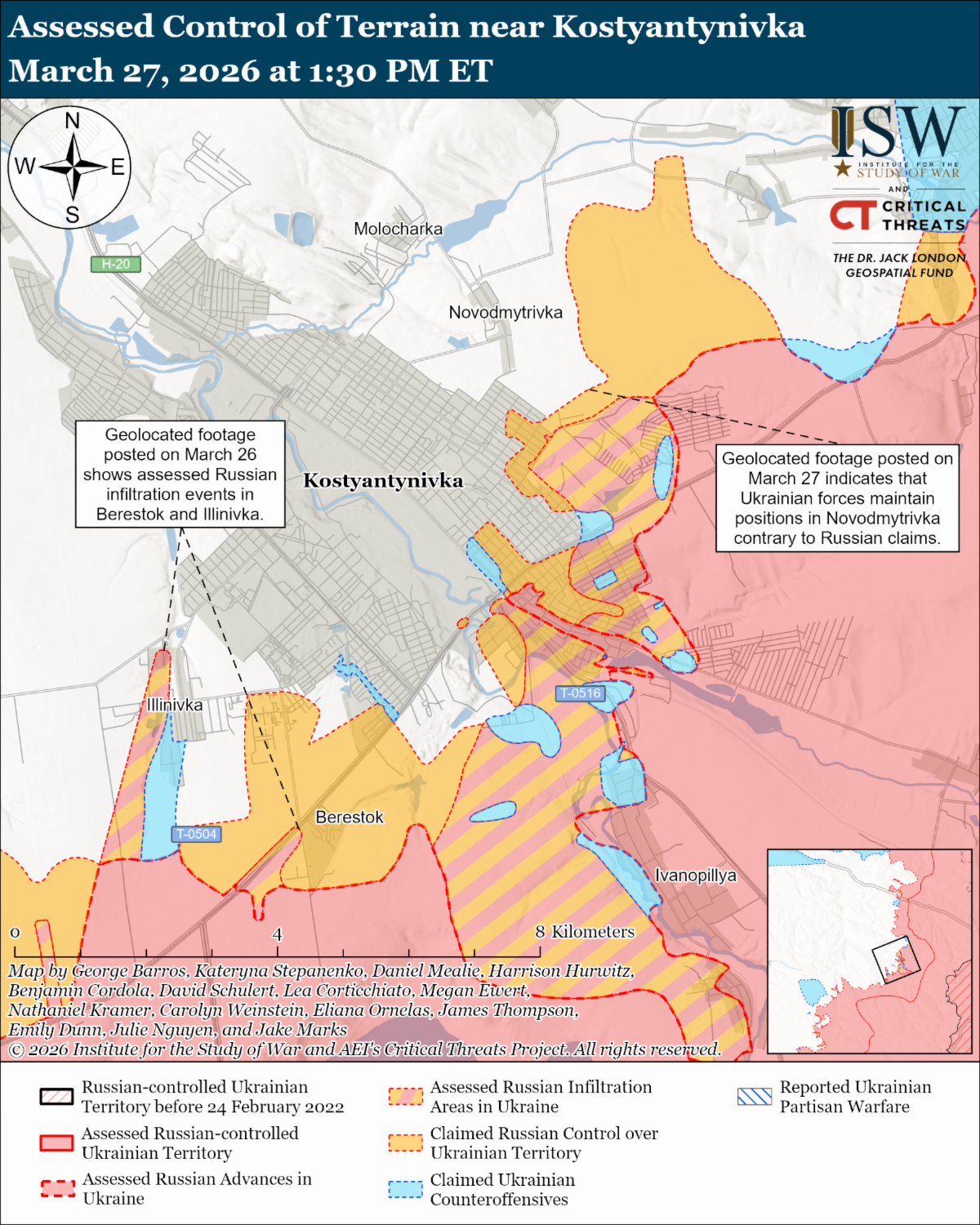
  • 전선 변화 없음: 3월 27일, 우크라이나군과 러시아군 모두 전선에서 진전을 이루지 못했습니다.
  • 우크라이나, 러시아 방위 산업 기지 공격: 우크라이나군은 러시아 방위 산업 기지(DIB)에 대한 장거리 공격을 실시했습니다. 러시아군은 우크라이나를 향해 102대의 드론을 발사했습니다.

최신 자료 및 링크 (관련 내용 확인):

“`

[원문]

Russian President Vladimir Putin reportedly requested that Russia’s top businessmen provide funding for the Russian government, indicating that the Kremlin may be growing desperate for economic relief

March 27, 2026

Data Cutoff: 12:15 PM ET

Grace Mappes, Samuel Shafiro, Kateryna Shymkiv, Justin Young, Anna Thacker, and Kateryna Stepanenko

TOPLINES

Russian President Vladimir Putin reportedly requested that Russia’s top businessmen provide funding for the Russian government, indicating that the Kremlin may be growing desperate for economic relief and may be setting conditions to nationalize their assets to support the war effort. Russian independent outlet The Bell reported, citing multiple sources familiar with the conversation, that Putin held a closed meeting with Russia’s top businessmen on March 26 in which Putin stated that Russia will continue to fight and called on the businessmen to contribute to the Russian federal budget. Two sources stated that Putin asked for these contributions in the context of Russia continuing the war in Ukraine, implying that the funds will support Russia’s war effort. One source told The Bell that the idea to “shake up business” came from Russian state oil company Rosneft Head Igor Sechin, who reportedly made this proposal and a proposal to issue military bonds as a mechanism for raising funds for Putin on March 25. The Bell reported that Russian Federation Council Senator Suleiman Kerimov immediately pledged 100 billion rubles (about $1.22 billion) to Putin and that another unspecified businessman pledged additional support but did not disclose the amount. Three people familiar with the matter told the Financial Times that Putin had asked during the meeting that top businessmen donate money to stabilize Russia’s finances. Kremlin Spokesperson Dmitry Peskov confirmed that Putin met with Russian businessmen but denied that Putin asked the businessmen for money, that the money is for the war effort, and that the idea came from Sechin. Peskov claimed that one participant discussed the necessity of donating a “very large sum of money” to the Russian state, but emphasized that this is a personal decision.

Putin’s reported request for Russian top businessmen to donate money to the Russian state threatens to break a promise he made to Russian oligarchs to not nationalize their assets soon after seizing power. Putin met with Russian top businessmen in July 2000 and promised to uphold the 1990s privatization of assets that previously belonged to the Soviet Union in exchange for the businessmen staying out of Russian politics and pledging allegiance to Putin. Peskov claimed on March 27 that one of the March 26 meeting participants had noted that most of those who attended the meeting started their businesses in the 1990s and were connected to the Russian state “in one way or another” at the time, so that many of the participants “consider it their duty” to make financial contributions to the Russian state. Putin has repeatedly implied that the Kremlin is against nationalization of property but has been gradually accelerating nationalization efforts during the full-scale invasion. Peskov’s invocation of the 1990s privatization of industrial assets in Russia and implication that the businessmen should consider funding the Russian state to be their “duty” may intend to set a pattern of expected behavior for oligarchs against the backdrop of increasing Russian censorship efforts. The Kremlin’s crackdowns against Telegram and other internet censorship efforts may help neutralize businessmen who could try to resist the Kremlin’s nationalization efforts by weaponizing the information space.

KEY TAKEAWAYS

  • Russian President Vladimir Putin reportedly requested that Russia’s top businessmen provide funding for the Russian government, indicating that the Kremlin may be growing desperate for economic relief and may be setting conditions to nationalize their assets to support the war effort.

  • Putin’s reported request for Russian top businessmen to donate money to the Russian state threatens to break a promise he made to Russian oligarchs not to nationalize their assets soon after seizing power.

  • Ukraine and Saudi Arabia concluded a defense cooperation agreement on March 27.

  • Ukrainian forces continued their long-range strike campaign against Russian oil infrastructure near the Baltic Sea on the night of March 26 to 27, marking the fourth strike in five days against Russian oil infrastructure in Leningrad Oblast.

  • Latvia warned on March 27 that Russia launched a cognitive warfare campaign falsely accusing the Baltic states of allowing Ukraine to launch strikes against Russia from the Baltic states’ territories.

  • Neither Ukrainian nor Russian forces advanced on March 27.


  • Ukrainian forces conducted long-range strikes against the Russian defense industrial base (DIB). Russian forces launched 102 drones against Ukraine.

EMAIL SUBSCRIPTION OPTIONS

ISW offers customizable email subscription options. Click below to learn more and customize your preferences.

ISW is powered by the support of individuals like you.

Help us stay independent and impactful.

Website | Jobs | Internships

Follow ISW on social media:

FacebookXYouTube | InstagramLinkedIn | Threads | Bluesky

© 2026 Institute for the Study of War and AEI’s Critical Threats Project. All rights reserved.

Donate online or by sending a check to the Institute for the Study of War at 1400 16th Street NW, Suite #515, Washington, DC 20036. Please consider including the Institute for the Study of War in your estate plans.


ISW is a tax-exempt organization under section 501(c)(3) of the Internal Revenue Code. Donations are tax-deductible to the extent permitted by law.

ISW is a non-partisan, non-profit, public policy research organization. ISW advances an informed understanding of military affairs through reliable research, trusted analysis, and innovative education. We are committed to improving the nation’s ability to execute military operations and respond to emerging threats in order to achieve US strategic objectives.

댓글 달기

이메일 주소는 공개되지 않습니다. 필수 필드는 *로 표시됩니다

위로 스크롤