[ISW] 이란 업데이트 특별 보고서, 2026년 3월 27일

“`html

핵심 내용 요약:

  • 이란은 이스라엘에 대한 대규모 미사일 공격 능력의 한계를 고려하여, 하루 종일 소규모 미사일 발사를 통해 이스라엘 민간인에게 심리적 영향을 가하려는 시도를 할 수 있습니다. 이는 민간인들이 지속적으로 대피하도록 강요하고 국가를 경계 상태로 유지하는 것을 목표로 합니다. 이란은 발사 간격을 여러 시간으로 벌려 발사를 분산시키고 있습니다. 이러한 전략은 이스라엘 민간인들이 하루에 여러 번 대피해야 하는 상황을 유발합니다.
  • 이러한 전략은 최적의 전략은 아니며, 미국-이스라엘 연합군의 공격으로 인해 이란의 대규모 미사일 공격 능력이 저하되었음을 시사합니다. 연합군의 미사일 능력 저하는 현재 분쟁에서 이란이 대규모 미사일 공격을 지속적으로 감행하는 것을 막고 있습니다.
  • 이란은 전쟁 중 이스라엘에 대한 공격에 집속탄을 점점 더 많이 사용하고 있습니다. 이는 이스라엘 내 특정 군사 목표에 실질적인 위협을 가할 수 없는 상황을 반영하며, 이스라엘 민간인에게 심리적 영향을 미치려는 시도로 보입니다.
  • 우크라이나와 사우디 아라비아는 3월 27일 방위 협력 협정을 체결했습니다. 우크라이나 대통령실은 이 협정에 따라 우크라이나가 사우디 아라비아의 대공 방어를 지원할 것이라고 밝혔습니다. 이 협정은 추가 접촉의 기초를 마련하고 기술 협력 및 투자를 포함합니다.
  • 연합군은 지하 기지에 있는 미사일 발사기에 대한 이란의 접근을 방해하는 등, 이란의 미사일 공격 능력을 지속적으로 저지하고 있습니다. 미국 중부 사령부(CENTCOM)는 3월 27일, 이란이 지하 시설 입구의 잔해를 제거하고 다시 열기 위해 사용하려던 불도저와 로더를 공격하는 영상을 공개했습니다.
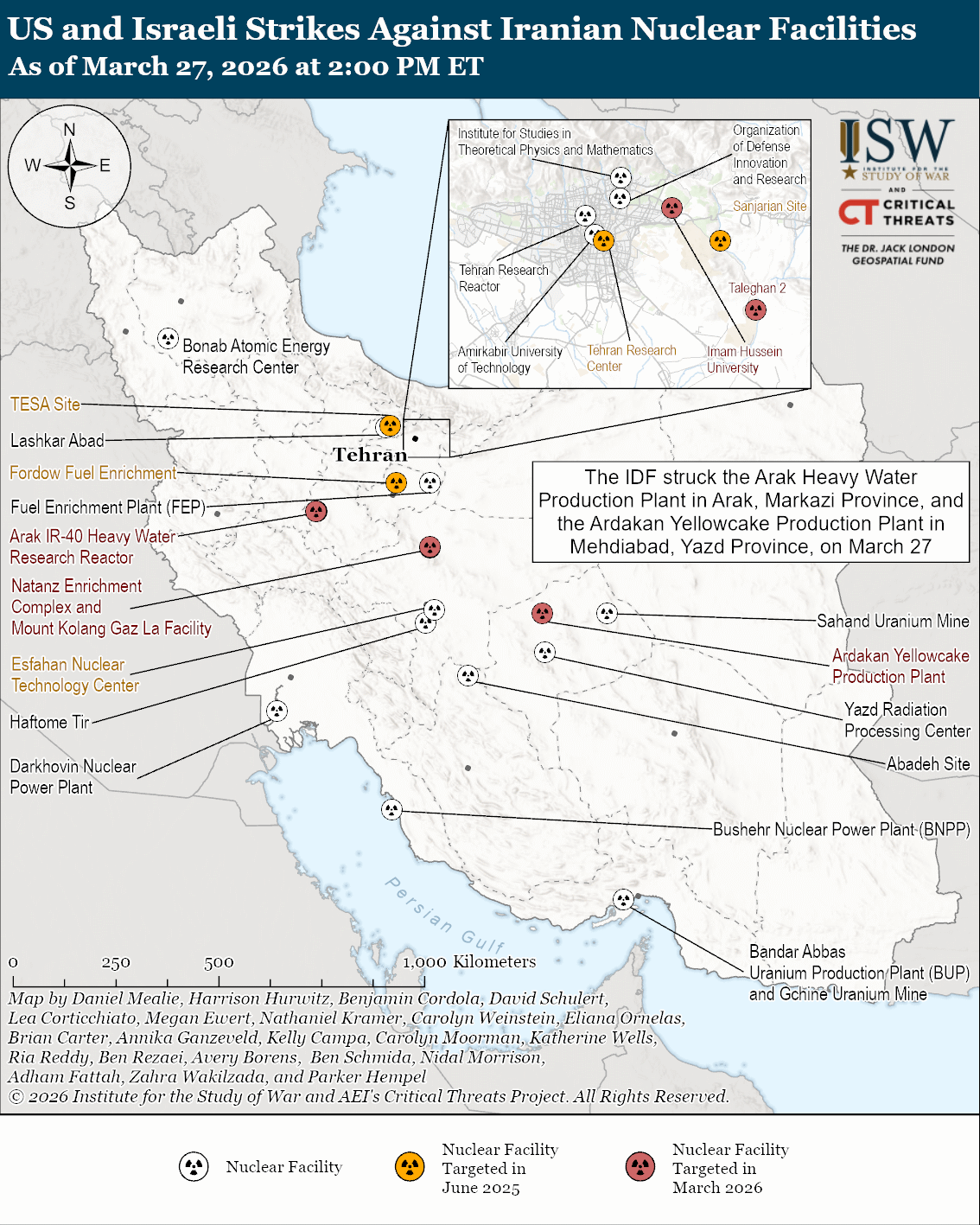
  • 이스라엘 방위군(IDF)은 3월 27일, 플루토늄 생산 및 우라늄 연료 주기와 관련된 시설을 포함한 이란의 핵 기반 시설을 공격했습니다. IDF는 2025년 6월 이스라엘-이란 전쟁 당시 공격 이후, 복구를 시도하던 아라크(Arak) 중수 생산 시설을 공격했습니다. IDF는 또한 야즈드(Yazd) 주에 있는 아르다칸(Ardakan) 옐로우케이크 생산 공장도 공격했습니다.

최신 자료 및 관련 링크:

  • 최신 이스라엘-이란 분쟁 관련 뉴스: 신뢰할 수 있는 뉴스 매체 (예: 로이터, BBC, CNN, 연합뉴스 등)에서 이스라엘-이란 분쟁 관련 최신 기사를 검색하여 이 보고서의 내용을 뒷받침하는 정보를 찾을 수 있습니다.

    (참고: 뉴스 매체는 시시각각 변동되므로, 검색을 통해 가장 최신의 정보를 확인하는 것이 좋습니다.)
  • 국제 핵기구 (예: IAEA) 관련 자료: 이란의 핵 프로그램과 관련된 IAEA 보고서 및 성명서를 통해 핵 시설에 대한 공격의 배경 및 영향에 대한 정보를 얻을 수 있습니다.

    (참고: IAEA 공식 웹사이트에서 관련 자료를 확인할 수 있습니다.)
  • 미사일 기술 및 군사 분석 관련 자료: 미사일 기술, 집속탄 사용, 지하 시설 공격 등에 대한 전문가 분석 기사 또는 보고서를 통해 이 보고서의 내용을 더욱 자세히 이해할 수 있습니다. 예를 들어, 군사 분석 기관 (예: SIPRI, IISS)의 자료를 참고할 수 있습니다.
  • 우크라이나-사우디 아라비아 방위 협력: 우크라이나 대통령실 공식 웹사이트 또는 주요 뉴스 매체를 통해 3월 27일 체결된 방위 협력 협정에 대한 자세한 내용을 확인할 수 있습니다.

    (참고: 우크라이나 대통령실 공식 웹사이트, 또는 주요 뉴스 매체 검색)

주의사항: 위 링크는 예시이며, 실제 정보를 얻기 위해서는 최신 정보를 검색해야 합니다. 또한, 정보의 출처를 확인하고, 다양한 자료를 비교 분석하여 객관적인 시각을 유지하는 것이 중요합니다.

“`

[원문]

Iran may be attempting to maximize the effects of its limited capacity to launch large missile salvos at Israel by launching small missile salvos throughout the day to impose psychological effects on

March 27, 2026

Data Cutoff: 2:00 PM ET

Kelly Campa, Ben Rezaei, Carolyn Moorman, Katherine Wells, Nidal Morrison, Grace Mappes, and Annika Ganzeveld

As the Middle East crisis evolves, ISW urgently needs your support.

Help us stay independent and impactful.

TOPLINES

Iran may be attempting to maximize the effects of its limited capacity to launch large missile salvos at Israel by launching small missile salvos throughout the day to impose psychological effects on Israeli civilians by consistently forcing them to take shelter and keeping the country under constant alert. Iran has launched between five and 11 missile barrages at Israel per day over the past week. The IDF reported on March 27 that Iran has launched about 10 missiles at Israel per day, which suggests that each Iranian barrage has consisted of either a single missile or a small number of missiles. Iran is spreading out its launches throughout the day, often pausing for several hours between launches. Ballistic missiles take about 10 minutes to reach Israel once launched from Iran. Spreading out ballistic missile launches over a long period of time presumably increases the number of times per day that Israeli civilians must seek shelter.

Such a strategy is suboptimal and likely reflects the US-Israeli combined force’s degradation of Iran’s ability to launch large-scale missile attacks. Iran has long sought to overwhelm Israeli air defenses through large missile and drone strike packages. Iran launched hundreds of ballistic and cruise missiles and one-way attack drones targeting Israel in April and October 2024, for example. The combined force’s degradation of Iran’s missile capabilities has prevented Iran from consistently launching large-scale missile attacks against Israel during the current conflict, however. The combined force has struck missile launchers, missile storage facilities, and dropped heavy munitions on hardened Iranian missile bases during the war. Iran could be launching smaller salvos due to its depleted missile stockpile. The United States assesses ”with certainty” that the combined force has destroyed about a third of Iran’s missile stockpile and assesses that the combined force has likely ”damaged, destroyed, or buried” another third of Iran’s missile stockpile, according to five people familiar with US intelligence speaking to Reuters on March 27. The decline could also reflect a deliberate Iranian strategy to protect missile launchers from combined force airstrikes by only fielding a small number of launchers at a time. The IDF has destroyed or rendered inoperable around 330 out of Iran’s 470 missile launchers. An Israeli OSINT account posted footage of an Iranian missile launch from the Yazd Missile Base on March 27. The combined force struck the base several hours later, which highlights how the combined force is patrolling Iranian airspace and striking targets as they appear.

KEY TAKEAWAYS

  • Iran may be attempting to maximize the effects of its limited capacity to launch large missile salvos at Israel by launching small missile salvos throughout the day to impose psychological effects on Israeli civilians by consistently forcing them to take shelter and keeping the country under constant alert. Iran is spreading out its launches throughout the day, often pausing for several hours between launches. Spreading out ballistic missile launches over a long period of time presumably increases the number of times per day that Israeli civilians must seek shelter.

  • Such a strategy is suboptimal and likely reflects the US-Israeli combined force’s degradation of Iran’s ability to launch large-scale missile attacks. The combined force’s degradation of Iran’s missile capabilities has prevented Iran from consistently launching large-scale missile attacks against Israel during the current conflict, however.

  • Iran has increasingly used cluster munitions in its attacks on Israel during the war, which likely reflects Iran’s inability to meaningfully threaten discrete military targets in Israel and efforts to inflict psychological effects on Israeli civilians.

  • Ukraine and Saudi Arabia concluded a defense cooperation agreement on March 27. The Ukrainian Presidential Office reported that Ukraine will help Saudi Arabia with air defenses under the agreement, which also outlines the foundations for further contacts and includes technological cooperation and investments.

  • The combined force has continued to disrupt Iran’s ability to launch missile attacks, including by disrupting Iranian efforts to regain access to missile launchers in underground bases. US Central Command (CENTCOM) published footage on March 27 showing that it struck bulldozers and loaders that Iran was likely using to try to clear debris and reopen tunnel entrances to underground facilities.


  • The IDF struck Iranian nuclear infrastructure on March 27, including sites involved in plutonium production and the uranium fuel cycle. The IDF struck the Arak Heavy Water Production Facility in Arak, Markazi Province, following repeated Iranian attempts to restore the site following IDF strikes on the site during the June 2025 Israel-Iran War. The IDF also struck the Ardakan Yellowcake Production Plant in Yazd Province.

EMAIL SUBSCRIPTION OPTIONS

ISW offers customizable email subscription options. Click below to learn more and customize your preferences.

Website | Jobs | Internships

Follow ISW on social media:

FacebookXYouTube | InstagramLinkedIn | Threads | Bluesky

© 2026 Institute for the Study of War and AEI’s Critical Threats Project. All rights reserved.

Donate online or by sending a check to the Institute for the Study of War at 1400 16th Street NW, Suite #515, Washington, DC 20036. Please consider including the Institute for the Study of War in your estate plans.

ISW is a tax-exempt organization under section 501(c)(3) of the Internal Revenue Code. Donations are tax-deductible to the extent permitted by law.

ISW is a non-partisan, non-profit, public policy research organization. ISW advances an informed understanding of military affairs through reliable research, trusted analysis, and innovative education. We are committed to improving the nation’s ability to execute military operations and respond to emerging threats in order to achieve US strategic objectives.

댓글 달기

이메일 주소는 공개되지 않습니다. 필수 필드는 *로 표시됩니다

위로 스크롤