[ISW] 이란 업데이트 특별 보고서, 2026년 4월 1일

“`html

핵심 요약

  • 테헤란의 고위 관리들은 호르무즈 해협과 주변 에너지 흐름을 이란이 전쟁 후 양보를 얻어내고 전략적 목표를 달성하기 위한 지렛대로 사용하려 한다는 신호를 보냈습니다. 또한, 미국과 이스라엘이 이란에 대한 모든 공격을 중단하지 않는 한, 휴전이나 호르무즈 해협에서의 국제 해운 중단을 받아들이지 않겠다는 신호를 보냈습니다.

  • 이란은 테헤란에서 해협에 대한 이란의 영향력에 대한 논의가 진행되는 가운데 해운에 대한 공격을 계속했습니다. 이란은 카타르 국영 에너지 회사에서 임대한 파나마 선적의 유조선 AQUA 1을 카타르 라스 라판에서 북서쪽으로 17해리 떨어진 곳에서 공격했습니다.

  • 이러한 발언은 이란이 전쟁이 끝난 후에도 해협에서의 해운을 방해하는 능력을 계속 사용하여 미국과 파트너 국가를 억제하거나 이란에 부정적인 영향을 미치는 행동을 피하도록 강요할 수 있음을 나타냅니다.

  • 이스라엘 방위군(IDF)은 4월 1일, 첨단 미사일 생산을 위한 국방부 및 군 병참(MODAFL) 단지를 포함하여 “약 15개의 무기 생산 시설”을 타격했다고 밝혔습니다.

  • IDF는 펜타닐과 같은 화학 무기에 사용될 수 있는 물질을 이란 정권에 공급하는 제약 연구 개발 회사를 타격했습니다.

  • IDF는 헤즈볼라와 아사드 정권을 위해 레바논과 시리아에서 지하 프로젝트를 추진하는 IRGC 쿠드스군 레바논 군단의 엔지니어링 책임자를 사살했습니다. 그는 첨단 무기 저장에 사용되는 레바논의 수십 개의 지하 시설을 관리했습니다.

  • 이란은 10발의 미사일 살보를 포함하여 5번의 미사일 살보를 발사했는데, 이는 전쟁이 시작된 이후 이스라엘을 겨냥한 가장 큰 미사일 살보 중 하나였습니다. 이것이 일회성 대규모 살보인지, 아니면 추세의 일부가 될지는 불분명합니다.

  • 이란은 4월 1일 바레인을 겨냥하여 19대의 드론과 4발의 탄도 미사일을 발사했습니다. 이 중 하나 이상이 바레인의 한 회사를 겨냥했습니다. 이는 3월 31일 IRGC가 미국과 이스라엘의 공격에 대한 보복으로 미국 관련 정보, 통신, 인공 지능 및 첨단 기술 회사를 공격하겠다고 위협한 데 따른 것입니다.

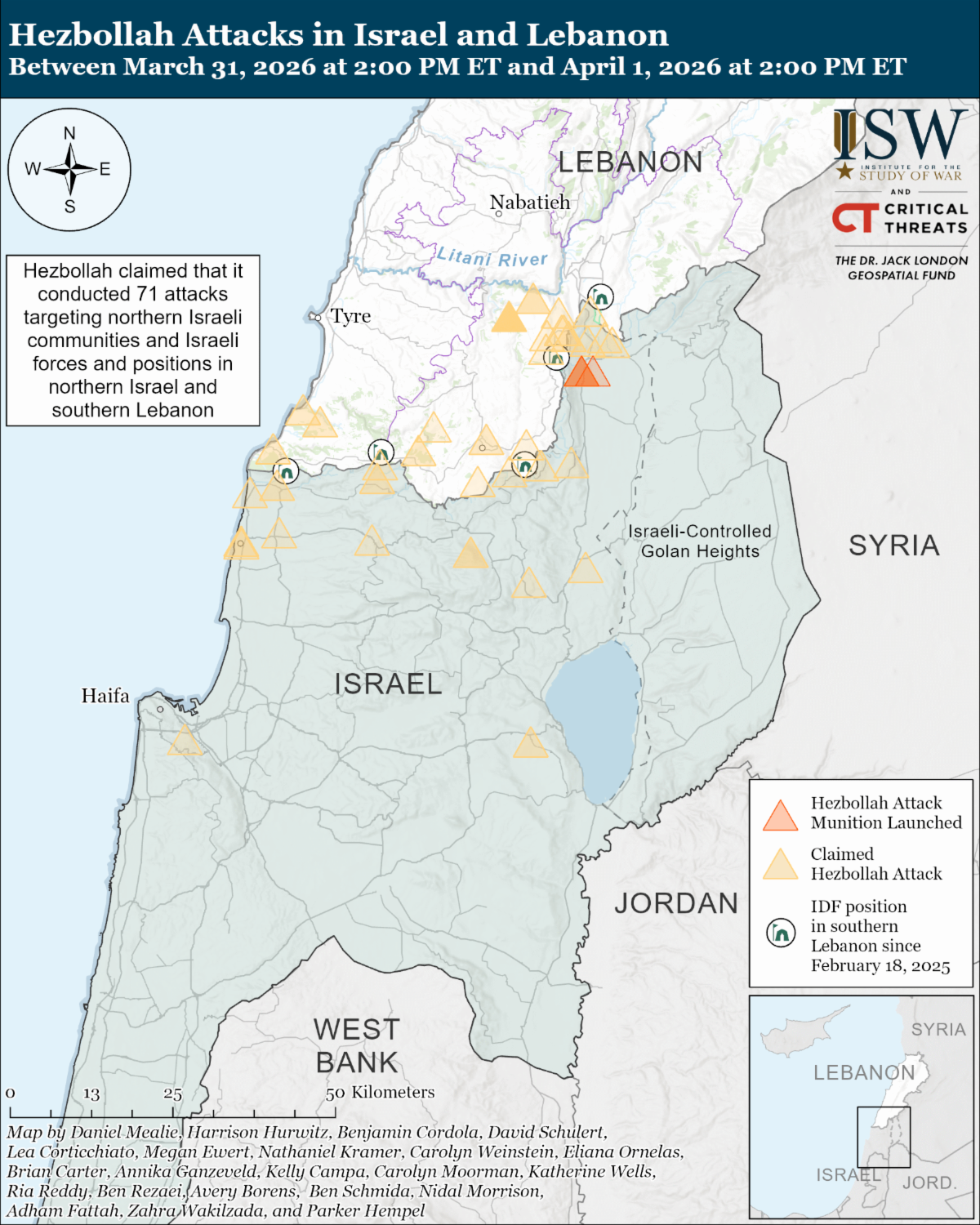
  • 헤즈볼라는 3월 31일 오후 2시(ET)부터 4월 1일 오후 2시(ET)까지 이스라엘 북부 지역 사회 및 이스라엘 군대와 북부 이스라엘 및 남부 레바논의 진지를 71차례 공격했다고 주장했습니다.

  • 후티는 4월 1일 남부 이스라엘을 겨냥하여 불특정 수의 탄도 미사일을 발사했습니다. 이번 공격은 3월 28일 분쟁에 참여한 이후 후티가 이스라엘을 공격한 네 번째 사례입니다. 후티는 이스라엘에 대한 탄도 미사일 공격을 헤즈볼라 및 이란과 협력했다고 주장했습니다.

관련 최신 자료 및 링크

아래 링크들은 현재 상황과 관련된 최신 정보를 제공합니다. 각 링크의 내용은 영어로 작성되었을 수 있으므로 필요에 따라 번역하여 확인하시기 바랍니다.

(참고: 위 링크들은 현재 시점의 정보를 바탕으로 하며, 링크의 내용이 변경될 수 있습니다.)

“`
**참고:**

* 이 HTML 코드는 워드프레스에서 사용할 수 있도록 구성되었습니다. 워드프레스 편집기에서 HTML 블록을 사용하여 이 코드를 삽입할 수 있습니다.
* 각 항목의 앞에는 디스크 스타일의 불릿 포인트를 추가하여 가독성을 높였습니다.
* 영어로 된 부분은 번역을 추가하거나, 번역이 필요함을 명시했습니다.
* 최신 자료를 찾기 위해 노력했지만, 상황이 빠르게 변하므로 최신 뉴스 기사를 지속적으로 확인하는 것이 중요합니다.
* “IDF”는 “이스라엘 방위군”으로 번역되었습니다.
* “IRGC”는 “이란 혁명수비대”로 번역되었습니다.
* “ET”는 “동부 표준시”로 번역되었습니다.
* 추가적으로, 각 링크의 내용을 확인하고, 내용이 최신 정보와 일치하는지, 그리고 신뢰할 수 있는 출처인지 검토하는 것이 중요합니다. 언어 번역 및 정보의 정확성을 위해 추가적인 검토를 권장합니다.

[원문]

Senior officials in Tehran have signaled that they seek to use the Strait of Hormuz and energy flows around it as points of leverage

April 1, 2026

Data Cutoff: 2:00 PM ET

Ria Reddy, Ben Schmida, Nidal Morrison, Ben Rezaei, Adham Fattah, Katherine Wells, and Brian Carter

As the Middle East crisis evolves, ISW urgently needs your support.

Help us stay independent and impactful.

TOPLINES

Senior officials in Tehran have signaled that they seek to use the Strait of Hormuz and energy flows around it as points of leverage that Iran can use after the war to extract concessions and secure strategic aims. Multiple Iranian officials and institutions, including Iranian parliament speaker and key regime leader Mohammad Bagher Ghalibaf, several IRGC-linked media platforms, and an analyst close to Iranian security institutions, all highlighted the strait’s value as leverage and Iran’s ability to use its leverage over shipping through the strait to “ensure” the regime’s survival now and in the future. Some of the officials discussing the value of the Hormuz are not decisionmakers, but their statements reflect a broader discussion in Tehran about how to achieve short- and long-term military and strategic aims. The analyst close to the regime stated on April 1 that Iran can remove the ability of the United States and Israel to threaten it if it maintains its "legal-security dominance" over the strait even after the war ends.

These statements indicate that Iran could continue to use its proven ability to disrupt shipping in the strait after the war ends to deter the United States and its partners or compel them to avoid actions that would have negative impacts on Iran. Iran would not need to continue attacks indefinitely to retain the ability to deter and coerce the United States and its partners using the leverage Tehran has over the straits. Iran now has a proven ability to disrupt the global economy by shutting down the Strait, and it could threaten to disrupt shipping in the future for any reason and at any time. Iran may be especially incentivized to leverage its control around the strait if it concludes that such actions are an effective means of coercing the United States and its partners.

Iran has continued attacks on shipping amid discussions in Tehran about Iran’s leverage over the strait. Iran attacked the Panamanian-flagged AQUA 1 oil tanker, leased by Qatari state-owned energy firm, 17 nautical miles northwest of Ras Laffan, Qatar. The tanker’s hull sustained damage. This is the second Iranian attack on a civilian vessel in two consecutive days. Such attacks are one of the ways that Iran can impede shipping around the strait.

KEY TAKEAWAYS

  • Senior officials in Tehran have signaled that they seek to use the Strait of Hormuz and energy flows around it as points of leverage that Iran can use after the war to extract concessions and secure strategic aims. They have also signaled that they will not accept a ceasefire or halt disruptions to international shipping in the Strait of Hormuz unless the United States and Israel cease all attacks on Iran.


  • Iran has continued attacks on shipping amid discussions in Tehran about Iran’s leverage over the strait. Iran attacked the Panamanian-flagged AQUA 1 oil tanker, leased by Qatari state-owned energy firm, 17 nautical miles northwest of Ras Laffan, Qatar.


  • These statements indicate that Iran could continue to use its proven ability to disrupt shipping in the strait after the war ends to deter the United States and its partners or compel them to avoid actions that would have negative impacts on Iran. 


  • The IDF stated on April 1 that it struck “approximately 15 weapons production sites,” including a Ministry of Defense and Armed Forces Logistics (MODAFL) complex for advanced missile production.


  • The IDF struck a pharmaceutical research and development company that supplied the Iranian regime with materials, such as fentanyl, that can be used for chemical weapons.


  • The IDF killed IRGC Quds Force Lebanon Corps Engineering Head responsible for advancing underground projects in Lebanon and Syria for Hezbollah and the Assad regime and he managed dozens of underground facilities in Lebanon used to store advanced weapons.


  • Iran launched five missile salvoes, including a 10-missile salvo, which was among the largest missile salvoes targeting Israel since the beginning of the war. It remains unclear if this was a one-off large salvo or will become part of a trend.


  • Iran launched 19 drones and four ballistic missiles targeting Bahrain on April 1. One or more of these targeted a company in Bahrain. This follows the IRGC’s threat on March 31 that it would target US‑linked information, communications, artificial intelligence, and advanced technology firms in retaliation for US and Israeli attacks.


  • Hezbollah claimed that it conducted 71 attacks targeting northern Israeli communities and Israeli forces and positions in northern Israel and southern Lebanon between 2:00 PM ET on March 31 and 2:00 PM ET on April 1.


  • The Houthis launched an unspecified number of ballistic missiles targeting southern Israel on April 1. This attack marks the fourth time that the Houthis have attacked Israel since entering the conflict on March 28. The Houthis claimed that it coordinated the ballistic missile attack on Israel with Hezbollah and Iran.

EMAIL SUBSCRIPTION OPTIONS

ISW offers customizable email subscription options. Click below to learn more and customize your preferences.

Website | Jobs | Internships

Follow ISW on social media:

FacebookXYouTube | InstagramLinkedIn | Threads | Bluesky

© 2026 Institute for the Study of War and AEI’s Critical Threats Project. All rights reserved.

Donate online or by sending a check to the Institute for the Study of War at 1400 16th Street NW, Suite #515, Washington, DC 20036. Please consider including the Institute for the Study of War in your estate plans.

ISW is a tax-exempt organization under section 501(c)(3) of the Internal Revenue Code. Donations are tax-deductible to the extent permitted by law.

ISW is a non-partisan, non-profit, public policy research organization. ISW advances an informed understanding of military affairs through reliable research, trusted analysis, and innovative education. We are committed to improving the nation’s ability to execute military operations and respond to emerging threats in order to achieve US strategic objectives.

댓글 달기

이메일 주소는 공개되지 않습니다. 필수 필드는 *로 표시됩니다

위로 스크롤