|
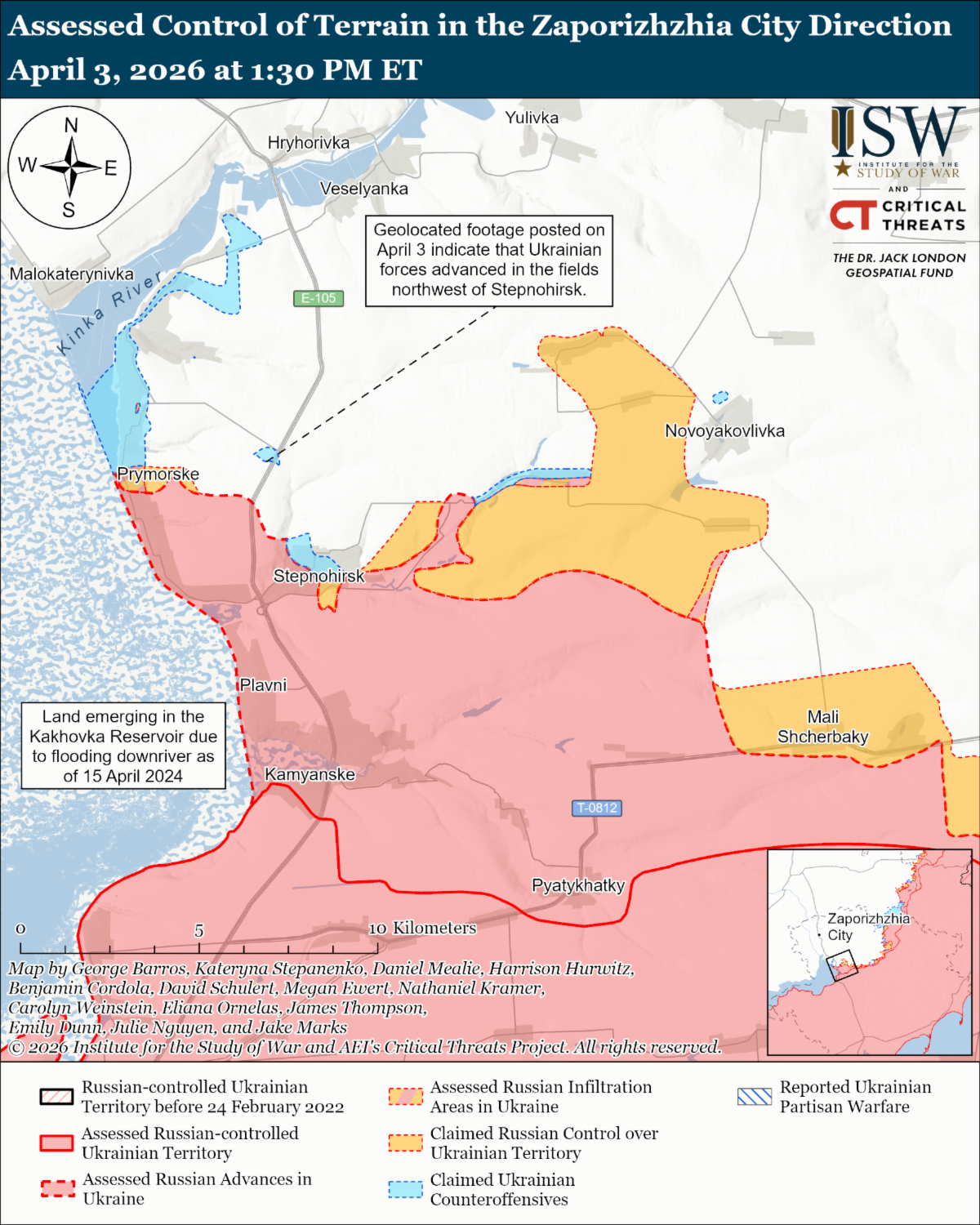
Ukraine continues to generate leverage against Russia by accomplishing tactical, operational, and strategic battlespace effects. Ukrainian President Volodymyr Zelensky reported on April 3 that Ukrainian and UK intelligence indicates that the frontline situation is the best that it has been for Ukraine in the last 10 months (since June 2025). Zelensky also stated that Russian forces were previously leveraging poor visibility during foggy weather to conduct attacks and infiltration — a phenomenon which ISW has previously assessed hinders Ukrainian drone operations and allows Russian forces to conduct ground operations — but that the approaching spring weather, with sunny days, will make it difficult for Russian forces to move unnoticed. Ukraine also achieved tactical and operational successes that may be increasingly generating strategic effects throughout late winter 2025 and early spring. Ukrainian forces began making significant tactical gains in southern Ukraine in late January 2026 that created cascading operational effects on the front and forced Russian forces to choose between defending against the Ukrainian counterattacks or allocating manpower and resources to other sectors of the frontline. ISW previously assessed that the Ukrainian counterattacks may have even disrupted Russian plans for the Spring-Summer 2026 offensive campaign plan. Russian officials have repeatedly attempted to perpetuate a false narrative that the Ukrainian frontlines are on the verge of collapse in an effort to convince the West to capitulate to Russian demands that Russia cannot secure militarily. Ukraine’s recent successes indicate that Ukraine is not at risk of collapse, however.
Ukraine’s technological innovation efforts appear to be increasingly generating operational effects against Russia. Zelensky reported on April 3 that Ukrainian drone strikes alone killed or seriously wounded 33,988 Russian servicemembers in March 2026 and that Ukrainian artillery and other strikes have eliminated another 1,363 Russian servicemembers. Ukrainian Unmanned Systems Forces (USF) Commander Major Robert “Magyar” Brovdi reported on March 31 that Russia’s recruitment rate in March 2026 was below its battlefield loss rate for the fourth month in a row (since December 2025). The Ukrainian Ministry of Defense (MoD) reported on April 1 that Ukrainian forces shot down or suppressed 89.9 percent of Russian missiles and drones in March 2026. These drone innovations are increasing Ukraine’s lethality and complicating Russia’s manpower complications—all of which may generate long-term operational and even strategic impacts on Russian battlefield capabilities.
Swedish authorities boarded a Russian shadow fleet tanker on April 3 that was suspected of causing an oil spill in the Baltic Sea. The Swedish Coast Guard reported on April 3 that the Swedish Police Authority and the Swedish Coast Guard boarded the Flora 1 oil tanker east of Gotland, Sweden, under suspicion that the vessel caused an oil spill east of Gotland. The Flora 1 is on the European Union (EU) sanctions list. Swedish Minister for Civil Defense Carl-Oskar Bohlin stated on April 3 that Swedish authorities boarded the ship south of Ystad (on the southern tip of Sweden). Bohlin implied that the vessel is part of the Russian shadow fleet. Data from the Starboard Maritime Intelligence ship-tracking platform indicates that the Flora 1 was sailing under a Cameroonian flag and that the ship’s automatic identification systems (AIS) show the tanker arriving in St. Petersburg on March 15, at which point the ship turned off its AIS until it left the port on April 1. ISW has previously assessed that Russia’s ability to sell oil is partially a function of its ability to transport it, and continued EU efforts against the Russian shadow fleet will degrade Russia’s ability to transport oil. European states have been increasingly seizing Russian shadow fleet tankers in recent months.
|