[ISW] 러시아 공격 작전 평가, 2026년 4월 6일

“`html

핵심 요약:

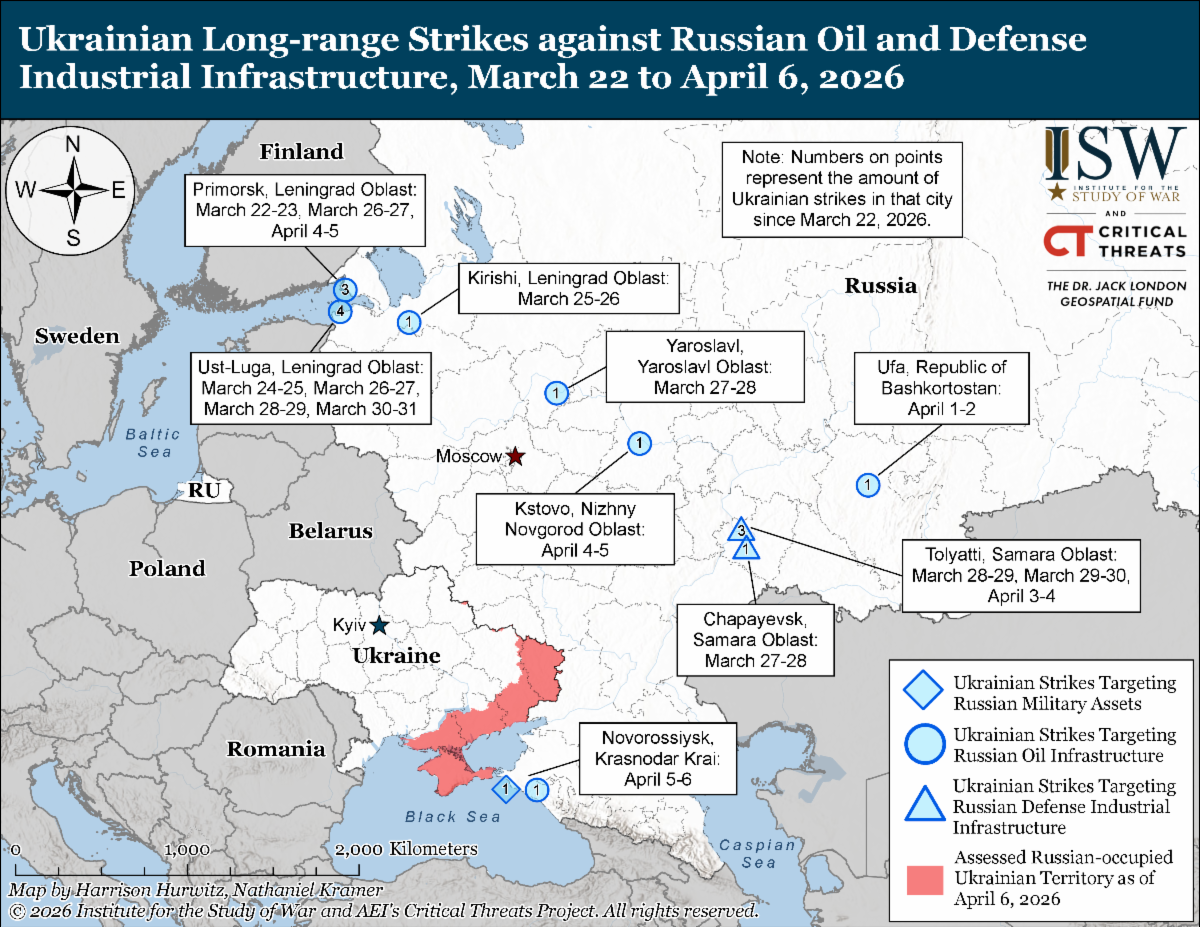
  • 우크라이나의 러시아 석유 기반 시설에 대한 장거리 공격 확대: 우크라이나는 러시아 방공망의 허점을 파고들어 러시아의 석유 수출 능력을 심각하게 훼손하고 있습니다.

    로이터 기사: 우크라이나, 러시아 정유소에 대한 드론 공격 강화 (2024년 3월 13일) – 최신 동향을 파악할 수 있습니다. 기사에서 “우크라이나”가 “러시아”의 석유 시설을 공격하고 있는 상황을 설명하고 있습니다.
  • 러시아 군사 블로거들의 비판: 러시아 군사 블로거들은 러시아 방공 시스템의 무능함을 지속적으로 비판하며 우크라이나 공격의 영향을 강조하고 있습니다.

    전쟁 연구소(ISW) 보고서: 러시아 공세 작전 평가 (2024년 3월 12일) – 러시아의 군사 블로거들이 방공 시스템의 문제점을 지적하는 내용이 포함되어 있을 수 있습니다. (보고서 내용을 확인하고, 해당 내용이 있다면 링크를 업데이트할 필요가 있습니다.)
  • 러시아 군의 인력 부족: 러시아 군은 전선에서의 손실을 대체할 충분한 계약 군인을 모집하지 못하며 인력 문제에 직면해 있습니다.

    전쟁 연구소(ISW) 보고서: 러시아 공세 작전 평가 (2024년 3월 13일) – 러시아의 인력 부족 문제와 관련한 정보를 찾을 수 있습니다. (보고서 내용을 확인하고, 해당 내용이 있다면 링크를 업데이트할 필요가 있습니다.)
  • 러시아 국방부의 추가 인력 확보 시도: 러시아 국방부는 재정적, 사회적 비용에 관계없이 다른 출처를 통해 추가 인력을 확보하려고 시도하고 있습니다.

    BBC 뉴스: 러시아, 우크라이나 전쟁 장기화에 따른 인력난 겪어 (2024년 3월 11일) – 러시아가 인력 부족 문제를 해결하기 위해 어떤 노력을 하고 있는지, 비용과 관계없이 인력을 충원하려는 시도에 대한 내용을 확인할 수 있습니다.
  • 모집 어려움 심화: 러시아가 계약 보너스를 늘리고 추가 인력 자원을 활용하려는 노력에도 불구하고 계약에 서명하려는 러시아인의 풀이 줄어들면서 모집 어려움이 증가하고 있습니다.

    로이터 기사: 러시아, 우크라이나 전쟁 손실 메우기 위해 모집 드라이브 강화 (2024년 3월 5일) – 모집 어려움, 보너스 증가, 추가 인력 자원 활용 등 관련 내용이 포함되어 있을 수 있습니다.
  • 우크라이나에 대한 서방 파트너의 방공 지원 지속: 우크라이나의 서방 파트너들은 우크라이나에 지속적으로 방공 지원을 제공하고 있습니다.

    미 국무부: 우크라이나 지원 추적기 – 서방 국가들의 우크라이나에 대한 방공 시스템 지원 현황을 확인할 수 있습니다. (최신 정보를 확인하고, 관련 링크를 업데이트할 필요가 있습니다.)
  • 우크라이나군의 진격: 우크라이나군은 최근 하르키우주 북부와 벨리키이 부르루크 방향으로 진격했습니다.

    전쟁 연구소(ISW) 보고서: 러시아 공세 작전 평가 (2024년 3월 14일) – 우크라이나군의 진격 상황에 대한 정보를 찾을 수 있습니다. (보고서 내용을 확인하고, 해당 내용이 있다면 링크를 업데이트할 필요가 있습니다.)
  • 러시아의 드론 공격: 러시아군은 우크라이나를 상대로 141대의 드론을 발사했습니다.

    BBC 뉴스: 우크라이나, 러시아 드론 대부분 격추 (2024년 3월 14일) – 러시아의 드론 공격과 관련된 정보를 확인할 수 있습니다.

“`
**참고:**

* 위 링크는 예시이며, 실제 내용과 일치하는지 확인 후 사용해야 합니다.
* 최신 정보는 언론 보도, 연구 기관의 보고서 등을 통해 지속적으로 업데이트해야 합니다.
* ISW(Institute for the Study of War) 보고서는 러시아-우크라이나 전쟁 관련 핵심 정보를 제공하는 신뢰할 수 있는 소스입니다.
* 번역 과정에서 오역이 있을 수 있으므로, 원문과 함께 확인하는 것이 좋습니다.

[원문]

Ukraine’s expanding long-range strike campaign against Russian oil infrastructure is exploiting overstretched Russian air defenses and significantly damaging Russian oil export capabilities.

April 6, 2026

Data Cutoff: 12:10 PM ET

Justin Young, Samuel Shafiro, Grace Mappes, Anna Thacker, Diana Nasreddine and Frederick W. Kagan

TOPLINES

Ukraine’s expanding long-range strike campaign against Russian oil infrastructure is exploiting overstretched Russian air defenses and significantly damaging Russian oil export capabilities. The Ukrainian General Staff reported on April 6 that Ukrainian forces struck the Sheskharis oil terminal near the port of Novorossiysk, Krasnodar Krai overnight on April 5 to 6, starting a large fire. Geolocated footage published on April 6 shows fires at oil tanker berths at the port of Novorossiysk. The Russian Ministry of Defense (MoD) acknowledged on April 6 that Ukrainian forces struck oil terminals in Novorossiysk. Two industry sources told Reuters on April 6 that the fires covered the main pier belonging to Russian state-controlled petroleum company Transneft near three oil tanker berths. NASA Fire Information for Resource Management System (FIRMS) data shows heat anomalies at the Sheskharis oil terminal starting on April 5. Ukrainian Unmanned Systems Forces (USF) Commander Major Robert “Magyar” Brovdi reported that Ukrainian forces also struck the Admiral Makarov Admiral Grigorovich-class frigate in the port of Novorossiysk overnight. Geolocated footage published on April 6 shows Ukrainian drones striking a Russian Admiral Grigorovich-class frigate in the port of Novorossiysk.


Russian milbloggers continued to criticize the ineffectiveness of Russian air defense systems and highlight the impact of Ukrainian strikes. A Kremlin-affiliated Russian milblogger stated on April 6 that the constant Ukrainian strikes against Russian facilities are “stretching” Russian surface-to-air missile air defense forces “to the limit” and exhausting ammunition “at an accelerated rate” as Russia cannot simply produce “thousands” of missiles for Pantsir air defense systems “out of thin air.” The milblogger stated that these limitations render ineffective Russian information space suggestions that Russia increase surface-to-air missile and air defense system production and encouraged Russian forces to adapt the Ukrainian emphasis on mobile fire groups, interceptor drones, and acoustic reconnaissance systems. Russian milbloggers also highlighted the resources consumed by repairing damage from Ukrainian strikes, daytime Ukrainian drone strikes exhausting Russian air defense, the systematic nature of the Ukrainian long-range drone strikes, and the vulnerability of Russian warships stationed at bases within Ukrainian drone range.

The Russian military is experiencing manpower challenges and is unable to recruit enough contract soldiers to replace its frontline losses. Ukraine’s “I Want to Live” initiative reported on April 6 that the Russian Ministry of Defense (MoD) recruited fewer soldiers in the first three months of 2026 than it would need to be on track to meet its 2026 recruiting target of 409,000 contract soldiers. The initiative reported that the Russian MoD would need to recruit 1,100-1,150 soldiers a day to meet its annual recruiting target but was only able to recruit an average of 940 contract soldiers a day in the first three months of 2026. The initiative reported that the MoD plans to recruit most heavily in the Central and Volga federal districts and to continue to recruit in occupied Ukraine. The initiative noted that about 24 percent of all contract soldiers were under criminal investigation or conviction, and that nearly 40 percent of these were debtors.

KEY TAKEAWAYS

  • Ukraine’s expanding long-range strike campaign against Russian oil infrastructure is exploiting overstretched Russian air defenses and significantly damaging Russian oil export capabilities.

  • Russian milbloggers continued to criticize the ineffectiveness of Russian air defense systems and highlight the impact of Ukrainian strikes.

  • The Russian military is experiencing manpower challenges and is unable to recruit enough contract soldiers to replace its frontline losses.

  • The Russian MoD is attempting to generate additional manpower through other sources, regardless of the financial and societal costs.

  • Russia is facing increasing recruitment challenges as the pool of Russians willing to sign contracts declines, despite Kremlin efforts to increase signing bonuses and tap additional sources of manpower.

  • Ukraine’s Western partners continue to provide air defense aid to Ukraine.

  • Ukrainian forces recently advanced in northern Kharkiv Oblast and the Velykyi Burluk direction.

  • Russian forces launched 141 drones against Ukraine.

EMAIL SUBSCRIPTION OPTIONS

ISW offers customizable email subscription options. Click below to learn more and customize your preferences.

ISW is powered by the support of individuals like you.

Help us stay independent and impactful.

Website | Jobs | Internships

Follow ISW on social media:

FacebookXYouTube | InstagramLinkedIn | Threads | Bluesky

© 2026 Institute for the Study of War and AEI’s Critical Threats Project. All rights reserved.

Donate online or by sending a check to the Institute for the Study of War at 1400 16th Street NW, Suite #515, Washington, DC 20036. Please consider including the Institute for the Study of War in your estate plans.


ISW is a tax-exempt organization under section 501(c)(3) of the Internal Revenue Code. Donations are tax-deductible to the extent permitted by law.

ISW is a non-partisan, non-profit, public policy research organization. ISW advances an informed understanding of military affairs through reliable research, trusted analysis, and innovative education. We are committed to improving the nation’s ability to execute military operations and respond to emerging threats in order to achieve US strategic objectives.

댓글 달기

이메일 주소는 공개되지 않습니다. 필수 필드는 *로 표시됩니다

위로 스크롤